
llmfit
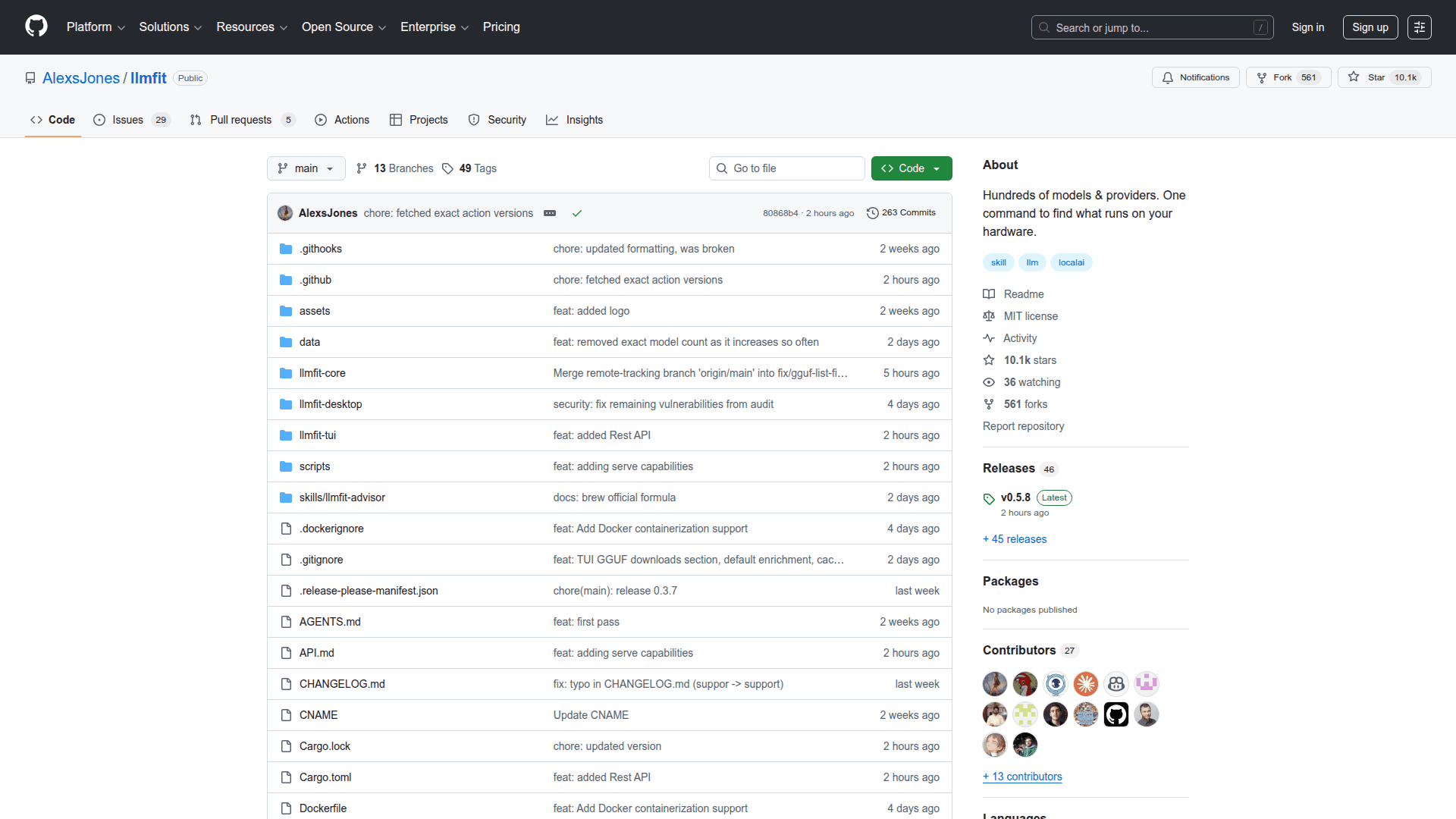
A terminal tool that detects your hardware and right-sizes LLM models to your system's RAM, CPU, and GPU, ranking hundreds of models by fit, speed, quality, and context.
At a Glance
Fully free and open-source under the MIT license. No cost to use, modify, or distribute.
Engagement
Available On
Alternatives
Updated Jul 2026
About llmfit
llmfit is an open-source CLI and TUI tool written in Rust that helps users find which large language models will actually run well on their specific hardware. Created by Alex Jones and published under the MIT license, it detects your system's RAM, CPU, GPU/VRAM, and backend, then scores every model in its catalog across four dimensions: memory fit, estimated speed, quality, and context. The project has accumulated over 29,000 GitHub stars, signaling strong community interest in local LLM tooling.
What It Is
llmfit is a hardware-aware model selection tool for local LLM inference. Rather than requiring users to manually calculate whether a model fits in their VRAM or RAM, llmfit automates the detection and scoring process. It ships with an interactive terminal UI (TUI) as the default experience and a classic CLI mode for scripting and automation. The tool supports multi-GPU setups, Mixture-of-Experts (MoE) architectures, dynamic quantization selection, speed estimation, and a range of local runtime providers.
Supported Runtime Providers and Platforms
llmfit integrates with the major local inference runtimes:
- Ollama — pull and serve models locally
- llama.cpp — GGUF-format inference
- MLX — Apple Silicon-optimized inference
- Docker Model Runner — containerized model serving
- LM Studio — GUI-based local model management
Installation is available via Scoop (Windows), Homebrew or MacPorts (macOS/Linux), a quick-install shell script, uv/pip as a Python package, Docker/Podman, or from source via Cargo.
How the Scoring and Estimation Work
llmfit's speed estimates are derived from a memory-bandwidth model grounded in runtime sampling and real community measurements. Every estimate ships with its inputs, so llmfit info <model> shows exactly what a number assumes and how to verify it on your own machine. The llmfit bench --share command measures real tokens-per-second and time-to-first-token (TTFT) on your hardware and can contribute results back to the project as a pull request — no gh CLI or third-party account required. Merged benchmark submissions ship in the next release, so users on identical hardware get measured (verified) numbers instead of estimates.
Key CLI Commands
llmfit— launches the interactive TUI with hardware detection and ranked model listllmfit fit— prints a table of all models ranked by fitllmfit recommend --json— outputs top picks as JSON for agent or script consumptionllmfit info "<model>"— shows fit analysis, estimate basis, and verify commands for one modelllmfit bench— measures real tok/s and TTFT against your running providerllmfit doctor— generates a hardware detection report for bug reports
Update: v1.1.3
The latest release is v1.1.3, published July 14, 2026. The project's notable milestone was llmfit 1.0, described in the repository as "the release where the numbers became verifiable," establishing a foundation of community-contributed, hardware-specific benchmark data. The bench --share workflow introduced in that cycle allows every run to be saved locally first, with sharing optional and the backlog uploadable at any time. The repository is actively maintained, with the last push on July 18, 2026, and 52 open issues at time of writing.
Sister Projects and Ecosystem
The llmfit author also maintains related tools in the local LLM space:
- sympozium — managing agents in Kubernetes
- llmserve — a TUI for serving local LLM models with backend selection
- llama-panel — a native macOS app for managing local llama-server instances
llmfit also documents an OpenClaw integration for users in that ecosystem.
Community Discussions
Be the first to start a conversation about llmfit
Share your experience with llmfit, ask questions, or help others learn from your insights.
Pricing
Open Source
Fully free and open-source under the MIT license. No cost to use, modify, or distribute.
- Interactive TUI and CLI modes
- Hardware detection and model scoring
- Community benchmark sharing
- All runtime provider integrations
- Custom model support
Capabilities
Key Features
- Interactive TUI with hardware detection and ranked model list
- CLI mode for scripting and automation
- Hardware detection: RAM, CPU, GPU/VRAM, backend
- Model scoring across fit, speed, quality, and context dimensions
- Multi-GPU setup support
- Mixture-of-Experts (MoE) architecture support
- Dynamic quantization selection
- Speed estimation via memory-bandwidth model
- Community benchmark sharing via llmfit bench --share
- Local runtime provider support: Ollama, llama.cpp, MLX, Docker Model Runner, LM Studio
- JSON output for agent/script consumption
- Custom model support
- Hardware detection report (llmfit doctor)
- Real tok/s and TTFT benchmarking
- OpenClaw integration
- Windows code signing via SignPath.io