LLMStack
Open-source no-code platform to build AI agents, workflows, and chatbots by chaining multiple LLMs and connecting them to your own data.
At a Glance
About LLMStack
LLMStack is a no-code platform for building generative AI agents, workflows, and chatbots, developed by MakerDojo, Inc. (operating as Promptly). It lets users chain multiple large language models together, connect them to proprietary data sources, and deploy the resulting applications either on their own infrastructure or via the hosted cloud offering at Promptly. The project is publicly available on GitHub with over 2,300 stars and is installable via pip.
What It Is
LLMStack is a multi-agent, no-code builder that sits at the intersection of LLM orchestration and application development. Users compose AI pipelines visually—without writing code—by connecting processors (LLM calls, data lookups, API calls) into chains. The resulting apps can be exposed as web UIs, embedded chatbots, or HTTP APIs, and can be triggered from Slack or Discord. A cloud-hosted version is available at Promptly for teams that prefer not to self-host.
Core Capabilities
- Agent building: Construct generative AI agents (AI SDRs, research analysts, RPA automations) without code, with access to web search and browser tools.
- Model chaining: Connect multiple LLMs sequentially or conditionally; supported providers include OpenAI, Cohere, Stability AI, Hugging Face, and others.
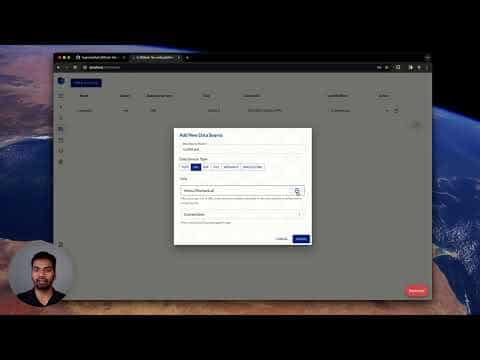
- Data integration: Import CSV, TXT, PDF, DOCX, PPTX, and more from Google Drive, Notion, websites, sitemaps, and direct uploads. The platform handles preprocessing and vectorization into a built-in vector database.
- Multi-tenant architecture: Supports multiple organizations with user-level access control, viewer and collaborator roles, and granular permission models.
- API access: Every app or chatbot built on LLMStack is accessible via HTTP API, enabling programmatic integration.
Deployment Model
LLMStack is designed for flexible deployment. Self-hosting is the primary path: install via pip install llmstack, run llmstack from the command line, and the platform starts locally at localhost:3000 with a bundled database and config. Docker is required for background job execution. For teams that want a managed experience, the Promptly cloud offering provides the same functionality without infrastructure management. Both paths share the same feature set.
License and Open-Source Status
The repository is publicly available on GitHub and source-visible, but the license (issued by Maker Dojo, Inc.) is a custom non-OSI license. It explicitly prohibits providing the software to third parties as a hosted or managed service without prior written permission. This means LLMStack is source-available rather than fully open-source under an OSI-approved license. Users can self-host for internal use, but cannot resell or offer it as a managed service.
Update: v0.2.6
The latest release is v0.2.6, published in November 2024. The repository was last pushed to in December 2024, indicating active maintenance. The project was created in August 2023 and has accumulated 348 forks and 24 open issues as of mid-2025, reflecting an active community. The GitHub topics include agents, llm-agents, llm-chain, llmops, and no-code-ai, signaling the team's positioning around agentic workflows and LLM operations.
Community Discussions
Be the first to start a conversation about LLMStack
Share your experience with LLMStack, ask questions, or help others learn from your insights.
Pricing
Self-Hosted
Install and run LLMStack on your own infrastructure via pip. Full feature access for internal use.
- No-code agent builder
- Multi-LLM chaining
- Data source integration
- Built-in vector database
- Slack and Discord triggers
Capabilities
Key Features
- No-code AI agent builder
- Multi-LLM chaining
- Data source integration (PDF, CSV, DOCX, PPTX, Google Drive, Notion, websites)
- Built-in vector database
- Slack and Discord triggers
- HTTP API access for all apps
- Embedded chatbot support
- Multi-tenant with organization management
- Granular permission model (viewer/collaborator roles)
- Self-hosting via pip
- Cloud offering via Promptly
- Web browsing and search for agents
- RPA automation support
Integrations
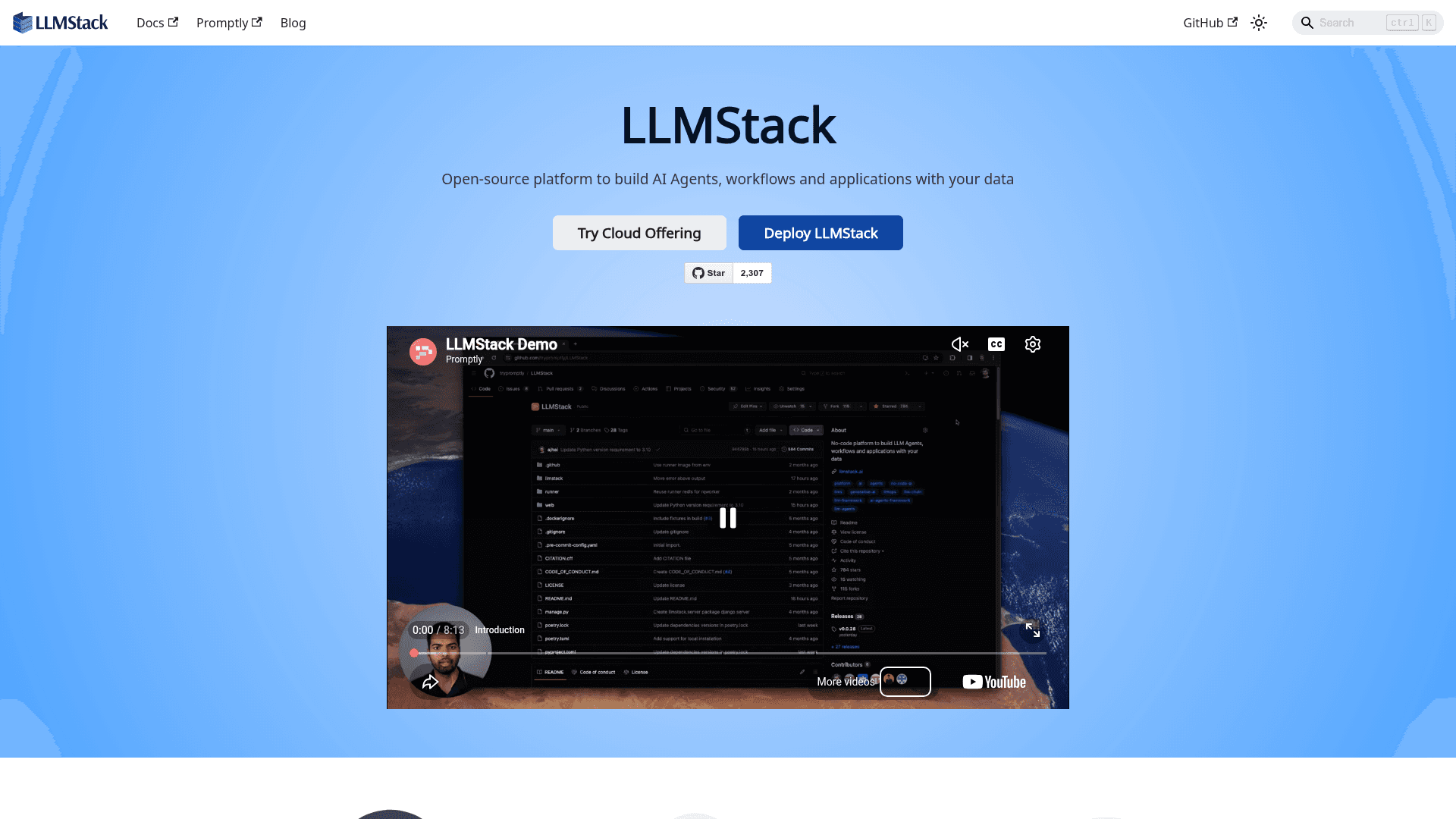
Demo Video