Local Deep Research
An open-source, privacy-first AI research assistant that runs locally, supports 20+ search engines and multiple LLMs, and synthesizes findings into cited reports.
At a Glance
Fully free and open-source under the MIT License. Self-host via Docker, Docker Compose, or pip.
Engagement
Available On
Alternatives
Listed Jun 2026
About Local Deep Research
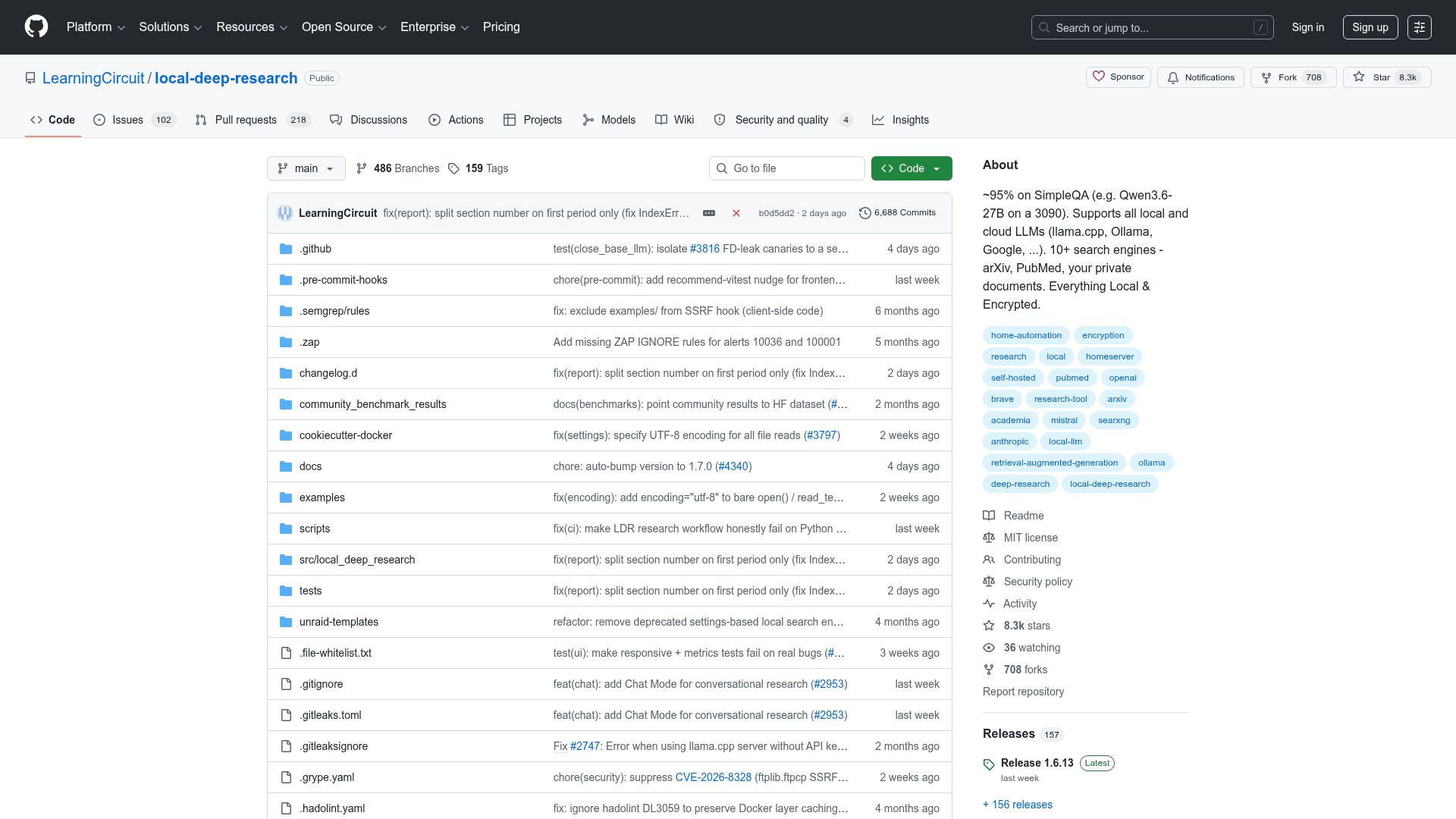
Local Deep Research is an open-source AI research assistant built by the LearningCircuit community and released under the MIT License. It runs entirely on local hardware, supports a wide range of local and cloud LLMs, and searches across web, academic databases, and private documents to produce structured, cited research reports. The project reports ~95% accuracy on the SimpleQA benchmark (n=500) using Qwen3.6-27B on a single RTX 3090 via the langgraph-agent strategy.
What It Is
Local Deep Research (LDR) is a self-hosted, agentic research tool that automates the process of querying multiple search engines, synthesizing results, and generating reports with proper citations. It sits in the category of AI-powered research assistants but distinguishes itself by keeping all LLM processing local — no data leaves the machine unless the user explicitly configures a cloud LLM or external search API. Users interact through a web UI served at localhost:5000, a REST API, a Python client library, or an MCP server for Claude Desktop and Claude Code.
How the Agentic Research Pipeline Works
LDR offers more than 20 research strategies ranging from quick summaries (30 seconds to 3 minutes) to deep multi-step analysis. The flagship mode is the LangGraph Agent Strategy, where the LLM autonomously decides what to search, which specialized engine to use (arXiv, PubMed, Semantic Scholar, Brave, Tavily, SearXNG, etc.), and when to synthesize. The pipeline:
- Accepts a complex research question
- Searches across web, academic papers, and user-uploaded documents
- Downloads and indexes sources into an encrypted local library
- Synthesizes everything into a structured report with citations
- Supports multi-turn Chat Mode with accumulated context across turns
A Journal Quality System (introduced in v1.6.0) automatically scores academic sources using 212K+ indexed journals, flags predatory publishers, and surfaces a quality dashboard — powered by OpenAlex, DOAJ, and Stop Predatory Journals data.
Privacy and Security Architecture
Every user gets an isolated SQLCipher database encrypted with AES-256. The project states there is no telemetry, no analytics, and no tracking of any kind. The only outbound network calls are search queries, LLM API calls, and optional Apprise notifications — all user-initiated. Docker images are signed with Cosign using GitHub's keyless OIDC flow and ship with SLSA provenance attestations and SPDX SBOMs. The CI pipeline runs CodeQL, Semgrep, DevSkim, Bearer, OSV-Scanner, OWASP ZAP, Trivy, and Dockle on every push.
Supported LLMs and Search Engines
Local inference:
- Ollama (default
http://localhost:11434) - LM Studio (OpenAI-compatible server)
- llama.cpp via
llama-server - Common models: Llama 3, Mistral, Gemma, DeepSeek, Qwen
Cloud LLMs: OpenAI (GPT-4/3.5), Anthropic (Claude 3), Google (Gemini), 100+ via OpenRouter
Free search engines: arXiv, PubMed, Semantic Scholar, Wikipedia, SearXNG, GitHub, Elasticsearch, Wayback Machine, The Guardian, Wikinews
Premium search engines: Tavily, Google (SerpAPI or PSE), Brave Search
Custom sources: local documents, LangChain retrievers (FAISS, Chroma, Pinecone, Weaviate, Elasticsearch)
Deployment and Setup Paths
LDR supports three primary installation methods:
- Docker Run (Linux native): single
docker runcommand; requires Ollama and SearXNG containers - Docker Compose (all platforms, including CPU-only and NVIDIA GPU variants): recommended for Mac/Windows/WSL2
- pip install:
pip install local-deep-researchthenpython -m local_deep_research.web.app; requires a running Ollama or OpenAI-compatible endpoint
An MCP server is available via pip install "local-deep-research[mcp]" for integration with Claude Desktop and Claude Code, exposing tools for quick research, detailed research, report generation, document analysis, and raw search engine queries.
Update: v1.6.13 (May 2026)
The latest release is v1.6.13, published May 25, 2026. Recent notable additions include the Journal Quality System (v1.6.0) with predatory journal detection, Chat Mode with streaming progress, an Analytics Dashboard for cost and performance tracking, per-user encrypted databases, and a breaking change in v1.7 where llm.model no longer has a default value and the llamacpp provider switched from in-process loading to HTTP (llama-server). The project shows active development with monthly commits and a community benchmark dataset on Hugging Face tracking accuracy across models and strategies.
Community Discussions
Be the first to start a conversation about Local Deep Research
Share your experience with Local Deep Research, ask questions, or help others learn from your insights.
Pricing
Open Source
Fully free and open-source under the MIT License. Self-host via Docker, Docker Compose, or pip.
- All research modes (quick summary, detailed, report generation, document analysis)
- 20+ research strategies including LangGraph agent
- Local LLM support via Ollama, LM Studio, llama.cpp
- Cloud LLM support (OpenAI, Anthropic, Google, OpenRouter)
- 10+ free search engines (arXiv, PubMed, Wikipedia, SearXNG, etc.)
Capabilities
Key Features
- Agentic LangGraph research strategy with autonomous search engine selection
- 20+ research strategies: quick summary, detailed research, report generation, document analysis
- Multi-turn Chat Mode with streaming progress and accumulated context
- Journal Quality System with 212K+ indexed sources and predatory journal detection
- Per-user AES-256 SQLCipher encrypted databases
- REST API with per-user authentication and CSRF handling
- Python client library (LDRClient, quick_query)
- MCP server for Claude Desktop and Claude Code integration
- Local document indexing and searchable knowledge base
- Support for Ollama, LM Studio, llama.cpp, OpenAI, Anthropic, Google, OpenRouter
- Free search engines: arXiv, PubMed, Semantic Scholar, Wikipedia, SearXNG, GitHub, Wayback Machine
- Premium search engines: Tavily, Google (SerpAPI/PSE), Brave Search
- LangChain retriever integration (FAISS, Chroma, Pinecone, Weaviate, Elasticsearch)
- Export results as PDF or Markdown
- Research history with save, search, and revisit
- Analytics Dashboard for cost, performance, and usage metrics
- Automated research digests with customizable frequency (daily, weekly, custom)
- Real-time WebSocket updates for live research progress
- Adaptive rate limiting with intelligent retry
- No telemetry, no analytics, no tracking
- Docker images signed with Cosign, SLSA provenance, SPDX SBOMs
- Benchmarking system with community leaderboard on Hugging Face
- Keyboard shortcuts for navigation
- Apprise notification support
Integrations
Demo Video