
LongCat-Video
A 13.6B parameter open-source foundational video generation model by Meituan supporting Text-to-Video, Image-to-Video, Video-Continuation, and audio-driven avatar animation.
At a Glance
Fully free and open-source under MIT License. Self-host model weights from Hugging Face or ModelScope.
Engagement
Available On
Alternatives
Listed Aug 2026
About LongCat-Video
LongCat-Video is a foundational video generation model developed by the Meituan LongCat Team, released under the MIT License. With 13.6 billion parameters, it unifies multiple video generation tasks in a single dense-architecture model and is available on GitHub and Hugging Face for self-hosted inference.
What It Is
LongCat-Video is an open-source video generation framework that handles Text-to-Video, Image-to-Video, Video-Continuation, and audio-driven character animation (Avatar) within a single model family. It is positioned as Meituan's first step toward world models, with a technical report published on arXiv (2510.22200). The project also includes LongCat-Video-Avatar and LongCat-Video-Avatar-1.5, specialized extensions for expressive, audio-driven human video generation.
Architecture and Technical Design
The base model uses a dense transformer architecture (DiT) with 13.6B total and activated parameters — contrasting with mixture-of-experts alternatives that activate only a fraction of their larger parameter counts. Key architectural choices include:
- Coarse-to-fine generation along both temporal and spatial axes for efficient 720p, 30fps output
- Block Sparse Attention to improve efficiency at high resolutions
- Multi-reward GRPO (Group Relative Policy Optimization) for RLHF-based quality alignment
- FlashAttention-2 enabled by default, with optional FlashAttention-3 or xformers support
- Context parallelism for multi-GPU inference via
torchrun
The Avatar extensions add audio-driven lip synchronization: v1.0 uses Wav2Vec2, while v1.5 upgrades to Whisper-Large-v3 for improved accuracy, adds step distillation for 8-step fast inference, INT8 quantization for reduced VRAM, and extends to stylized domains including anime and animals.
Supported Tasks and Workflow
Users clone the repository, set up a conda environment with PyTorch and FlashAttention, and download model weights from Hugging Face or ModelScope. Inference scripts cover:
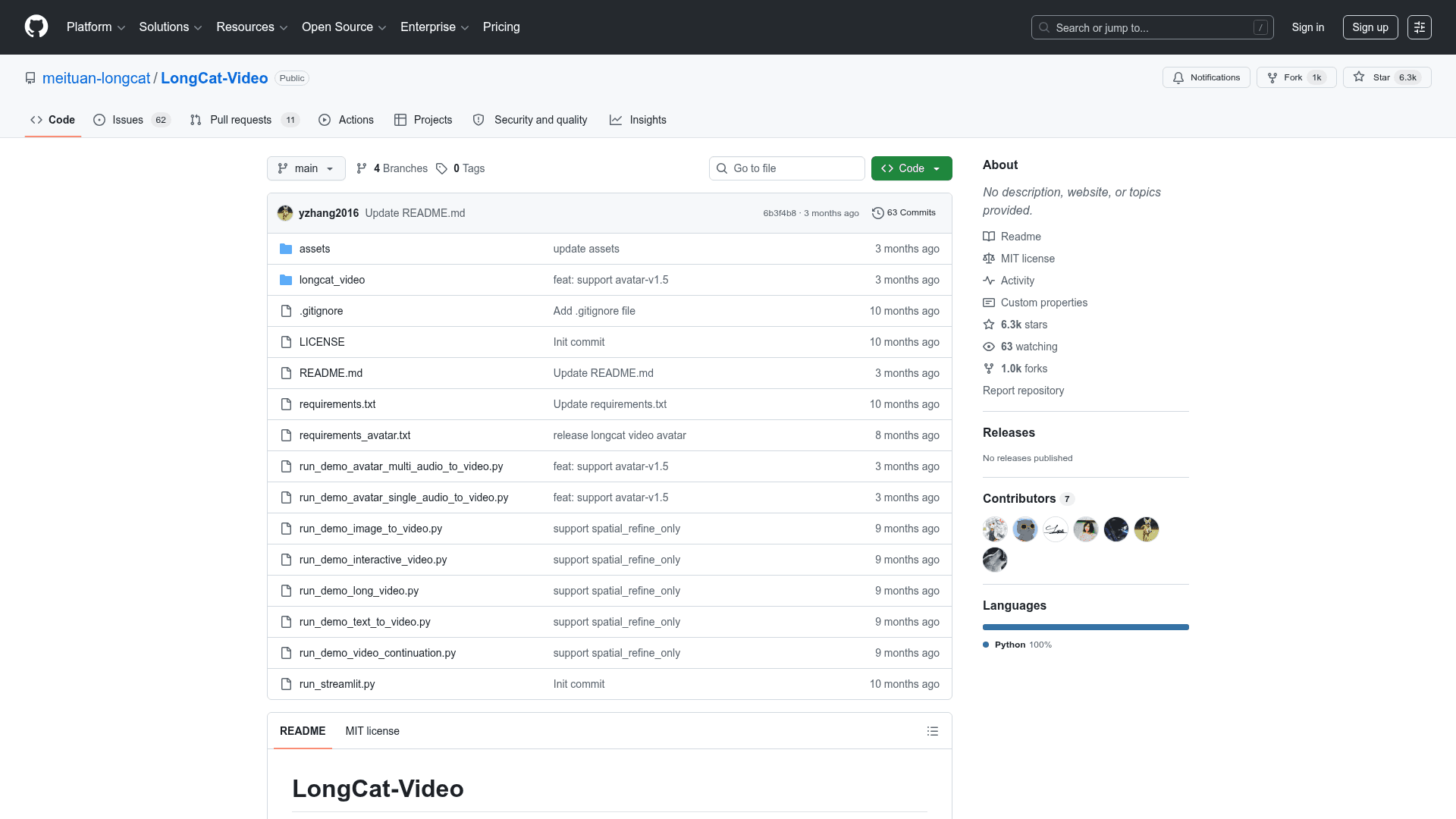
run_demo_text_to_video.py— text prompt to videorun_demo_image_to_video.py— image + text to videorun_demo_video_continuation.py— extend existing video clipsrun_demo_long_video.py— minutes-long video generationrun_demo_interactive_video.py— interactive generationrun_demo_avatar_single_audio_to_video.py/run_demo_avatar_multi_audio_to_video.py— single- and multi-character audio-driven animationrun_streamlit.py— a Streamlit web UI for local use
Multi-GPU inference is supported via context parallelism (--context_parallel_size).
Update: LongCat-Video-Avatar 1.5 (May 2026)
The most recent release, LongCat-Video-Avatar 1.5 (May 21, 2026), is an upgraded open-source framework for audio-driven human video generation. Notable changes from v1.0 include:
- Whisper-Large-v3 replaces Wav2Vec2 for more accurate lip synchronization
- Production-ready physical rationality and temporal stability for long videos
- Generalization to stylized domains (anime, animals, complex real-world conditions)
- Support for both single-stream and multi-stream audio inputs
- 8-step distillation inference for faster generation
- INT8 quantized DiT model option for reduced VRAM
The base LongCat-Video model was first released October 25, 2025, with LongCat-Video-Avatar following December 16, 2025. Weights are available on Hugging Face and ModelScope.
Evaluation and Benchmarks
According to the project's internal MOS (Mean Opinion Score) benchmarks published in the README, LongCat-Video's Text-to-Video overall quality (3.38) is reported as comparable to Wan 2.2-T2V-A14B (3.35) and PixVerse-V5 (3.36), while being an open-source dense model at 13.6B parameters. For Image-to-Video, the model achieves a visual quality score of 3.27, slightly above Wan 2.2-I2V-A14B (3.23) on the same internal benchmark. These figures are vendor-published and based on Meituan's internal evaluation methodology.
Community Discussions
Be the first to start a conversation about LongCat-Video
Share your experience with LongCat-Video, ask questions, or help others learn from your insights.
Pricing
Open Source
Fully free and open-source under MIT License. Self-host model weights from Hugging Face or ModelScope.
- Text-to-Video generation
- Image-to-Video generation
- Video-Continuation
- Long video generation
- Audio-driven avatar animation
Capabilities
Key Features
- Text-to-Video generation
- Image-to-Video generation
- Video-Continuation generation
- Long video generation (minutes-long)
- Audio-driven avatar animation (single and multi-character)
- Unified multi-task architecture in a single model
- Coarse-to-fine temporal and spatial generation strategy
- Block Sparse Attention for high-resolution efficiency
- Multi-reward GRPO RLHF alignment
- FlashAttention-2/3 and xformers support
- Multi-GPU inference via context parallelism
- INT8 quantization for reduced VRAM (Avatar 1.5)
- Step distillation for fast 8-step inference (Avatar 1.5)
- Whisper-Large-v3 audio encoder for lip sync (Avatar 1.5)
- Streamlit web UI for local inference
- 720p 30fps video output