
LoopGain
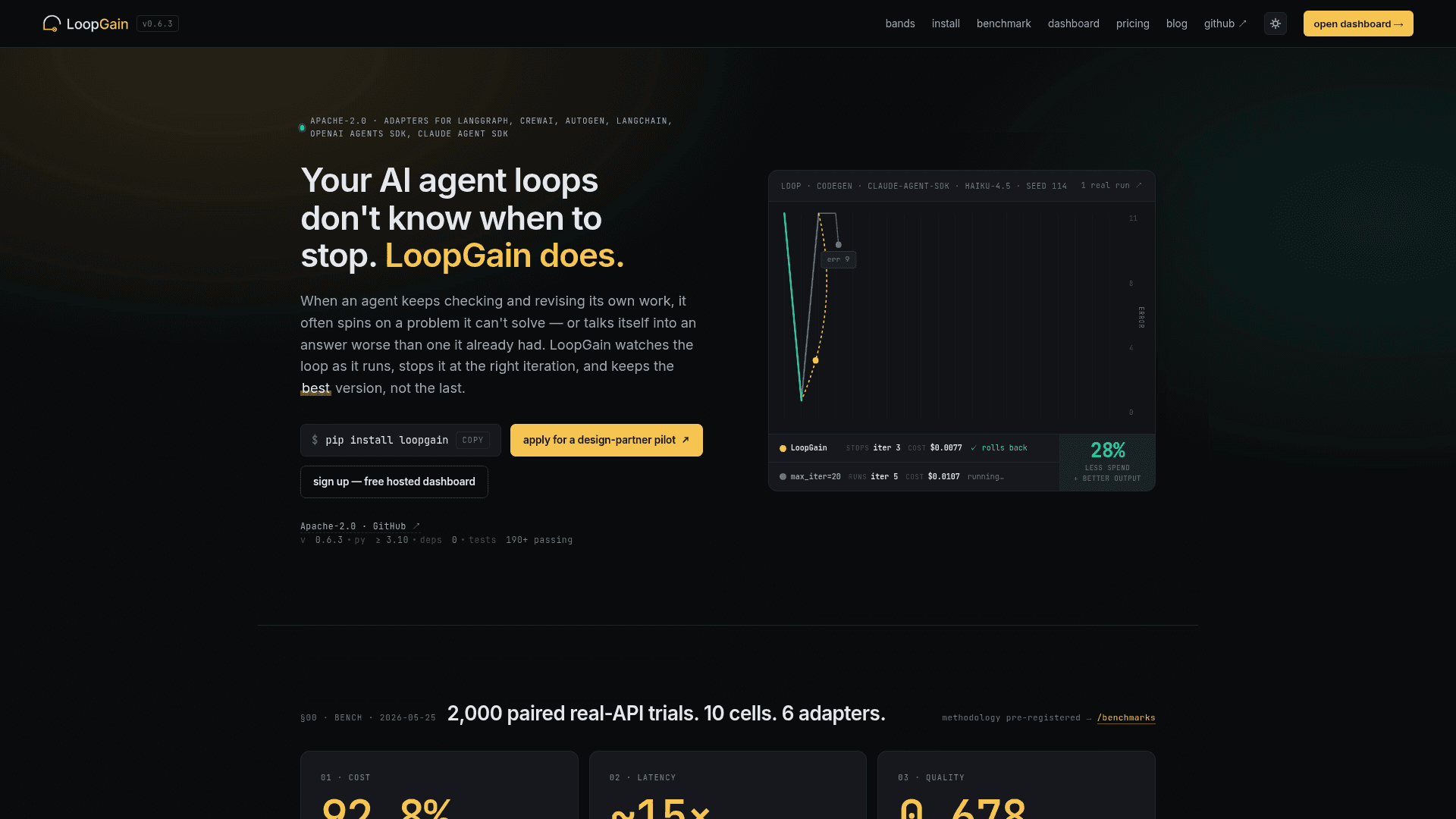
An open-source Python library that replaces fixed max_iterations caps in AI agent loops with real-time convergence detection and best-so-far rollback.
At a Glance
Full LoopGain library, all framework adapters, best-so-far rollback, per-run savings accounting, self-host telemetry receiver and dashboard, or hosted dashboard for a single user with 7-day retention.
Engagement
Available On
Alternatives
Listed Jul 2026
About LoopGain
LoopGain is an open-source cost controller for AI agent loops, published under the Apache-2.0 license by LoopGain Technologies Inc. It replaces the universal max_iterations=N hack with a control-theoretic stop-and-rollback policy grounded in the Barkhausen stability criterion — a foundational result from electrical-engineering feedback-oscillator analysis (1921). The library is pure Python with zero runtime dependencies and supports Python 3.10+.
What It Is
LoopGain sits inside a running agent loop and watches the error trajectory in real time. When the loop has genuinely converged, it stops it; when the loop is oscillating or diverging, it rolls back to the best output seen so far instead of returning the last (potentially degraded) draft. The core primitive is two calls — should_continue() to gate the loop and observe(errors, output=output) to feed it the latest error signal — plus a result object that carries the outcome, the best output, and a savings count versus a fixed cap.
Five-State Decision Engine
The classifier reads four features off the full error trajectory each iteration:
- E_ratio — cumulative reduction (E_current / E_first)
- slope_log — OLS slope of log10(E), the geometric trend direction
- slope_p — t-test p-value of the slope, for statistical significance
- osc_std — standard deviation of detrended log10(E), the oscillation magnitude
Those four features route the loop into one of five named states: FAST_CONVERGE and CONVERGING say keep going; STALLING, OSCILLATING, and DIVERGING say stop (with rollback on the latter two). The state itself is the decision — no number to interpret. A legacy single-Aβ-band classifier from v0.1 remains available via classifier='legacy_bands' for callers who have empirically tuned those thresholds.
Framework Adapters and Integration Path
LoopGain ships pre-built adapters for six major agent frameworks, each installable as a pip extra:
- LangGraph — drives
graph.stream()step by step - CrewAI — installs
step_callback/task_callbackon a Crew, chains with existing callbacks - AutoGen v0.4+ — wraps
team.run_stream(), supportsobserve_sourcesfiltering - LangChain — duck-types against
create_agent()and legacyAgentExecutor - OpenAI Agents SDK — wraps
Runner.run_streamed().stream_events(), async-first - Claude Agent SDK — wraps
claude_agent_sdk.query(), filters toAssistantMessageby default
The core wheel has zero runtime dependencies; framework packages are optional extras (pip install 'loopgain[langgraph]', [crewai], [autogen], [langchain], [openai-agents], [claude-agent-sdk], or [all]). A Claude Code plugin (loopgain-plugin) scans a whole repo for wrappable loops and proposes reviewed diffs one file at a time.
Benchmark Results and Honest Limits
The project's homepage reports results from a pre-registered 2,000-trial benchmark across 10 workload cells and 6 adapters. According to those vendor-published figures: 92.8% less API spend versus max_iter=20 ($27.05 → $1.94 total benchmark spend), approximately 15× faster median wall-clock per trial (30.9s → 2.1s), and a 0.678 weighted judge preference across 1,800 pairwise comparisons. The benchmark repository (loopgain-bench) is public and reproducible.
The README is explicit about limits: LoopGain detects convergence, not correctness. It stops when the error signal stops improving, not when the answer is right. The project reports a false-stop rate of ≤4.5% on the benchmark's code-gen workload, and notes that quality of the stop is bounded by the quality of the verifier behind the error signal.
Hosted Dashboard and Telemetry Architecture
An optional hosted dashboard at dashboard.loopgain.ai provides six panels — Overview, Loop Health Map, Convergence, Waste Report, Rollback Log, and Alerts — over a shared fleet view. Telemetry is opt-in and off by default; when enabled, it sends only state transitions, smoothed Aβ summary values, rollback flags, iteration counts, savings figures, and a per-iteration trajectory — never prompts, completions, error contents, or output buffers. Both the telemetry receiver (a Cloudflare Worker) and the dashboard are open-source repositories under the loopgain-ai GitHub organization, making full self-hosting possible.
Update: v0.6.3
The current release is v0.6.3, as shown on the homepage badge and in the README. This version adds support for bare lg.send_telemetry() calls configured entirely via environment variables (LOOPGAIN_TELEMETRY_ENDPOINT and LOOPGAIN_TELEMETRY_TOKEN), and introduces actual_dollars_spent / actual_dollars_saved optional fields for passing genuinely measured cost figures to the dashboard. The project self-describes as alpha software with a stable math and API surface, recommending version pinning before 1.0.
Community Discussions
Be the first to start a conversation about LoopGain
Share your experience with LoopGain, ask questions, or help others learn from your insights.
Pricing
Individual
Full LoopGain library, all framework adapters, best-so-far rollback, per-run savings accounting, self-host telemetry receiver and dashboard, or hosted dashboard for a single user with 7-day retention.
- Full LoopGain library — zero runtime deps
- Framework adapters (LangGraph, CrewAI, AutoGen, LangChain, OpenAI Agents SDK, Claude Agent SDK)
- Best-so-far buffer + rollback
- Per-run savings accounting vs a fixed max_iterations cap
- Self-host telemetry receiver + dashboard
Team
Hosted dashboard for a shared workspace with 30-day history, Slack/email/webhook alerts, Waste Report, per-iteration scrubber, saved threshold profiles, and read & ingest API.
- Everything in Individual
- Hosted dashboard for a shared workspace — no infra, no auth, no patches
- 30-day run history, retained
- Alerts delivered to Slack, email, or webhooks
- Waste Report — fleet-wide dollar ROI for stakeholders
- Per-iteration scrubber + share links
- Saved threshold profiles — dashboard-managed, applied across fleet
- Read & ingest API
- Advanced alert routing
Enterprise
Everything in Team plus SSO, audit log, priority Slack Connect support, 99.9% SLA, custom data residency, dedicated infrastructure, custom retention, and dedicated CSM.
- Everything in Team
- SSO (SAML / OIDC)
- Audit log + security-review support
- Priority support — Slack Connect
- 99.9% SLA with credits
- Custom data residency (US / EU / APAC)
- Dedicated infrastructure
- Custom retention + 10M+/mo events
- Custom MSA + dedicated CSM
Capabilities
Key Features
- Five-state trajectory classifier (FAST_CONVERGE, CONVERGING, STALLING, OSCILLATING, DIVERGING)
- Best-so-far rollback buffer — returns argmin(error), not the last iteration
- Per-run savings_vs_fixed_cap accounting vs a fixed max_iterations cap
- Framework adapters for LangGraph, CrewAI, AutoGen, LangChain, OpenAI Agents SDK, Claude Agent SDK
- Zero runtime dependencies in the core wheel; framework adapters are optional pip extras
- Opt-in telemetry with self-hostable receiver and dashboard
- Legacy single-Aβ-band classifier available via classifier='legacy_bands'
- CLI: loopgain doctor, loopgain telemetry --show/--enable/--disable
- Claude Code plugin (loopgain-plugin) for scanning repos and proposing loop-wrapping diffs
- Hosted fleet dashboard with Loop Health Map, Waste Report, Rollback Log, and Alerts
- Async support across all adapters (arun, astream)
- target_error=None mode for plateau-based stopping without a fixed target
- TrajectoryThresholds customization for domain-specific tuning
- Reproducible public benchmark (loopgain-bench, 2,000 trials)