
LoopGrid
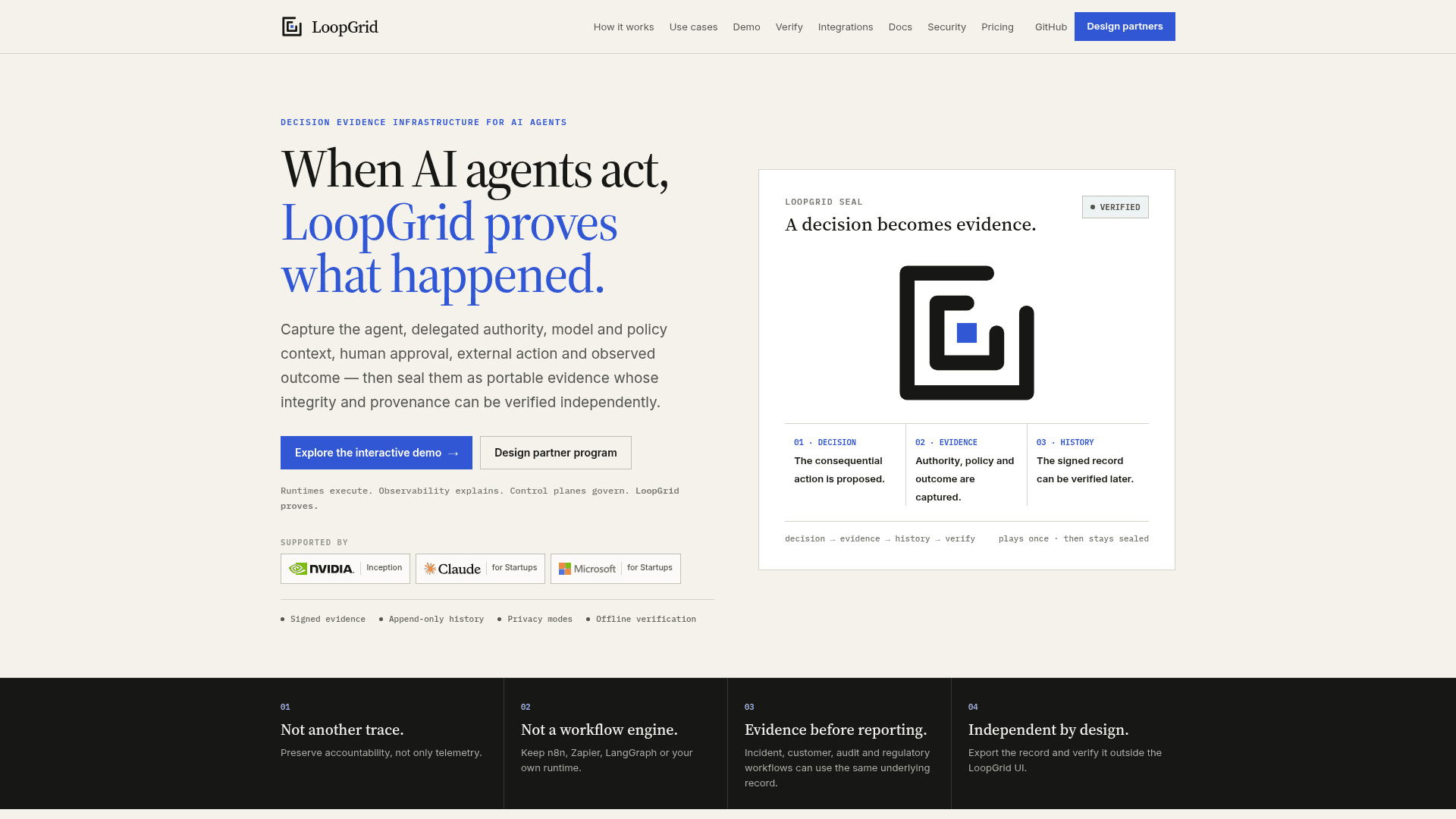
Decision evidence infrastructure that captures and cryptographically seals the identity, authority, policy, oversight, action and outcome around AI agent decisions.
At a Glance
Developer tier for local evaluation and technical exploration; core is Apache-2.0 licensed and self-hostable. Preview access; not a production SLA.
Engagement
Available On
Listed Nov 2026
About LoopGrid
LoopGrid is decision evidence infrastructure for AI agents, published by cybertechsoft. It captures the agent, delegated authority, model and policy context, human approval, external action and observed outcome of a consequential decision, then seals them as signed, tamper-evident records that can be verified independently. The current release is v0.8.1, positioned for controlled design-partner technical evaluation rather than production GA.
What It Is
LoopGrid is an evidence layer that sits alongside agent runtimes, observability and governance tools rather than replacing them. Teams record a decision through REST, Python or TypeScript SDKs, OpenTelemetry/OTLP or MCP. Each evidence event is committed to a workspace-isolated SHA-256 hash chain and signed (Ed25519 locally, with an AWS KMS path). Reviews, actions, outcomes and replays are appended as new signed events instead of rewriting the original decision.
Capture to proof workflow
The lifecycle runs capture, seal, investigate and prove. Investigators can reconstruct what happened, inspect approvals and policy versions, and run counterfactual replay without mutating production history. Exports are portable evidence bundles containing a manifest, decision and event files, chain witnesses, a public key and an HTML report. A standalone verifier (loopgrid-verify) checks hashes, signatures and chain continuity offline, with signer pinning, and a GitHub Action can verify exported bundles in CI. Verification establishes integrity and provenance; it does not prove a decision was correct or confer legal compliance.
Privacy modes
FULL, REDACTED and PROOF-ONLY modes control how much source data is retained. Raw payloads can sit in a separate AES-256-GCM disclosure vault, be replaced by field commitments, or stay customer-side with only the commitment kept. Encrypted disclosures can be erased without rewriting the signed chain.
Integrations and setup
Documented integrations include a verified Dify Marketplace plugin, an n8n node, Langflow, Strands Agents, Google ADK, Vercel AI SDK, OpenAI Agents SDK, Haystack, CrewAI, Microsoft Agent Framework, Pydantic AI, Claude Agent SDK, LangChain, LangGraph, Mastra and Agno. A no-Docker quickstart script creates a synthetic refund decision, exports a bundle and verifies it; a PostgreSQL-backed Docker path exists for design-partner deployments.
Current Status
The README states the release is approved for controlled design-partner evaluation and is not Production GA. It does not claim a production SLA, legal compliance, validated multi-instance scaling, or live hardware-backed KMS signing unless exercised in a given deployment. The source is Apache 2.0 licensed.
Community Discussions
Be the first to start a conversation about LoopGrid
Share your experience with LoopGrid, ask questions, or help others learn from your insights.
Pricing
Evaluate
Developer tier for local evaluation and technical exploration; core is Apache-2.0 licensed and self-hostable. Preview access; not a production SLA.
- Local / self-hosted evaluation
- REST + SDK integration paths
- Demo workspace and sample evidence
- Portable evidence bundles
- Offline verifier
Pilot
Design Partner pilot: one consequential workflow with direct founder support and agreed success criteria. Commercial terms are scoped individually; no public price.
- One state-changing agent workflow
- Hands-on integration support
- Policy + human review evidence
- External action + observed outcome
- Evidence export + offline verification
- Pilot success criteria and technical review
- Recurring product/technical feedback during the evaluation
Controlled pilot
Enterprise validation, typically 8–12 weeks for a higher-assurance deployment; custom pricing.
- 1–3 consequential workflows
- PostgreSQL deployment path
- Hardened authentication / RBAC target
- KMS / signer-boundary validation where available
- Timestamp / retention architecture review
- Security and production-readiness review
- Conversion path to annual enterprise agreement
Capabilities
Key Features
- Signed, append-only decision evidence records
- SHA-256 workspace hash chains with Ed25519 signing
- Capture of agent identity, delegated authority, model/context, policy, human oversight, action and outcome
- Portable evidence bundles with offline verification and signer pinning
- FULL, REDACTED and PROOF-ONLY privacy modes
- AES-256-GCM disclosure vault with erasable payloads
- Signed workspace checkpoints and optional RFC 3161 timestamping
- Counterfactual replay without mutating history
- Scoped service API keys and human RBAC
- OTLP/HTTP trace ingestion (protobuf and JSON, optional gzip)
- GitHub Action for CI evidence verification
- Python and TypeScript SDKs
- Interactive web demo and verifier