loudkit
Open-source, on-device text-to-speech engine with 28 voices across 10 languages, voice cloning from 10 seconds of audio, and SDKs for Python, Swift, Go, Rust, and TypeScript.
At a Glance
Fully free and open-source under Apache-2.0. Download the model once and run offline with no account, telemetry, or usage billing.
Engagement
Available On
Alternatives
Listed Sep 2026
About loudkit
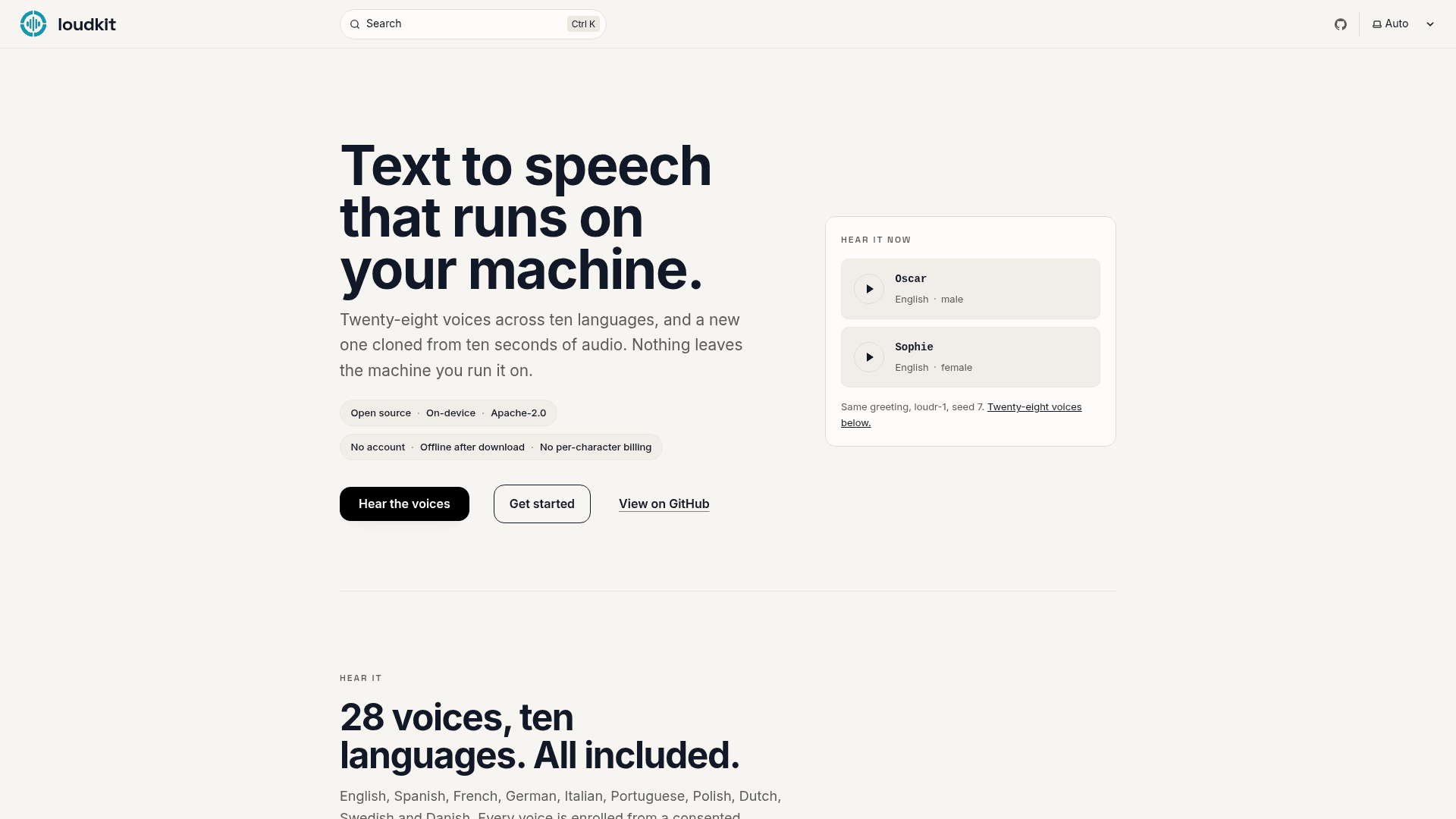
loudkit is an open-source, on-device text-to-speech engine released under Apache-2.0 by LoudReader. It ships 28 voices across ten languages, supports voice cloning from roughly ten seconds of audio, and provides native SDKs for Python, Swift, Go, Rust, and TypeScript. Nothing leaves the machine it runs on — no account, no telemetry, and no per-character billing.
What It Is
loudkit is a local inference toolbox for speech synthesis, not a hosted speech platform. It provides the loudr-1 and loudr-1-turbo models, which run entirely on the user's hardware after a one-time model download. The engine powers LoudReader, an iOS reading app that speaks articles, PDFs, and books on device, and is published separately under Apache-2.0 for anyone who wants to build with it directly. The project explicitly states it does not provide accounts, billing, multi-tenancy, model training, or emotion control.
Language and Platform Coverage
The engine supports English, Spanish, French, German, Italian, Portuguese, Polish, Dutch, Swedish, and Danish — ten English voices and two voices per other language, for 28 total. Every voice is enrolled from a consented donation or a CC0/CC-BY corpus, with the source named in VOICES.md. Python is the reference implementation; Swift (CoreML, macOS 14 or iOS 17), Go (ONNX Runtime), Rust (ONNX Runtime), and TypeScript (ONNX Runtime, Node 20) are full ports held to the same conformance fixture, so the same text, voice, and seed produce identical speech tokens across all five languages.
Measured Performance
The project publishes benchmark figures from tools/bench.py runs on named hardware:
- RTX 3090 (CUDA graphs): 8.55× real time with loudr-1, 13.05× with loudr-1-turbo
- Apple M3 Pro (PyTorch/MPS split): 3.29× with loudr-1, 5.77× with loudr-1-turbo
- Apple M3 Pro (ONNX Runtime, CPU): 1.14× with loudr-1, 1.59× with loudr-1-turbo
- Jetson Orin Nano (CUDA graphs): 1.85× with loudr-1, 2.50× with loudr-1-turbo
- Batched token-generator throughput (RTX 3090, loudr-1-turbo): 42.0× at batch 1, up to 155.0× at batch 64
All figures are multiples of real time measured on version 0.1.1. The benchmark page records the machines, versions, and commands that reproduce each row.
Integrations and Server Mode
loudkit ships a built-in server (loudkit serve) with its own HTTP routes and an OpenAI-compatible /v1/audio/speech endpoint, streaming over Server-Sent Events. Additional modes include --grpc for a typed schema with backpressure and --mcp for an MCP server on stdio (preview). A Speech Dispatcher module for Linux screen readers is included in integrations/. Docker images and compose files are provided for the server. Agents that speak OpenAI's speech API — including Hermes Agent and OpenClaw — connect with configuration alone, according to the project documentation.
Update: v0.1.1
Version 0.1.1 was published on 2026-09-10. This release adds loudr-1-turbo support across all five SDKs (Python, Swift, Go, Rust, TypeScript), includes all 28 voices in both model downloads, and is the version against which all published benchmark figures are measured. The repository was created on 2026-08-22 and last pushed on 2026-09-10, indicating active early development. The project's GitHub topics include text-to-speech, voice-cloning, on-device, offline, onnx, pytorch, coreml, swift, golang, rust, and typescript.
Responsible Use and Scope
Voice cloning produces a portable profile of about 150 KB from a recording the user owns or has permission to use. WAVs saved from Python and the server's replies carry a machine-readable note naming the model, voice, seed, and backend, with a checksum tying the note to the audio. The project states this is not C2PA Content Credentials. The documentation explicitly states loudkit will not assist with undisclosed impersonation, bypassing voice authentication, or stripping the machine-readable note from generated audio.
Community Discussions
Be the first to start a conversation about loudkit
Share your experience with loudkit, ask questions, or help others learn from your insights.
Pricing
Open Source
Fully free and open-source under Apache-2.0. Download the model once and run offline with no account, telemetry, or usage billing.
- 28 voices across 10 languages
- Voice cloning from ~10 seconds of audio
- loudr-1 and loudr-1-turbo models
- SDKs for Python, Swift, Go, Rust, TypeScript
- On-device / offline inference
Capabilities
Key Features
- 28 voices across 10 languages (English, Spanish, French, German, Italian, Portuguese, Polish, Dutch, Swedish, Danish)
- Voice cloning from ~10 seconds of audio
- On-device inference — no data leaves the machine
- Two models: loudr-1 and loudr-1-turbo
- SDKs for Python, Swift, Go, Rust, and TypeScript
- Offline after one-time model download
- OpenAI-compatible /v1/audio/speech HTTP endpoint
- gRPC server mode with backpressure
- MCP server on stdio (preview)
- CUDA graphs support for NVIDIA GPUs
- Apple Silicon (MPS) and CoreML support
- ONNX Runtime backend (no PyTorch required)
- Jetson Orin Nano / edge device support
- Streaming synthesis (sentence-by-sentence)
- Machine-readable provenance note in saved WAVs
- Speech Dispatcher module for Linux screen readers
- Docker images and compose files
- Voice gallery with enrollment recordings
- Deterministic output: same text + voice + seed = same tokens
- CLI: loudkit speak, loudkit clone, loudkit serve, loudkit verify