
LUCI
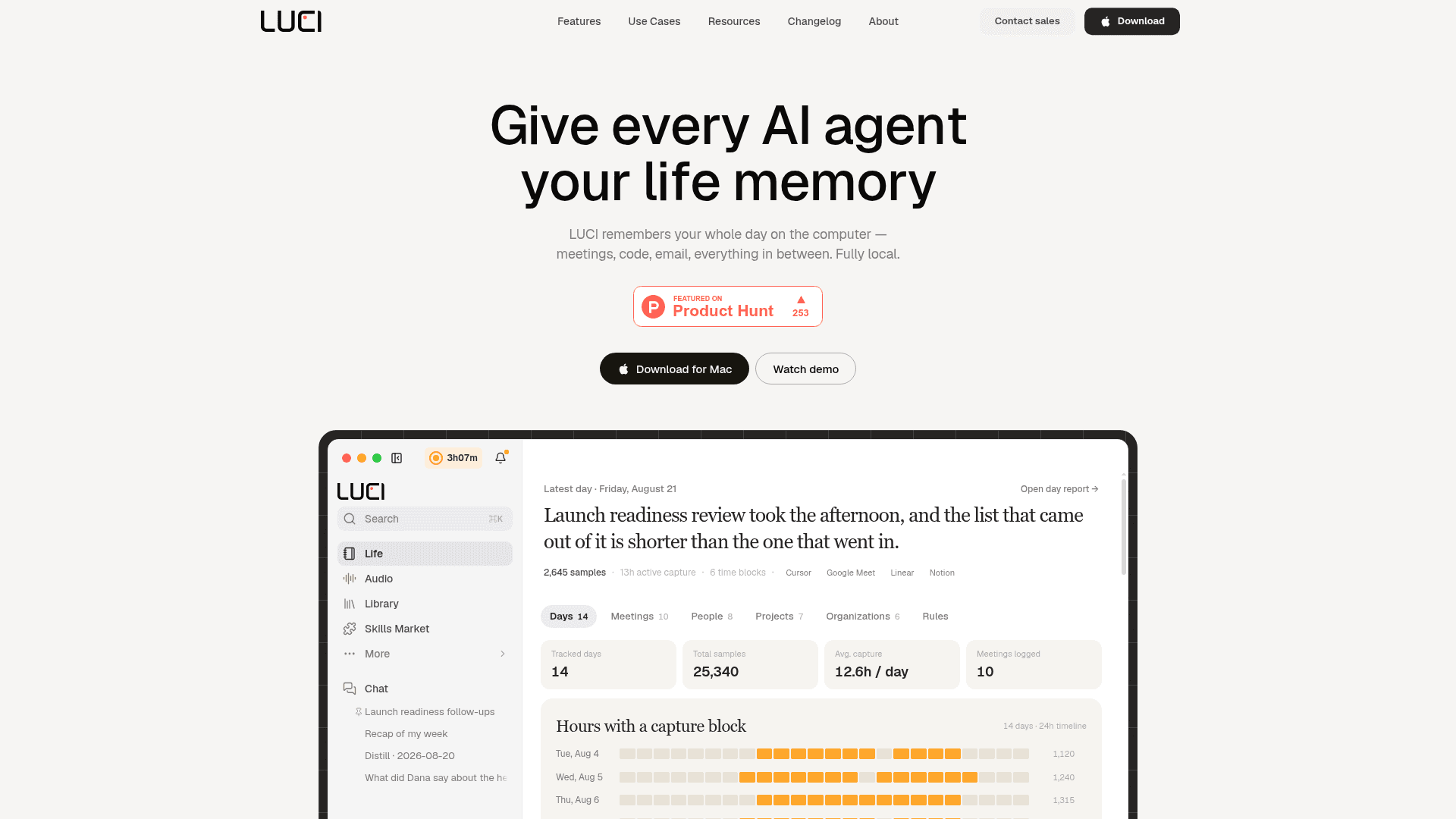
LUCI is a free, fully local desktop app that remembers your entire day on the computer — meetings, screen activity, code, and email — and gives that memory to AI agents like Claude Code, Cursor, and Codex.
At a Glance
About LUCI
LUCI is a free desktop app for Mac and Windows from Memories AI that captures your entire day on the computer — meetings, screen activity, code, email, and documents — and stores it locally on your device, encrypted at rest. It then exposes that persistent memory to AI coding agents like Claude Code, Cursor, Codex, Gemini, and GitHub Copilot, so those agents never start from a blank slate. The app is built by a team with backgrounds from Meta and Cambridge, and is currently shipping for both Mac and Windows.
What It Is
LUCI sits in the category of AI memory and agent context tools. Its core job is to solve the "context reset" problem: every time you open a new chat with an AI agent, it has no idea what you were doing before. LUCI continuously captures what happens on your screen and in your meetings, builds a searchable, structured memory from that raw activity, and makes that memory available to whichever agent you ask — without requiring you to copy, paste, or re-explain anything. The memory is stored entirely on your own machine as plain files, with no cloud upload.
How the Memory Layer Works
LUCI captures two primary streams of information:
- Screen activity: It reads and understands what is on your screen in real time, building a chronological record of every app, document, and tab you interact with.
- Meeting audio and transcripts: It records Zoom, Google Meet, and Microsoft Teams calls locally — no bot joins the call — and attaches full transcripts to the day they happened.
These streams are processed on-device using local models (Phi, Qwen, Llama, DeepSeek — user-selectable). A "Distill" step turns the raw daily capture into a structured written report filed in a ~/.Life/ folder as plain text files. Sensitive data like passwords, API keys, and card numbers are redacted before anything is saved.
Agent Integration Architecture
LUCI connects to agents through two mechanisms. The first is the Agent Bridge, a local interface that Claude Code, Cursor, Codex, Gemini, GitHub Copilot, Windsurf, Zed, VS Code, Warp, Cline, and others can query without any per-agent configuration — LUCI connects itself. The second is Luci-skills, an open-source repository (MIT-licensed, available at Memories-ai-labs/Luci-skills on GitHub) that provides installable skills for coding agents. The three official skills are /luci:luci (search live history), /luci:distill-my-life (generate daily reports), and /luci:summarize-meeting (write a meeting into the Life folder). Skills can be installed via the Claude Code plugin marketplace or via npx skills add.
Privacy and Local-First Design
The privacy model is a core architectural decision, not a marketing add-on. According to the product documentation:
- All capture, understanding, and storage happens on the user's device.
- There is no cloud copy of recordings, transcripts, or memory.
- Memory is encrypted at rest on disk.
- The Life folder is plain files that outlive the app itself.
- Users control retention — deleting a day removes it entirely.
- The app holds SOC 2 Type 2 certification and is GDPR compliant, per the trust page linked from the homepage.
Who It Is Built For
The product page identifies six primary audiences: developers (who can resolve context across sessions without re-explaining architecture decisions), founders (who get an honest picture of where their week went), researchers (who can find things they read weeks ago), consultants (who get every call written up automatically), designers (who can find visual references by describing them), and support and ops teams (who can trace the exact thread behind a ticket). The agent memory feature is specifically positioned for developers using coding agents who lose context between sessions.
Current Status
LUCI is actively shipping for Mac and Windows as of 2026. The GitHub repository for Luci-skills was created in August 2026 and last pushed in September 2026, indicating active development. The pricing page notes that Rewind — a comparable local screen-memory product — ended capture in December 2025, and LUCI positions itself as the active alternative in that space. The product is listed on Product Hunt under "LUCI Desktop."
Community Discussions
Be the first to start a conversation about LUCI
Share your experience with LUCI, ask questions, or help others learn from your insights.
Pricing
Free
Everything LUCI does, for everyone, at no cost. Fully local, no subscription, no credit card required.
- Unlimited agent runs across all skills
- Context-aware meeting reminders
- Meeting video recording
- Real-time coaching with action items
- Unlimited meeting transcriptions
Capabilities
Key Features
- Local AI screen recording with on-device understanding
- AI meeting notes for Zoom, Google Meet, and Microsoft Teams without a bot
- Persistent memory stored as plain files in a Life folder
- Agent Bridge for zero-configuration integration with Claude Code, Cursor, Codex, Gemini, Copilot, Windsurf, and more
- Luci-skills open-source skill set for coding agents
- Daily distillation of raw screen activity into structured reports
- Plain-language search across screen and meeting history
- Local model support: Phi, Qwen, Llama, DeepSeek
- Automatic redaction of passwords, API keys, and card numbers
- Encrypted at rest, no cloud upload
- Chronological timeline of daily activity
- Meeting transcript and summary generation
- Chat interface for querying past activity
- Skills Market with official and community agent prompts
- SOC 2 Type 2 certified and GDPR compliant