
Maki
A Python framework for building multi-agent LLM applications that run on local models via Ollama, hosted APIs (OpenAI, Anthropic, OpenRouter), or a mix of both.
At a Glance
Fully free and open-source under the MIT License. Clone, modify, and distribute freely.
Engagement
Available On
Listed Sep 2026
About Maki
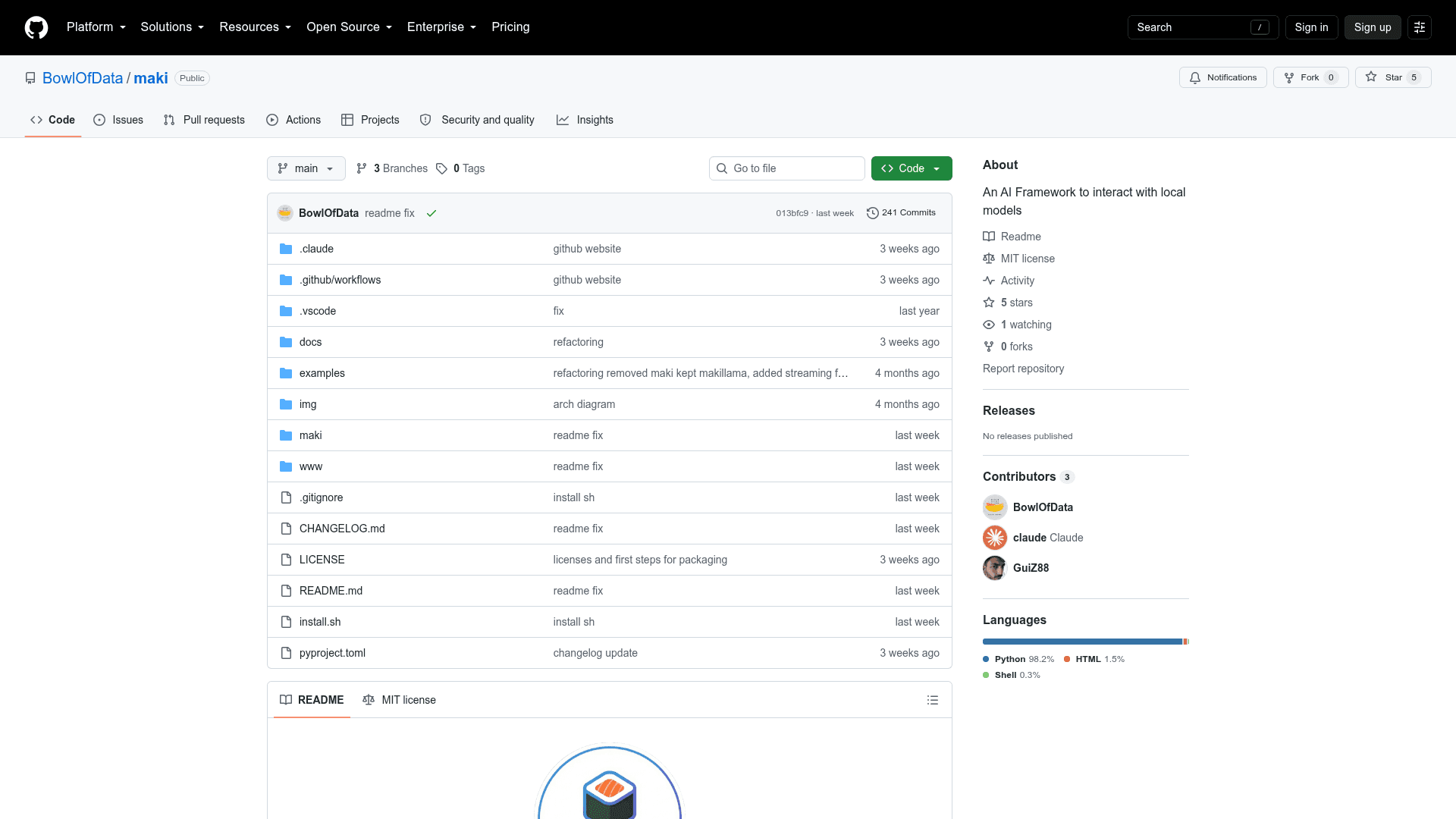
Maki is a Python framework for multi-agent LLM applications developed by Bowl of Data, an open-source AI research community. It lets developers build tool-using agents that run on local hardware through Ollama, on hosted APIs like OpenAI and Anthropic, or a combination of both — using the same agent code throughout. The project is licensed under MIT and is in early 0.x development, self-described as deliberately small and focused.
What It Is
Maki sits in the agent framework category: it provides the scaffolding to define role-based agents, wire them to LLM backends, equip them with plugins, and orchestrate them in multi-step workflows. Its distinguishing design choice is treating local inference (Ollama) as a first-class backend equal to hosted APIs, rather than an afterthought. All backends — MakiLLama, MakiOpenAI, MakiAnthropic, MakiOpenRouter, and HFBackend — implement the same abstract LLMBackend contract, so swapping inference providers requires changing only one object.
Architecture and Core Layers
The framework is organized into four layers on top of a shared infrastructure layer:
- LLM Backends — Ollama, OpenAI, Anthropic, OpenRouter, and an in-process HuggingFace Transformers backend (requires manual install of
torch,transformers,accelerate) - Agent System —
AgentcomposesPluginHandlerandReasoningEnginemixins;AgentManagerorchestrates agents viaWorkflowTaskandWorkflowStatewith dependency resolution, retries, parallel batching, and checkpoint/resume - Distributed Layer —
AgentServer(FastAPI) exposes agents over HTTP viamaki serve;AgentProxyprovides a remote-agent client with circuit-breaking;DistributedAgentManagermixes local and remote agents in the same workflow - Infrastructure — a hardened
Connectorwith URL validation, private-address blocking, and DNS pinning; shared data classes; typed exceptions; runtime config; and structured logging
The base install has only three dependencies: requests, httpx, and python-dotenv. All other capabilities are opt-in extras.
Security and Guardrails
Maki ships with guardrails enabled by default rather than as an optional add-on. URLs sourced from content (web pages, feeds) are checked against private and reserved address ranges at connect time, including redirect hops. Plugins are fail-closed: a model can only call methods a plugin explicitly declares in ALLOWED_METHODS, and destructive operations — file writes, FTP transfers, trades — remain disabled unless the agent is instantiated with allow_dangerous_tools=True. The trading plugin runs in paper mode unless live trading is explicitly opted into.
Built-in Plugins
Maki includes 16 built-in plugins across several categories:
- File system:
directory_reader,file_reader,file_writer,json_reader - Web:
web_search(RSS, HackerNews, Reddit, GitHub Trending, Lobste.rs),web_to_md,provider_updates,trend_search - Market data and trading:
alpaca_data,alpaca_news,alpaca_trading,alpaca_stream - Memory:
obsidian_memory(persistent note-based memory via Obsidian vault),rag_memory(retrieval-augmented memory with pluggable vector backends) - Vision:
image_classifier,ocr
Current Status
The repository was created in May 2025 and was last pushed in September 2026, indicating active development. The project self-identifies as version 0.x and explicitly notes it is young and deliberately small. The README acknowledges it is not suited for teams needing a large catalog of third-party integrations, hosted tracing, or a large ecosystem — positioning it as a focused local-first framework for developers who want control over inference and security defaults. The test suite covers 900+ tests across backends, agents, workflows, plugins, connectors, the distributed layer, and security behavior.
Community Discussions
Be the first to start a conversation about Maki
Share your experience with Maki, ask questions, or help others learn from your insights.
Pricing
Open Source
Fully free and open-source under the MIT License. Clone, modify, and distribute freely.
- All LLM backends (Ollama, OpenAI, Anthropic, OpenRouter, HuggingFace)
- Multi-agent orchestration with AgentManager
- 16 built-in plugins
- Distributed agent serving
- Workflow engine with retries and checkpoints
Capabilities
Key Features
- Local-first LLM inference via Ollama
- Hosted API backends: OpenAI, Anthropic, OpenRouter
- In-process HuggingFace Transformers backend
- Role-based agents with task execution, memory, and reasoning
- Multi-agent orchestration with AgentManager
- Dependency-aware workflow engine with retries and parallel batching
- Checkpoint/resume for long-running workflows
- 16 built-in plugins (files, web, market data, memory, vision)
- Distributed agent serving via maki serve (FastAPI)
- AgentProxy for remote agent consumption with circuit breaker
- Fail-closed plugin security with ALLOWED_METHODS
- Hardened HTTP connector with private-address blocking
- Native tool-calling for Ollama, OpenAI, and Anthropic
- Token-budgeted ConversationMemory
- RAG memory with pluggable vector backends
- Obsidian vault persistent memory
- Streaming, async, and synchronous chat modes
- PySide6 desktop GUI shell
- Bearer-token auth for agent servers
- Paper trading mode for Alpaca plugin