
Matrix
Local-first communication hub that routes people, scripts and supervisory agents to ACP or A2A coding agents while keeping runs, sessions and workspace state together.
At a Glance
Self-hosted Matrix core released under the Apache License 2.0; runs locally on Linux, macOS and Windows.
Engagement
Available On
Listed Nov 2026
About Matrix
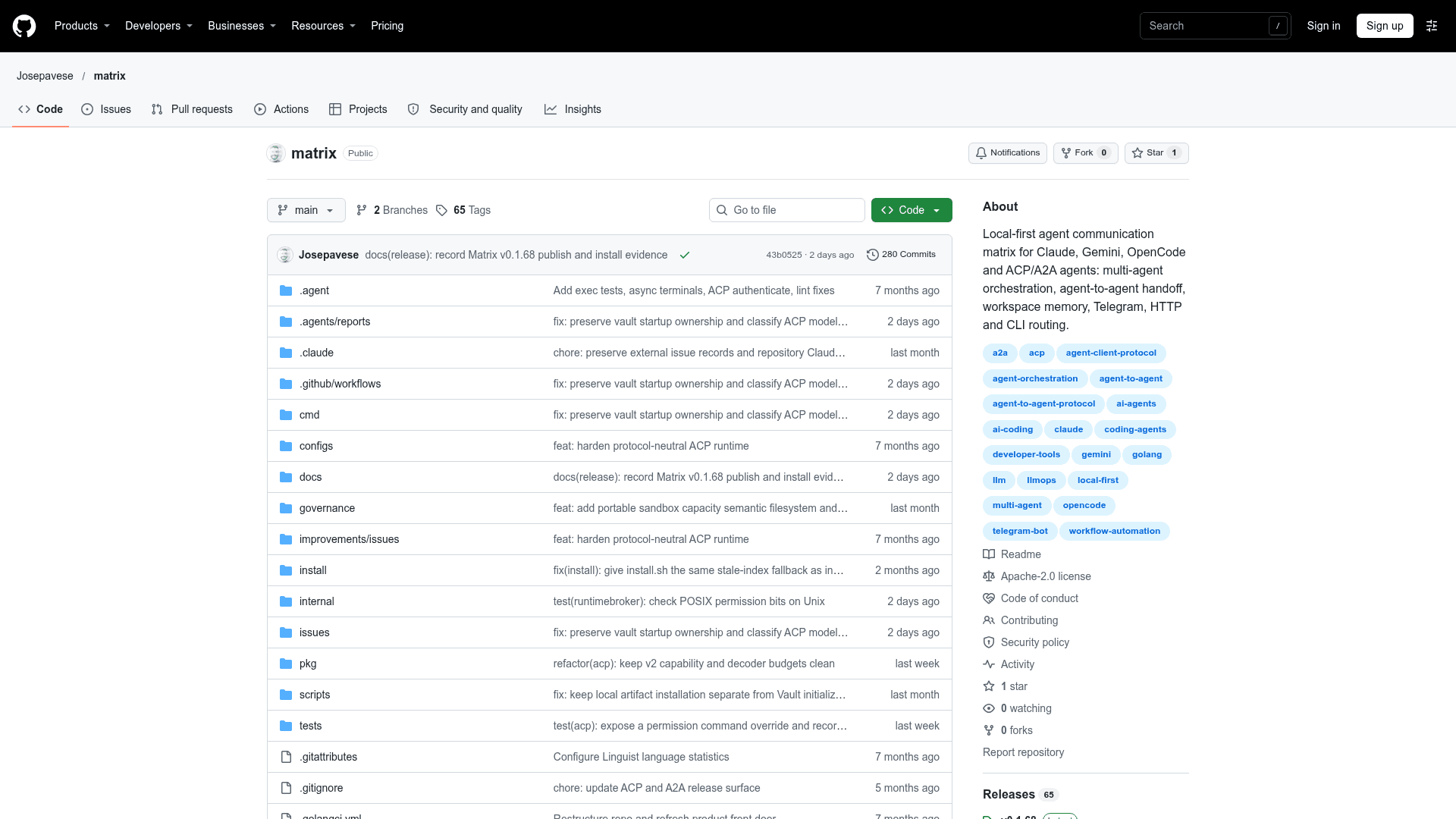
Matrix is an open-source, local-first communication hub for coding agents, published by Josepavese on GitHub. It connects people, scripts and supervisory agents to existing ACP or A2A agents such as OpenCode, and keeps their runs, session identities and project state in one place. The README marks it as experimental software whose commands, APIs and integration contracts can change.
What It Is
Matrix is a routing and coordination layer, not an agent itself. Requests arrive through Telegram, authenticated HTTP or the CLI and pass into a common routing core. From there they reach external agents over ACP or A2A. The agents keep their own models, tools and accounts. Matrix can request a model where the protocol supports it, while credentials, subscriptions and inference stay with the provider.
It runs on Linux, macOS and Windows and stores runtime state under one OS-native application home. Agents or model services can still be remote, so local-first describes where Matrix's control and state live rather than where prompts are processed.
Delegation and Session Continuity
A supervisor can submit an async run against an explicit workspace and agent, keep the run ID, and consume events for completion, failure, interruption or input requests instead of reading whole transcripts. On Linux and macOS, matrix run wait reads a private notification socket. Windows clients use the HTTP run event stream and elicitation API.
Sessions carry distinct logical and provider IDs. Load, resume, discovery and fork depend on the capabilities each provider advertises, and unsupported operations are reported rather than simulated. A handoff delivers a recorded brief to another specialist on its next turn. Sidecar capsules attach supervisory context with delivery traces, separate from normal chat text.
Agents and Protocols
Shipped seed definitions include OpenCode, Gemini CLI, Claude Code's ACP adapter and Kimi. Codex has a dedicated ACP installation and launch contract, and MiMo Code can be registered as an ACP agent. The README lists many further ACP ecosystem agents but states this is a directory, not a claim that each has passed end-to-end qualification. Remote agents can be registered over A2A.
Execution, Observability and Setup
Optional controls include provider permissions, Docker isolation on a prepared local Linux image, and admission limits based on concurrency and workspace disk capacity. A read-only semantic filesystem exposes agent, run and workspace state, and optional OTLP/HTTP export sends selected operational logs rather than prompt content. Run traces show requested and effective model information and typed recovery outcomes.
Setup uses release installer scripts for Linux/macOS and PowerShell. Users then run matrix bootstrap doctor, register a workspace with matrix workspace add, start matrix run, and submit tasks over HTTP. An installed, authenticated agent or a configured remote A2A endpoint is required. Native platform contracts are tested on Linux, Windows and macOS, while real container and FUSE qualification is recorded for Linux.
Community Discussions
Be the first to start a conversation about Matrix
Share your experience with Matrix, ask questions, or help others learn from your insights.
Pricing
Open Source (Apache-2.0)
Self-hosted Matrix core released under the Apache License 2.0; runs locally on Linux, macOS and Windows.
- Licensed under Apache-2.0
- Local-first communication hub for ACP/A2A coding agents
- Telegram, authenticated HTTP and CLI routing
- Workspace roots, session bindings, timeline and work memory
- Async runs, run events, cancellation and notifications
Capabilities
Key Features
- Routing from Telegram, authenticated HTTP and CLI to ACP/A2A agents
- Workspace roots, session bindings, timeline and work memory
- Async runs with events, input requests and cancellation
- Capability-gated session load, resume, discovery and fork
- Handoff briefs between specialist agents
- Sidecar capsules for supervisory context
- Run traces and typed recovery outcomes
- Optional Docker isolation and runtime admission control
- Read-only semantic filesystem with optional native mount
- Optional bounded OTLP/HTTP log export
- Agent registry search and install via CLI