
Maxim
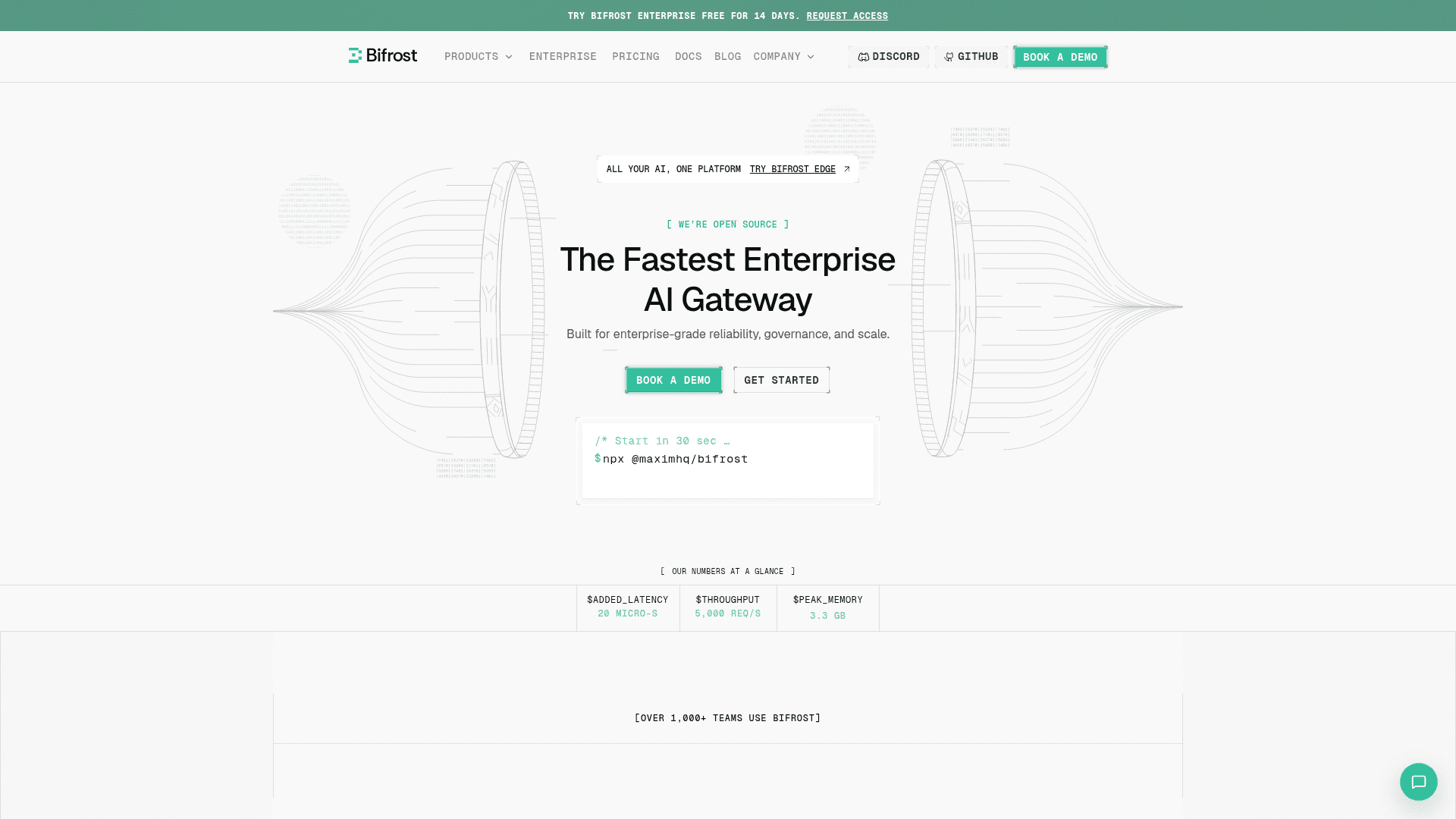
Maxim's Bifrost is an open-source enterprise LLM gateway that unifies model access with governance, guardrails, MCP gateway, and observability.
At a Glance
For developers, small teams, and self-managed deployments; self-hosted via Docker, K8s or Go binary. Open source under Apache 2.0 License.
14-day free trial of Bifrost Enterprise, requested via license request form.
Engagement
Available On
Alternatives
Updated Oct 2026
About Maxim
Maxim, built by H3 Labs Inc., offers Bifrost, an open-source LLM gateway licensed under Apache 2.0 that gives applications a single layer for accessing many model providers. It can be started locally with npx @maximhq/bifrost, and an enterprise edition is offered with a 14-day free trial request.
What It Is
Bifrost is an AI gateway that sits between applications and model providers. The site describes a unified API across providers, so teams can switch models without changing code. It also supports custom deployed models. Maxim describes itself as building an AI evaluation and observability platform, with Bifrost as the gateway product featured on its homepage.
How It Fits Into an Existing Stack
Bifrost is positioned as a drop-in replacement for existing AI SDKs. The homepage shows pointing the OpenAI client at a Bifrost deployment base URL, and says it works with OpenAI, Anthropic, Vercel AI SDK, LangChain, LangGraph, LiteLLM and Google GenAI. Provider fallback provides automatic failover between providers.
Governance, Security and MCP
Virtual keys carry independent budgets and access control, and spending limits can be tracked across teams, projects and models. Enterprise capabilities listed include SSO-based access control, audit logs, guardrails and adaptive load balancing. A built-in MCP gateway centralizes MCP tool connections, authentication and policy enforcement. The FAQ states that in-VPC deployments keep data within the customer's environment.
Performance and Observability
Maxim states Bifrost adds about 11 microseconds of overhead at 5k RPS on a t3.xlarge machine, and publishes a benchmark claiming it is 50x faster than LiteLLM at 500 RPS on identical hardware. Observability comes from OpenTelemetry support and a built-in dashboard, with semantic caching and telemetry documented.
Community Discussions
Be the first to start a conversation about Maxim
Share your experience with Maxim, ask questions, or help others learn from your insights.
Pricing
OSS
For developers, small teams, and self-managed deployments; self-hosted via Docker, K8s or Go binary. Open source under Apache 2.0 License.
- Drop-in Replacement
- OTel Compatible Metrics & Traces
- Built-in Observability
- Budget Management & Rate Limits with Virtual Keys
- Custom Routing Rules & Flows
Enterprise Free Trial
14-day free trial of Bifrost Enterprise, requested via license request form.
Enterprise
For teams running production AI systems at scale; VPC, on-prem, air-gapped.
- Everything in OSS
- Guardrails
- Cluster Mode
- Adaptive Load Balancing
- Enterprise SSO via SAML and OIDC
- Vault Support with Integrations
- MCP with Federated Auth
- Log Exports
- Audit Logs
- Role-Based Access Control
- SLA-Backed Enterprise Support
Capabilities
Key Features
- Unified API across 8+ providers and 1000+ models
- Drop-in SDK replacement
- Automatic provider fallback
- Virtual key management with budgets
- MCP gateway
- Guardrails
- Governance with SSO and audit logs
- OpenTelemetry observability and built-in dashboard
- Semantic caching
- Adaptive load balancing
- In-VPC deployment
- LiteLLM compatibility