
mcptunnels
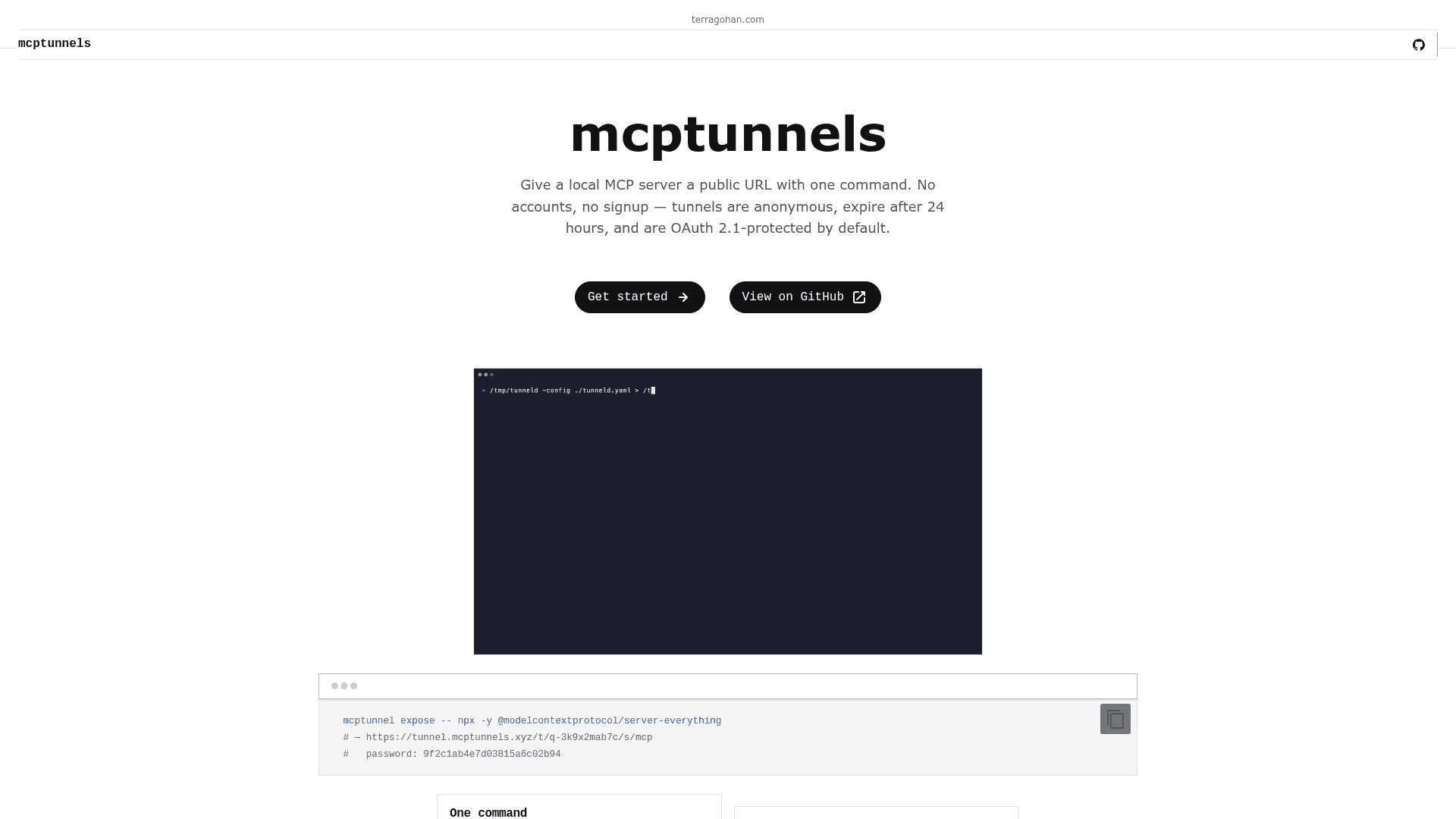
Give a local MCP server a public URL with one command — no accounts, no signup, with OAuth 2.1 protection and 24-hour ephemeral tunnels.
At a Glance
Fully free and open-source under Apache 2.0. Includes the mcptunnel CLI and self-hostable tunneld relay. The default public relay at tunnel.mcptunnels.xyz is free and best-effort.
Engagement
Available On
Listed Sep 2026
About mcptunnels
mcptunnels is an open-source CLI tool that exposes local MCP (Model Context Protocol) servers to the public internet in a single command. Built by Terra Gohan and licensed under Apache 2.0, it bridges stdio MCP servers to Streamable HTTP and prints a public URL — no deployment, no accounts, no configuration files required. The project reached v1 in August 2026 and is actively developed as a spare-time project.
What It Is
mcptunnels is a purpose-built tunneling tool for the MCP ecosystem. Unlike generic tunnels such as ngrok or cloudflared that forward raw TCP/HTTP traffic, mcptunnels understands the MCP protocol: it spawns any stdio MCP server, bridges it to Streamable HTTP, and creates an ephemeral public URL through a hosted relay at tunnel.mcptunnels.xyz. The core use cases are connecting remote MCP clients (Claude, ChatGPT, Cursor) to a locally running server, demoing an MCP server to a teammate without deploying anything, and testing a server against a real client during development.
How the Tunnel Architecture Works
The tool operates through an outbound WebSocket connection so no inbound ports are required and it works behind NAT:
mcptunnel exposeasks the relay (tunneld) for a quick tunnel and receives an ephemeral tenant plus an agent key- It spawns the specified command and bridges stdio to loopback HTTP
- The agent dials outbound to
tunneldvia WebSocket + yamux — no inbound ports needed tunneldreverse-proxies public HTTPS requests over that connection to the local process
The relay component (tunneld) is a self-hostable single binary backed by SQLite with ACME TLS support, deployable via Docker or bare-metal. The data plane is covered by end-to-end tests including WebSocket + yamux proxy, stdio bridge, SSE streaming, and automatic reconnect.
Security Model
All tunnels are OAuth 2.1-protected by default. When a tunnel is created, the CLI generates a password; MCP clients like ChatGPT, Claude, and Cursor discover the OAuth flow automatically and prompt for that password. The --no-auth flag creates open URLs with no authentication. Key security properties:
- Tunnels expire after 24 hours automatically; Ctrl-C deletes the tunnel server-side immediately
- All traffic transits the relay operator — the project explicitly warns to expose throwaway servers only, never private data
- A managed bearer token registry (
mcptunnel token add/list/remove) handles long-lived credentials without putting secrets on the command line
CLI Capabilities
Beyond the basic expose command, mcptunnels supports several modes:
- Expose a remote HTTP MCP server:
mcptunnel expose --url https://api.example.com/mcppoints the tunnel at an existing Streamable HTTP endpoint - Reverse bridge:
mcptunnel run --url <url>bridges a remote Streamable HTTP MCP server to local stdio, so stdio-only clients can consume remote servers - Header injection:
--header "Authorization: Bearer $KEY"(repeatable) forwards credentials to upstream servers - Token registry: Register tokens once per upstream;
exposeandrunpick them up automatically from the OS config directory
Prebuilt binaries are available for Linux and macOS (amd64/arm64) via GitHub Releases, and the tool can also be installed with go install (requires Go 1.26+).
Update: v1 and Roadmap
The project shipped v1 on August 25, 2026, covering anonymous quick tunnels, OAuth 2.1 by default, 24h TTL with a janitor sweeping expired tenants, a self-hostable tunneld, and an end-to-end tested data plane. The roadmap — explicitly ordered by real user pain with no fixed dates — targets permanent named tunnels with stable URLs and minimal identity next, followed by a stdio-to-HTTP framework for scaling MCP servers as Streamable HTTP services, and later pluggable identity providers and audience isolation. The project explicitly rules out generic TCP/HTTP tunneling and a billing-backed hosted SaaS as non-goals, keeping the default public relay free and best-effort while self-hosting remains a first-class path.
Community Discussions
Be the first to start a conversation about mcptunnels
Share your experience with mcptunnels, ask questions, or help others learn from your insights.
Pricing
Open Source
Fully free and open-source under Apache 2.0. Includes the mcptunnel CLI and self-hostable tunneld relay. The default public relay at tunnel.mcptunnels.xyz is free and best-effort.
- Anonymous quick tunnels with one command
- OAuth 2.1 protection by default
- 24-hour ephemeral tunnel TTL
- Self-hostable tunneld relay
- stdio to Streamable HTTP bridging
Capabilities
Key Features
- One-command tunnel creation: mcptunnel expose -- <cmd>
- stdio to Streamable HTTP bridging
- OAuth 2.1 protection by default with CLI-generated password
- 24-hour ephemeral tunnels with automatic expiry
- Ctrl-C immediate server-side tunnel deletion
- No accounts or signup required
- Self-hostable relay (tunneld) as single binary + SQLite
- ACME TLS support for self-hosted relay
- Docker and bare-metal deployment for tunneld
- Expose remote HTTP MCP servers via --url flag
- Reverse bridge: mcptunnel run bridges remote HTTP MCP to local stdio
- Header injection for upstream credentials
- Managed bearer token registry per upstream URL
- Auto-refresh and on-demand token minting
- -no-auth flag for open unauthenticated URLs
- WebSocket + yamux proxy for outbound-only connections (NAT-friendly)
- SSE streaming and automatic reconnect
- End-to-end tested data plane
- Prebuilt binaries for Linux/macOS amd64/arm64
- Go install support (Go 1.26+)