Memanto
Memanto is an open-source Memory Agent that curates, reconciles, expires, and shares long-term memory across a fleet of AI agents.
At a Glance
Memanto core is MIT-licensed; runs locally via Docker + Ollama with no account or API key. A free cloud option with 100K free operations is also offered.
Engagement
Available On
Listed Oct 2026
About Memanto
Memanto is an MIT-licensed memory agent from Moorcheh (moorcheh-ai) that runs alongside other AI agents and manages their shared memory. Rather than acting as a storage API, it extracts durable knowledge from agent interactions, consolidates duplicates, reconciles contradictions, applies expiry policies, and briefs agents before they act. It ships as a Python package with a CLI, plus TypeScript and Go SDKs and a REST API.
What It Is
Memanto is a memory management layer for multi-agent setups. The README positions it as a companion agent that decides what to keep, what conflicts, what expires, and who needs to know, with storage substrates such as vector stores sitting beneath it. Memories are typed into 13 categories (for example instruction, fact, decision, goal, preference, relationship, event, error), so recall can be filtered rather than returned as one blob.
How the workflow runs
- Capture:
memanto rememberstores single memories, batches, or extracts from conversation logs;memanto uploadingests files such as PDF, DOCX, XLSX, JSON, TXT, CSV and Markdown. - Reconcile: newer knowledge supersedes older rather than appending, and
memanto conflictssurfaces contradictions for review. - Recall:
memanto recallsupports point-in-time (--as-of) and--changed-sincequeries;memanto answerproduces answers grounded in retrieved memory. - Brief:
memanto agent bootstraphands an agent a relevant slice of memory before it acts. - Automate:
memanto schedule enableruns a daily curation, merge, and conflict-flagging loop.
Expiry policies and traceability
Memories are either active or expired. Retirement happens only through user-written YAML policies, with a per-type retention table and named rules (including pinning). Expired memories remain recallable, labelled as expired, and can be restored with memanto memory restore. Each memory carries confidence, source, provenance, and timestamp, and each agent gets its own namespace.
Portability and deployment
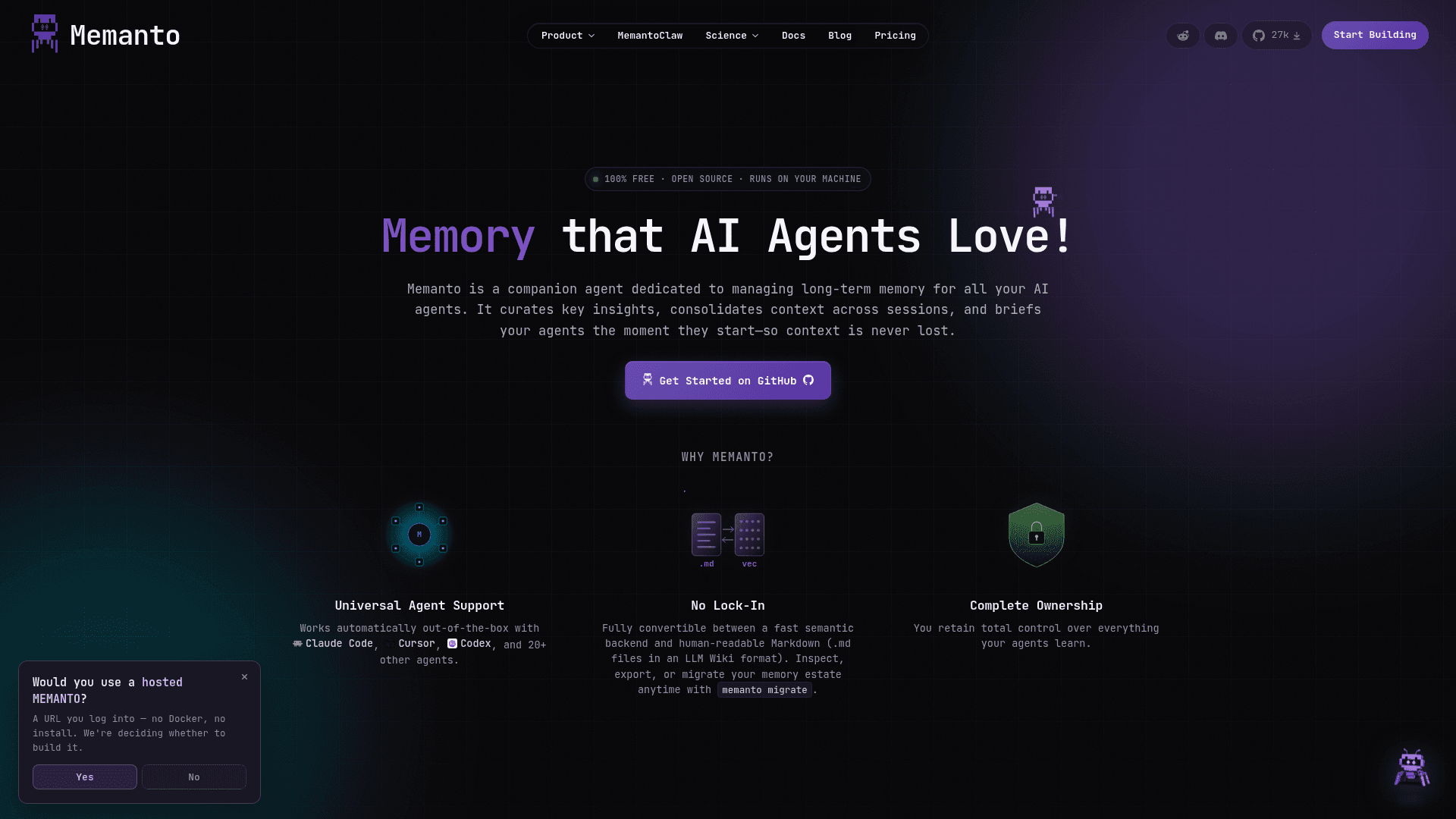
The estate can be exported as Open Knowledge Format (plain Markdown), and memanto migrate imports from Mem0, Letta, Supermemory, Zep, Hindsight, or an OKF bundle. Memanto can run fully on-prem with Docker and Ollama without an account, or against a Moorcheh cloud backend with an API key; memanto config backend switches between them. memanto connect integrates with tools such as Claude Code, Cursor, Codex, Windsurf, Cline, Goose, and GitHub Copilot, and memanto ui opens a local dashboard.
Research claims
The project's arXiv paper reports 89.8% on LongMemEval and 87.1% on LoCoMo. The authors caution that cross-project benchmark scores are not directly comparable and should be treated as directional.
Community Discussions
Be the first to start a conversation about Memanto
Share your experience with Memanto, ask questions, or help others learn from your insights.
Pricing
Open Source (MIT)
Memanto core is MIT-licensed; runs locally via Docker + Ollama with no account or API key. A free cloud option with 100K free operations is also offered.
- MIT License
- Local Docker + Ollama, no account, no API key
- Free cloud API key: 100K free operations, no card
- Switch backends with `memanto config backend`
Capabilities
Key Features
- Extracts durable memories from agent conversations
- Consolidates duplicate memories
- Conflict detection with supersede-based reconciliation
- Policy-based expiry with restore
- Point-in-time recall (--as-of, --changed-since)
- Grounded answers from retrieved memory
- 13 typed memory categories
- Per-agent namespaces
- Provenance, confidence, and timestamps on memories
- Scheduled daily curation
- Open Knowledge Format export
- Migration from Mem0, Letta, Supermemory, Zep, Hindsight
- Local dashboard and REST API
- File ingestion (PDF, DOCX, XLSX, JSON, TXT, CSV, MD)
- Fully local on-prem mode with Docker and Ollama
Integrations
Demo Video