MemEngine
A unified and modular Python library for developing and using advanced memory models for LLM-based agents.
At a Glance
MemEngine Python library, declared MIT-licensed in the README badge; GitHub metadata lists no license file.
Engagement
Available On
Listed Oct 2026
About MemEngine
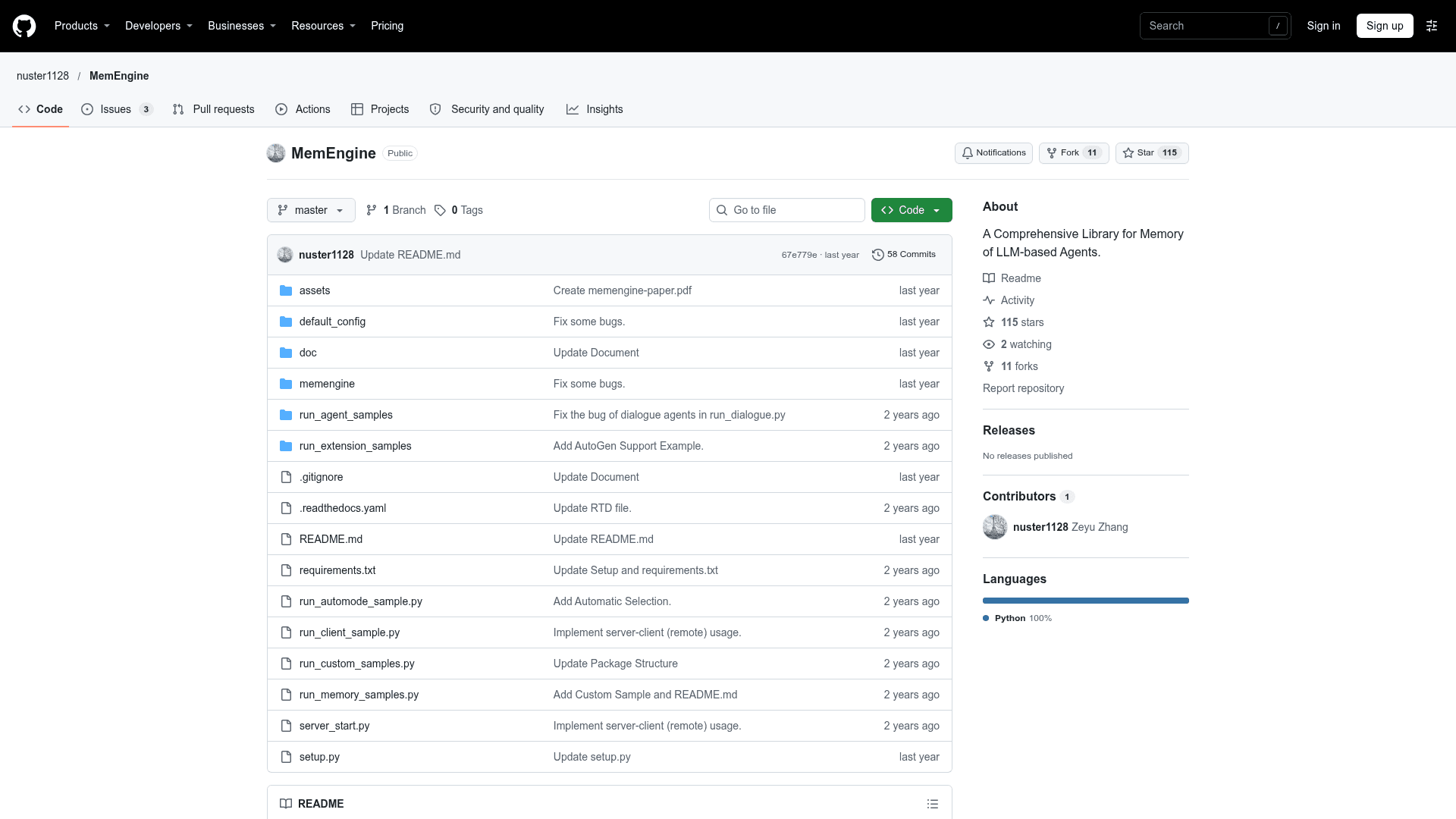
MemEngine is a Python library for building memory for LLM-based agents. The README describes a unified framework in which memory models from recent research are implemented and can be swapped, tested and extended. It can be used locally inside a Python program or deployed as a remote service that clients call over HTTP.
What It Is
MemEngine is a memory-development library for LLM agents. It organizes memory into three hierarchical, modular levels, so higher-level modules can reuse lower-level ones. It also includes a configuration module for adjusting hyper-parameters and prompts, and a utility module for saving and displaying memory contents. According to the README, the project was accepted to TheWebConf'25 (Resource Track) and has an arXiv paper.
How Memory Is Used
Agents create a memory object, such as FUMemory, from a configuration. They call store to record observations and recall to retrieve memory context for a prompt. The README lists three usage modes: default, configurable and automatic. In automatic mode, developers define a reward function and a set of candidate memory models or hyper-parameter ranges. The library then ranks the candidates and returns the best model and configuration.
Deployment Options
For local deployment, the library is installed from source, pip or conda, and memory modules run inside the agent program. For remote deployment, the library runs on a server through uvicorn and FastAPI. A lightweight client then sends memory operations over HTTP. The repository includes sample scripts for stand-alone memory, HotPotQA agents, dialogue agents, automatic selection and custom memory.
Customizing Memory Models
Researchers can extend three layers: memory functions (for example a custom judge), memory operations (such as recall or store pipelines) and complete memory models built from these operations. The README says the memory modules are pluggable across agent frameworks and compatible with some prominent ones.
Community Discussions
Be the first to start a conversation about MemEngine
Share your experience with MemEngine, ask questions, or help others learn from your insights.
Pricing
Open Source
MemEngine Python library, declared MIT-licensed in the README badge; GitHub metadata lists no license file.
- README badge declares MIT license
- GitHub metadata shows no license file detected
- Unified and modular memory library for LLM-based agents
- Available on PyPI
Capabilities
Key Features
- Unified three-level modular memory framework
- Memory models implemented from recent research
- Configuration module for hyper-parameters and prompts
- Utility module for saving and displaying memory contents
- Default, configurable and automatic memory usage modes
- Automatic selection of memory models and configurations via a reward function
- Local deployment in Python programs
- Remote deployment via uvicorn and FastAPI with an HTTP client
- Customizable memory functions, operations and models
- Pluggable into different agent frameworks
Integrations
Demo Video