MemOS
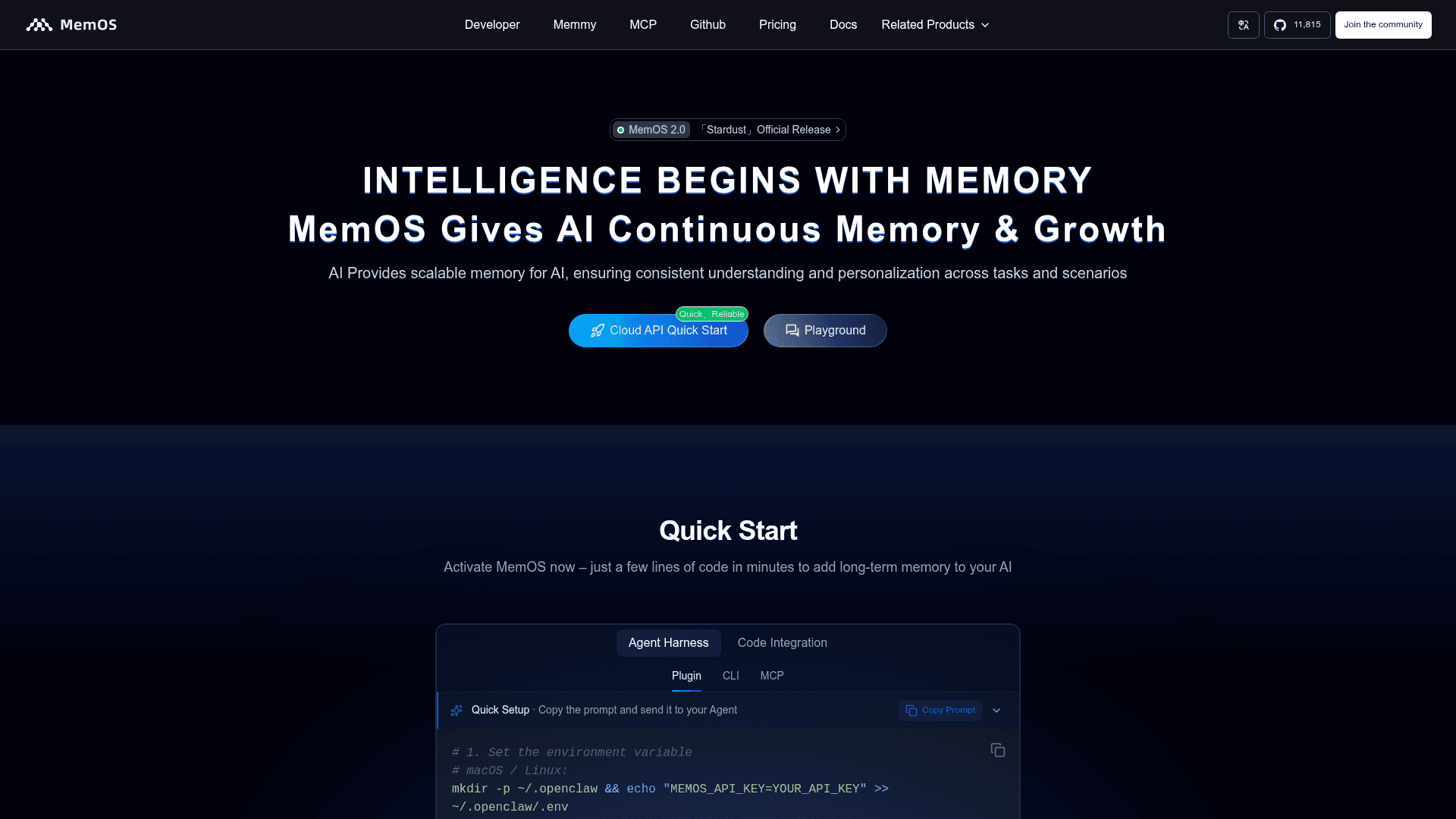
Memory operating system for LLMs and AI agents that unifies storing, retrieving and managing long-term memory via a cloud API, self-hosting, or agent plugins.
At a Glance
Great for students, devs, and POCs
Engagement
Available On
Updated Oct 2026
About MemOS
MemOS is a memory operating system for LLMs and AI agents, developed by MemTensor and released under the Apache 2.0 license. It provides a unified API to add, retrieve, edit and delete long-term memory, and is offered as a hosted cloud API, a self-hosted REST service, and plugins for agent runtimes such as OpenClaw, Hermes Agent and DeepSeek Harness. The latest GitHub release listed is v2.0.34.
What It Is
MemOS gives AI agents persistent memory so they can keep context across sessions and tasks. Memory is structured as a graph that can be inspected and edited, rather than being held as an opaque embedding store. It supports text, images, tool traces and personas, and organizes knowledge bases as composable memory cubes that can be isolated, shared or combined across users, projects and agents. Documented uses include assistants with consistent conversations, customer support that recalls past tickets, personalized agents, and multi-agent collaboration with shared or isolated memory.
Ways to Use It
- Cloud API: a fully managed service. You get an API key from the dashboard, then call add and search endpoints with user and conversation IDs.
- Self-host: run the REST service with
docker compose up, which starts the MemOS API alongside Neo4j and Qdrant. It can also run with uvicorn if those services are already running. - MemOS Cloud Plugin: installs into OpenClaw or DeepSeek Harness. It recalls memories from MemOS Cloud before each agent run and saves new messages back afterward. The DeepSeek Harness version is described as fail-open, so a cloud outage does not interrupt the current task.
- Local Plugin: keeps memory on-device in local SQLite for DeepSeek Harness, Hermes or OpenClaw. It offers hybrid retrieval (FTS5 plus vector), smart deduplication, tiered skill evolution (L1 traces, L2 policies, L3 world model), multi-agent collaboration, and a local Memory Viewer dashboard.
Architecture and Scheduling
The project describes layers for application and API access, memory scheduling, and storage. MemScheduler runs memory operations asynchronously, which MemTensor says gives millisecond-level latency under high concurrency. Predictive, intent-aware scheduling preloads relevant memory based on dialogue history or task semantics. Users can also correct memories with natural-language feedback, which can refine, supplement or replace existing entries.
Benchmarks and Ecosystem
MemTensor reports scores of 88.83 on LoCoMo and 89.20 on LongMemEval, evaluated through its OmniMemEval framework against commercial memory products. These are vendor-published figures. The vendor also lists related products built on MemOS: ClawForce, an enterprise agent platform, and Memmy, a personal memory hub. Enterprise deployment options listed include public cloud, private cloud, on-premises and hybrid.
Community Discussions
Be the first to start a conversation about MemOS
Share your experience with MemOS, ask questions, or help others learn from your insights.
Pricing
Free
Great for students, devs, and POCs
- Memory API: 50K add per month
- Memory API: 20K search per month
- Chat API: 3M input tokens per month
- Chat API: 1M output tokens per month
- Knowledge Base: Maximum supported: 10
Starter
Suitable for growing teams; currently shown as Free Now with an original price of $19
- Memory API: 600K add per month
- Memory API: 200K search per month
- Chat API: 12M input tokens per month
- Chat API: 4M output tokens per month
- Knowledge Base: Maximum supported: 30
- Storage per item: 10G
- Community support
- Currently promotional $0/month (Original $19)
Pro
Made for scaling teams; currently shown as Free Now with an original price of $286
- Memory API: 80M add per month
- Memory API: 30M search per month
- Chat API: 90M input tokens per month
- Chat API: 30M output tokens per month
- Knowledge Base: Maximum supported: 100
- Storage per item: 100G
- Dedicated support
- Currently promotional $0/month (Original $286)
Enterprise
Custom enterprise plans
- Memory API: Unlimited
- Chat API: Unlimited
- Knowledge Base: Unlimited
- Private deployment, own data
- Custom integration
- Lower latency
Capabilities
Key Features
- Unified memory API to add, retrieve, edit and delete memory
- Graph-structured, inspectable and editable memory
- Multi-modal memory (text, images, tool traces, personas)
- Multi-cube knowledge base management
- Asynchronous ingestion via MemScheduler
- Memory feedback and correction in natural language
- Predictive intent-aware memory scheduling
- Hybrid retrieval (FTS5 + vector) in local plugin
- Tiered skill evolution (L1/L2/L3)
- Local Memory Viewer dashboard
- Cloud, self-hosted and local-first deployment options
- Memory sharing or isolation between agents