
MemU
An agentic memory framework for LLMs and AI agents with persistent, self-evolving memory for proactive 24/7 autonomous agents.
At a Glance
Engagement
Available On
Alternatives
Listed Feb 2026
About MemU
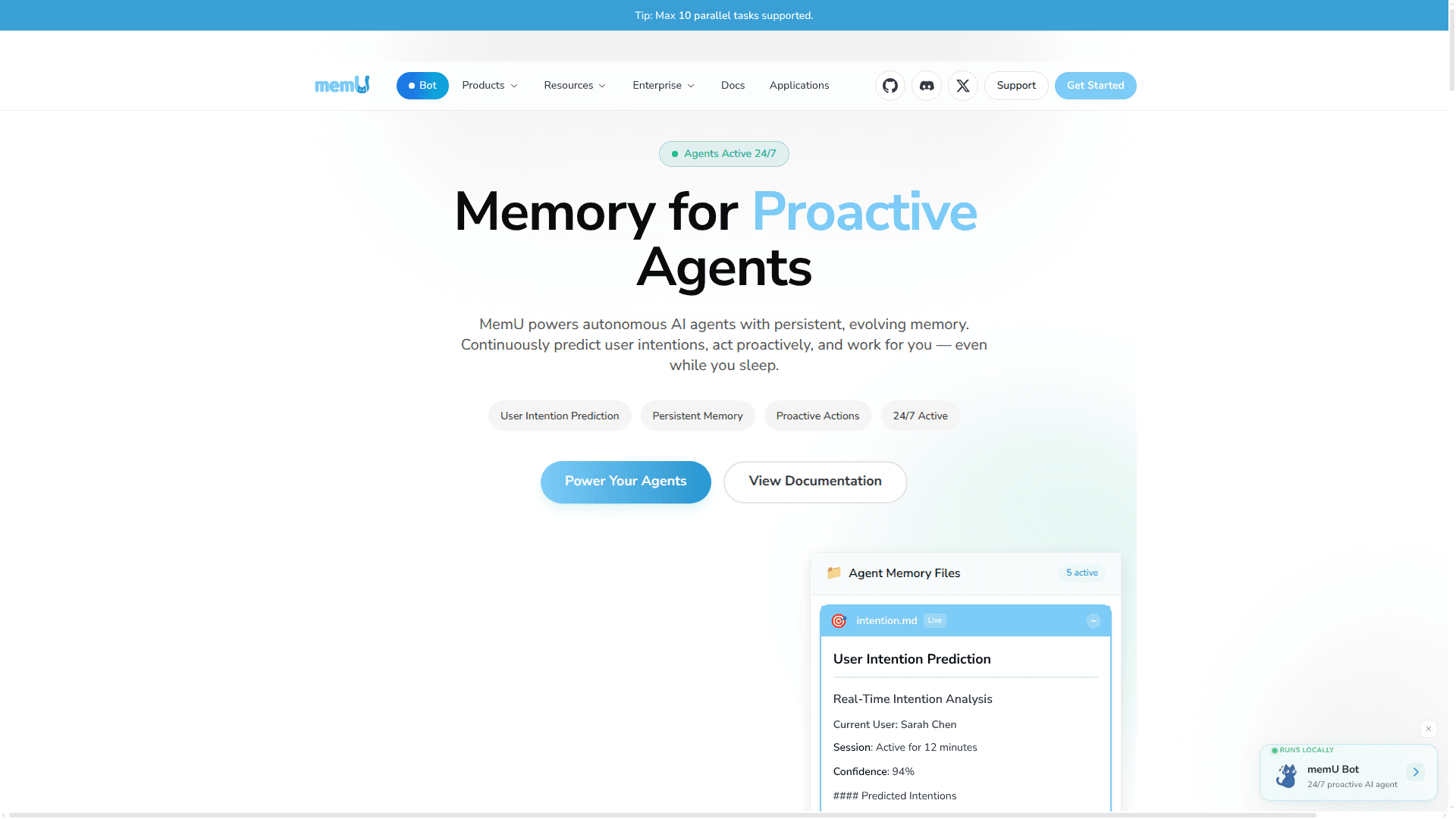
MemU is an agentic memory framework designed for LLMs and AI agents that provides persistent, self-evolving memory capabilities. It enables autonomous AI agents to continuously predict user intentions, act proactively, and work around the clock with intelligent memory management. The platform achieves 92.09% average accuracy in reasoning tasks and offers sub-50ms latency with 99.9% uptime SLA.
-
Three-Layer Memory Architecture provides a unified multimodal memory framework consisting of Resource Layer (raw data), Memory Item Layer (fine-grained memory items), and Memory Category Layer (thematic knowledge structures) with full bidirectional traceability.
-
Dual-Mode Retrieval combines embedding search for fast semantic matching with LLM-based search that allows models to directly read and interpret memory category files for richer context understanding.
-
Response API offers one API call for fully autonomous responses where agents retrieve memories, generate context-aware replies, and store new learnings automatically—perfect for 24/7 agents.
-
Memory API provides full control over agent memory with semantic search, pattern queries, and bulk operations for storing strategic insights and building agents that anticipate user needs.
-
Self-Evolution Capability enables memory structures to adapt automatically based on usage patterns and agent behavior, with intelligent forgetting mechanisms that gracefully manage memory decay.
-
Multimodal Support handles text, images, audio, and video inputs, transforming heterogeneous data into queryable, semantically interpretable textual memory.
-
Visual Memory Console allows real-time monitoring of memory health, decision tracing, and agent behavior debugging.
-
User Intention Prediction continuously infers user intentions from behavior patterns, enabling agents to know what users need before they ask.
To get started, install the Python SDK with pip install memu-py, initialize the MemuClient with your API key, and use the memorize_conversation method to store interactions. The platform integrates with OpenAI, Anthropic, Gemini, DeepSeek, Qwen, and LangGraph, with CrewAI, N8N, and Dify integrations coming soon. MemU offers both cloud-hosted and self-hosted deployment options through its open-source components including memU-server and memU-ui.
Community Discussions
Be the first to start a conversation about MemU
Share your experience with MemU, ask questions, or help others learn from your insights.
Pricing
GPT-4.1-mini
Memory model pricing for GPT-4.1-mini
- Input: $0.00040 per 1K tokens
- Output: $0.00160 per 1K tokens
DeepSeek-v3.1
Memory model pricing for DeepSeek-v3.1
- Input: $0.00055 per 1K tokens
- Output: $0.00165 per 1K tokens
Gemini-3-flash
Memory model pricing for Gemini-3-flash
- Input: $0.00050 per 1K tokens
- Output: $0.00300 per 1K tokens
Voyage 3.5 Lite Embedding
Embedding model for memory search
- $0.00002 per 1K tokens
- Used for embedding search in Memory APIs
Enterprise
Enterprise-grade AI solutions with custom development and premium support
- Commercial License
- Custom Development
- SSO/RBAC integration
- Intelligence & Analytics
- 24/7 Premium Support
- Custom SLAs
Capabilities
Key Features
- Three-layer memory architecture (Resource, Memory Item, Memory Category)
- Dual-mode retrieval (embedding search + LLM-based search)
- Response API for autonomous agent responses
- Memory API for granular memory control
- Self-evolving memory structures
- Multimodal memory support (text, image, audio, video)
- User intention prediction
- Cross-session continuity
- Proactive pattern recognition
- Visual memory console
- 24/7 always-on memory
- Intelligent forgetting mechanism
- Full bidirectional traceability
- Sub-50ms latency
- 99.9% uptime SLA
- SOC 2 compliant