
Mercury Agent
Soul-driven open-source AI agent with Second Brain memory, multi-agent orchestration, 40+ permission-hardened tools, and multi-channel access via CLI, Web, and Telegram.
At a Glance
About Mercury Agent
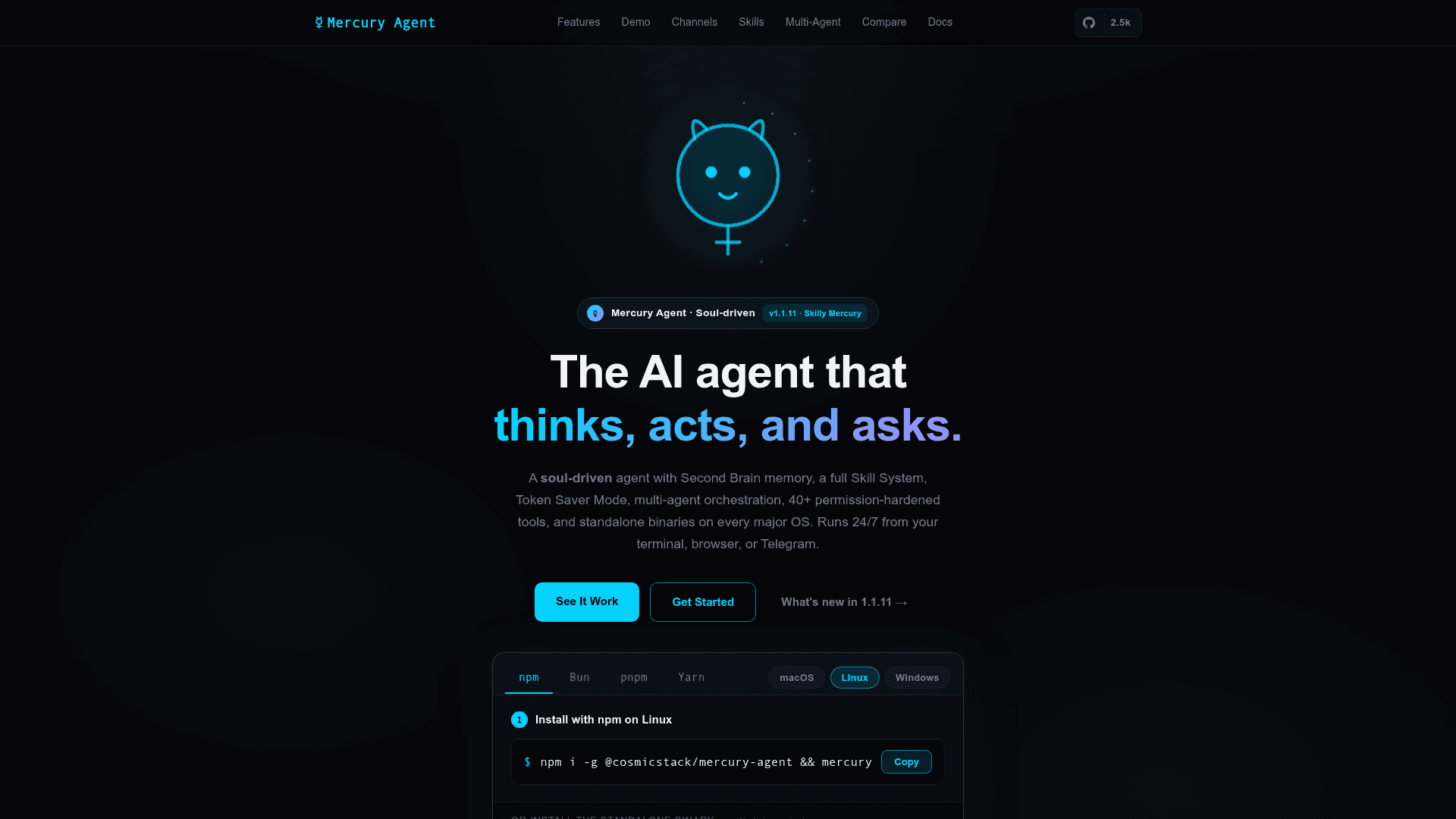
Mercury Agent is an open-source, MIT-licensed AI agent built by Cosmic Stack and published on GitHub under cosmicstack-labs/mercury-agent. It runs 24/7 from a terminal, browser dashboard, or Telegram bot, and is designed around three core principles: it thinks (orchestrates parallel sub-agents), acts (executes 40+ built-in tools), and asks (prompts for permission before any write, command, or scope change). As of the latest release, v1.1.11 ("Skilly Mercury"), the project has accumulated over 2,500 GitHub stars.
What It Is
Mercury Agent is a terminal-first, multi-channel AI agent that combines persistent memory, a skill registry, multi-agent orchestration, and a configurable permission system into a single installable binary or npm package. It targets developers and power users who want a persistent, autonomous agent that runs on their own machine without cloud lock-in. The agent's "soul" — its personality and behavior — is defined by four markdown files the user owns and edits directly.
Architecture and Deployment Model
Mercury is built in TypeScript on Node.js 18+, using the Vercel AI SDK v4 for LLM calls and grammY for Telegram integration. All persistent data — memory, schedules, Kanban boards, configuration — lives in ~/.mercury/ on the user's machine. The Second Brain uses SQLite with FTS5 full-text search; no data leaves the device. The agent can run as a foreground process, a background daemon with crash recovery, or a system service (macOS LaunchAgent, Linux systemd, Windows Task Scheduler) that starts on boot.
Two install paths are supported:
- Standalone binary — a one-line
curl | shinstaller that downloads a pre-built, SHA-256-verified binary for macOS (arm64/x64), Linux (x64/arm64), or Windows (x64); no Node.js required. - npm package —
npm i -g @cosmicstack/mercury-agentfor users already on Node.js 20+.
Three Channels, One Agent
The same agent capabilities are exposed across three interfaces:
- CLI — An Ink-based TUI with live progress views, slash command autocomplete, a Workspace IDE mode with file explorer and git panel, and keyboard shortcuts for background/foreground switching.
- Web Dashboard — A React SPA at
localhost:6174with chat (SSE streaming), Kanban boards, Second Brain visualization, provider/skill/permission management, and dark/light theme. - Telegram — A bot with a single pinned status card showing live progress, ephemeral permission prompts, file uploads, and an organization access model with admin/member roles.
Second Brain Memory System
Mercury's memory is modeled after conscious and subconscious layers. The conscious layer holds active working memory for the current session; the subconscious layer stores long-term facts extracted automatically after each conversation. Ten memory types are supported: identity, preference, goal, project, habit, decision, constraint, relationship, episode, and reflection. Conflict resolution favors higher-confidence or more recent memories. Auto-consolidation runs hourly to synthesize profile summaries and detect patterns. All data is stored locally in SQLite and never sent to a cloud service.
Skills Registry and Multi-Agent Orchestration
Mercury supports a community skill registry at skills.mercuryagent.sh, which the project describes as hosting 126+ skills across 23 categories. Skills are single-purpose markdown files installable with one command (mercury skills install <category/slug>) and can be scheduled as recurring tasks. The registry requires no authentication and supports self-hosted overrides via environment variable.
For parallel workloads, Mercury spawns sub-agents in isolated context windows with reader-writer file locks to prevent concurrent write conflicts. The Autopilot system monitors for stuck loops by analyzing parameter diversity and success rates, and can halt unproductive execution paths automatically.
Update: v1.1.11 — Skilly Mercury
The latest stable release, v1.1.11 ("Skilly Mercury"), was published on May 31, 2026. The homepage links directly to its release notes. The GitHub README also references v1.1.9 as a recent stable marker, indicating active release cadence. New provider integrations added in recent releases include ChatGPT Web (OAuth, no API key) and GitHub Copilot subscription access, which expose OpenAI, Anthropic, and Google models through existing subscriptions. The roadmap notes Google Gemini and Mistral as upcoming providers.
Community Discussions
Be the first to start a conversation about Mercury Agent
Share your experience with Mercury Agent, ask questions, or help others learn from your insights.
Pricing
Open Source
Fully free and open-source under the MIT license. Self-hosted on your own machine.
- Full agent capabilities with 40+ built-in tools
- Second Brain memory (SQLite, fully local)
- Multi-agent orchestration
- CLI, Web Dashboard, and Telegram channels
- Skills registry access (126+ community skills)
Capabilities
Key Features
- Soul-driven personality via editable markdown files (soul.md, persona.md, taste.md, heartbeat.md)
- Second Brain memory with 10 types, auto-extraction, conflict resolution, and auto-consolidation
- 40+ permission-hardened built-in tools (filesystem, shell, git, GitHub, web, Spotify)
- Multi-agent orchestration with parallel sub-agents and reader-writer file locks
- Mercury Autopilot loop detection via parameter diversity and success rate analysis
- Ask Me / Allow All permission modes with safe command whitelist
- CLI (Ink TUI), Web Dashboard (React SPA), and Telegram bot channels
- Skills registry with 126+ community skills installable via one command
- Daemon mode with crash recovery and system service (LaunchAgent, systemd, Task Scheduler)
- Token budget enforcement with daily limits, color-coded stats, and override command
- Kanban boards with agent-powered card execution and SQLite storage
- Provider fallback across DeepSeek, OpenAI, Anthropic, Grok, Ollama, ChatGPT Web, GitHub Copilot
- Standalone binaries for macOS (arm64/x64), Linux (x64/arm64), Windows (x64) — no Node.js required
- Workspace IDE mode with file explorer and git panel
- Cron-based task scheduling with per-channel routing
- Spotify integration with native playback, DJ mode, and 14 tools
- Fully local SQLite + FTS5 storage — no cloud data egress