
Meta-Harness
Framework for automated search over task-specific LLM harnesses using a coding agent with filesystem access to full execution history.
At a Glance
Meta-Harness framework and reference experiments released under the MIT License; free to use, copy, modify and distribute. External costs such as proposer agent (Claude Code) and model inference are not included.
Engagement
Available On
Listed Nov 2026
About Meta-Harness
Meta-Harness is an open-source framework from the Stanford IRIS lab for automatically searching over model harnesses: the code around a fixed base model that decides what to store, retrieve, and show while the model works. The repository contains the reusable framework, an onboarding flow for new domains, and two reference experiments from the accompanying paper.
What It Is
Meta-Harness treats harness engineering as an optimization problem. A proposer agent reads a filesystem containing the source code, scores, and execution traces of all prior candidate harnesses, then proposes a new harness. Each candidate is evaluated on held-out tasks, its logs are written back to the filesystem, and the loop repeats. The examples use Claude Code as the proposer, and the project says it can be swapped by adapting the provided wrapper scripts, which must log proposer interactions.
How the Search Loop Works
The project page contrasts this with prior text-optimization methods that compress history into summaries, scalar scores, or sliding windows. Meta-Harness instead lets the proposer inspect raw history with standard tools such as grep and cat, so it can trace failures to specific harness decisions. The authors report up to 10M tokens of diagnostic context per step.
Reference Experiments
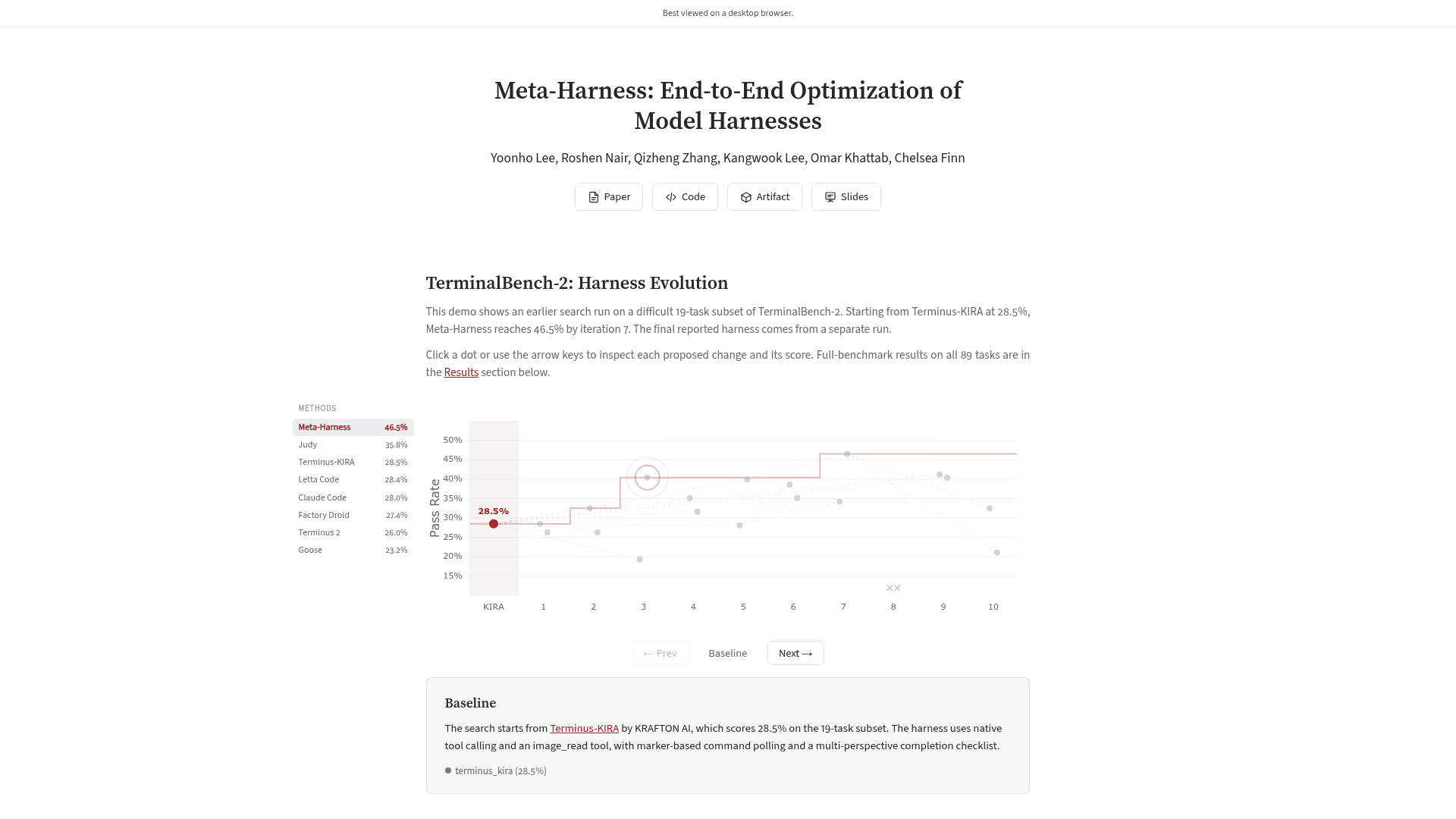
The repo includes a text classification memory-system search and a Terminal-Bench 2.0 scaffold evolution example. The authors report that on text classification, the best discovered harness reached 48.6% versus ACE's 40.9% with fewer context tokens. They also report a retrieval harness for math reasoning that improved average accuracy across five held-out models, and 76.4% on TerminalBench-2 with Claude Opus 4.6 and 37.6% with Claude Haiku 4.5. The optimized Terminal-Bench 2 harness is in a separate artifact repository.
Applying It to a New Domain
Users point a coding assistant at ONBOARDING.md and hold a conversation that produces a domain_spec.md containing an implementation and evaluation plan. Quick-start commands use uv to run the text classification and Terminal-Bench 2 examples. The authors describe the code as a cleaned-up version of the paper code that has only been verified to run.
Community Discussions
Be the first to start a conversation about Meta-Harness
Share your experience with Meta-Harness, ask questions, or help others learn from your insights.
Pricing
Open Source (MIT)
Meta-Harness framework and reference experiments released under the MIT License; free to use, copy, modify and distribute. External costs such as proposer agent (Claude Code) and model inference are not included.
- MIT License
- Reusable framework for automated search over task-specific model harnesses
- Reference experiments: text classification and Terminal-Bench 2
- Uses Claude Code as the example proposer agent (external cost)
Capabilities
Key Features
- Automated search over task-specific model harnesses
- Filesystem of prior candidates' code, traces, and scores for the proposer
- Coding-agent proposer (Claude Code by default, adaptable via wrapper)
- Text classification reference experiment
- Terminal-Bench 2.0 scaffold evolution reference experiment
- Onboarding flow producing a domain_spec.md for new domains
- MIT licensed source code