
Mnemoverse
Hosted persistent memory API for AI agents, accessible via MCP, REST and a Python SDK, with outcome feedback that re-ranks recall.
At a Glance
About Mnemoverse
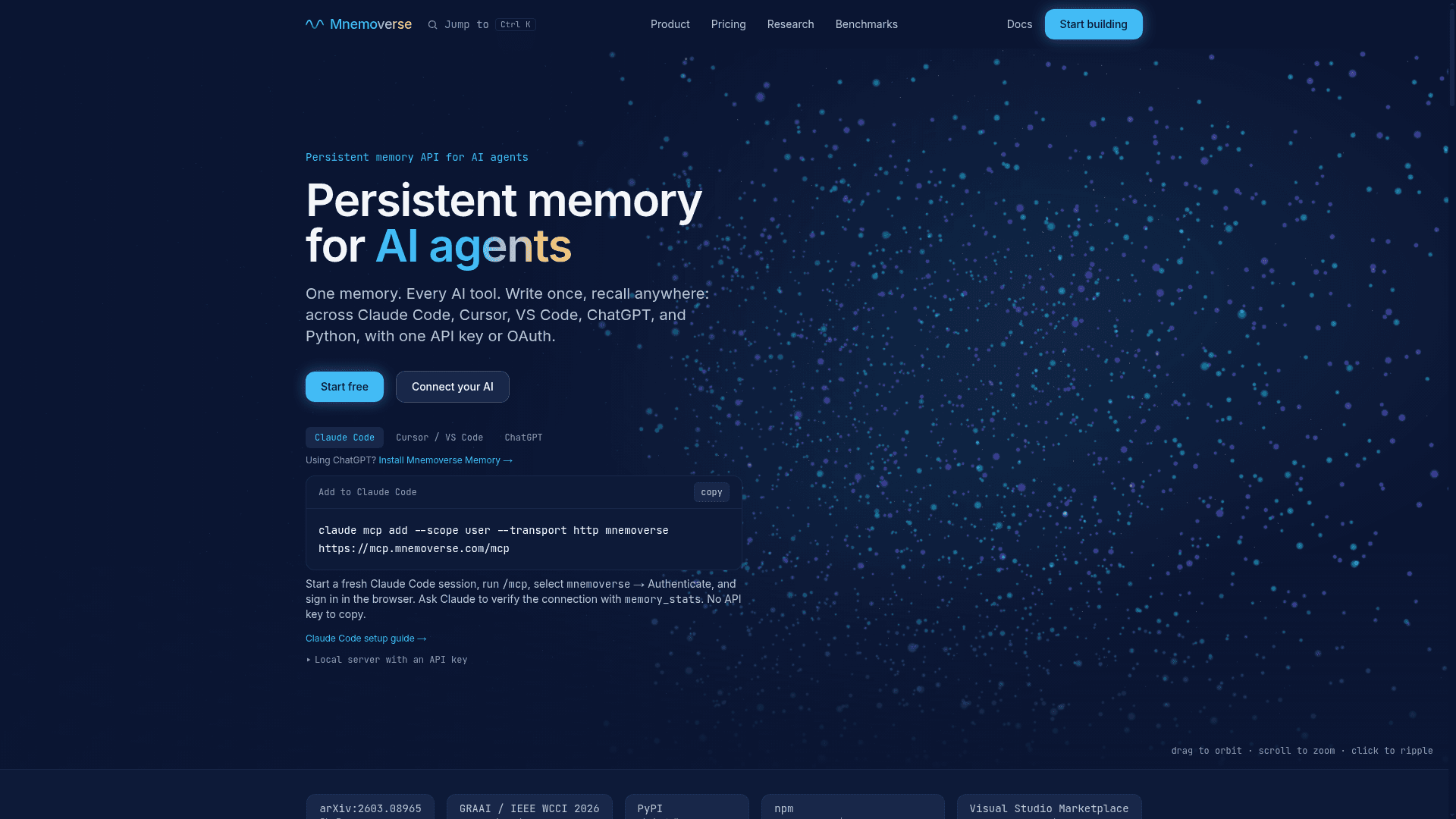
Mnemoverse is a hosted persistent memory API for AI agents. You write preferences, decisions and lessons once and recall them from Claude Code, Claude Desktop, Cursor, VS Code, Windsurf, ChatGPT, Python or any HTTP client using one API key or OAuth. Recalled memories can be rated as helpful or misleading, and that feedback re-ranks what comes back next.
What It Is
Mnemoverse is a memory layer for AI agents rather than a vector database. Memories carry concepts, and concepts recalled together form Hebbian associations. A Rescorla-Wagner-style update tunes how much each association is worth. The memory engine is a hosted service, while the client libraries (Python SDK and MCP server) are open source under MIT.
The Write, Learn, Recall Loop
The core calls are write, read and feedback. A write stores the memory with a semantic embedding and its concepts, and a write too similar to an existing memory can be refused. A read expands the query along learned associations, then applies valence-boosted ranking. Feedback is an outcome value from -1 to 1 that updates valence, so helpful memories rank higher and misleading ones rank lower. Nothing is erased. Consolidation (HDBSCAN clustering with Von Restorff protection) is built but switched off on the hosted service today.
Ways to Connect
- Hosted MCP connector at mcp.mnemoverse.com with browser sign-in, including a one-line Claude Code command.
- Local MCP server, @mnemoverse/mcp-memory-server on npm, using an API key and listed on the official MCP Registry.
- Python SDK (pip install mnemoverse) and a REST API.
- A VS Code extension and a ChatGPT plugin.
- Rooms, which are shared memory pools across accounts for teams or several agents.
Research and Evaluation
Mnemoverse says it is evaluated on the public LoCoMo and LongMemEval benchmarks, with published numbers tracing to committed run artifacts. Its SLoD paper (arXiv:2603.08965) was accepted at the GRAAI workshop (IEEE WCCI 2026); the hosted engine does not run that method yet.
Community Discussions
Be the first to start a conversation about Mnemoverse
Share your experience with Mnemoverse, ask questions, or help others learn from your insights.
Pricing
Free
Free is $0 with no card: 1,000 queries a day, 10,000 atoms and 60 requests a minute.
- 1,000 queries/day
- 10,000 atoms storage
- 60 req/min rate limit
- Full API access: write, read, feedback, stats
- MCP server included
Pro
For individual builders running memory in production.
- 50,000 queries/day
- 500,000 atoms storage
- 600 req/min rate limit
- Priority support
Team
Shared memory and management for a whole team.
- 500,000 queries/day
- 5,000,000 atoms storage
- 3,000 req/min rate limit
- Team management and shared domains
- Priority support
Enterprise
Dedicated infrastructure, compliance, and SLAs.
- Custom queries/day
- Custom atom storage
- Custom rate limits
- SSO/SAML single sign-on
- Dedicated infrastructure
- Self-hosting by agreement, for security requirements
- Audit logs, SLA, custom data residency
Capabilities
Key Features
- Persistent cross-tool memory for AI agents
- Write, read and feedback API
- Hebbian concept associations
- Outcome feedback re-ranking
- Automatic query expansion
- Hosted MCP connector with OAuth sign-in
- Local MCP server with API key
- Python SDK and REST API
- Shared rooms across accounts
- VS Code extension
- ChatGPT plugin
- Per-tenant data isolation