
Model2Vec
Open-source Python library that distills any sentence transformer into a small, fast static embedding model.
At a Glance
Model2Vec core Python package released under the MIT License; free to use, copy, modify and distribute.
Engagement
Available On
Alternatives
Listed Oct 2026
About Model2Vec
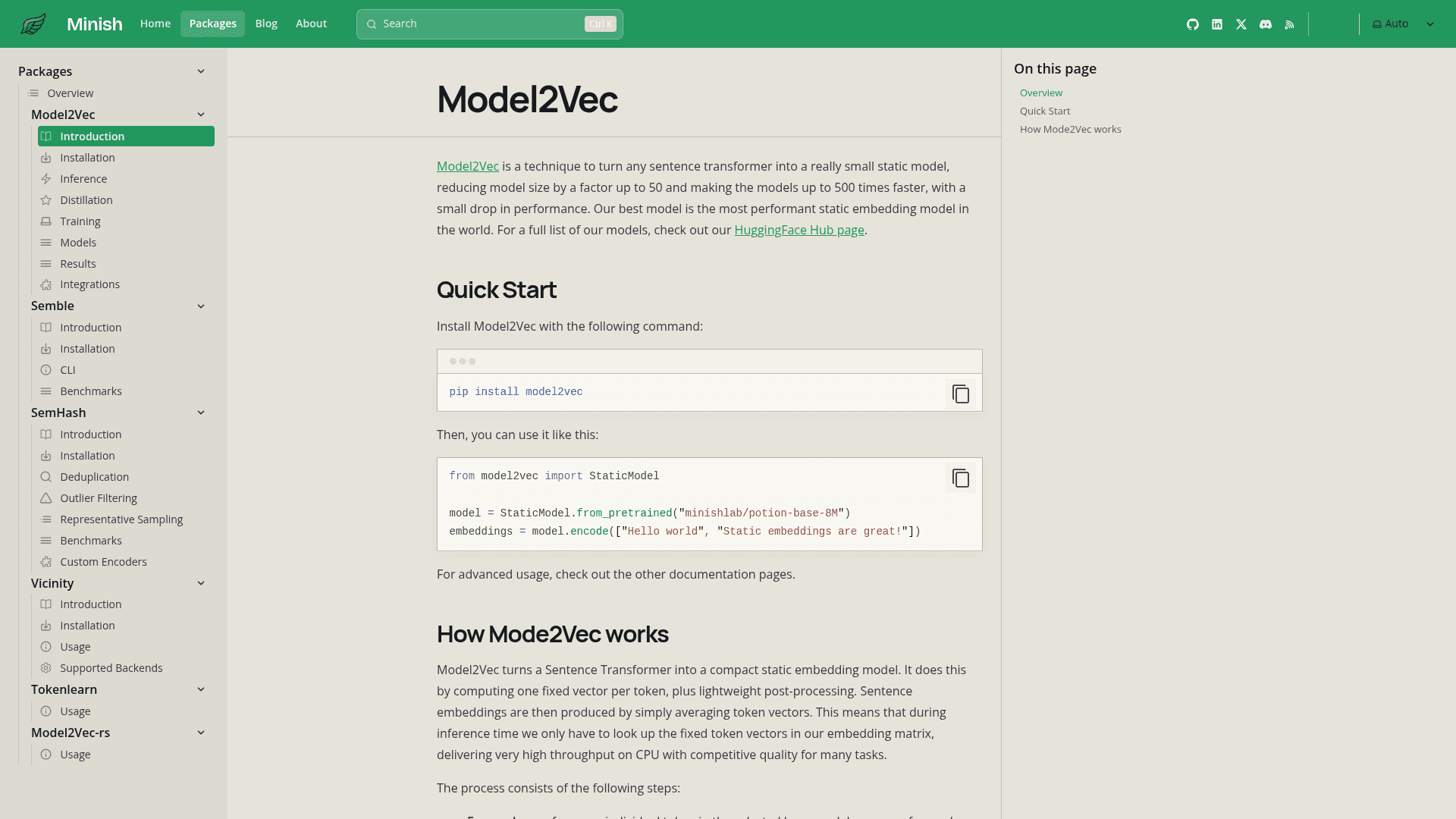
Model2Vec is an open-source Python package from MinishLab that turns a sentence transformer into a compact static embedding model. The project states it reduces model size by up to 50x and makes inference up to 500x faster, with a small drop in performance. It ships with pre-trained Potion models on the HuggingFace Hub and is released under the MIT license.
What It Is
Model2Vec is a static embedding toolkit. Instead of running a full transformer at inference time, it computes one fixed vector per token and produces sentence embeddings by averaging those token vectors. Inference is therefore a lookup into an embedding matrix, which the docs say gives high throughput on CPU. Embeddings can be used for text classification, retrieval, clustering, or RAG systems.
How Distillation Works
Distillation forward-passes the vocabulary of a chosen base model through it to create initial token embeddings. It then applies PCA for dimensionality reduction and Smooth Inverse Frequency token weighting, approximating token probabilities from vocabulary rank via Zipf's law, so no corpus is needed. Optional steps include quantization to 16-bit floats or 8-bit integers, vocabulary clustering with k-means, and pre-training with Tokenlearn, which is how the Potion models are created. The README says a model can be distilled in about 30 seconds on a CPU without a dataset.
Usage and Models
The base package installs with pip and depends mainly on numpy; extras exist for distillation and training. Users load models with StaticModel.from_pretrained and call encode or encode_as_sequence. Distilled or pre-trained models can be fine-tuned for classification, similarity, regression, or pair similarity and run without torch. Listed models include potion-base-32M, potion-base-8M, potion-retrieval-32M, potion-multilingual-128M, and potion-code-16M-v2.
Ecosystem and Integrations
Model2Vec integrates with Sentence Transformers and LangChain and works with the HuggingFace Hub for sharing and loading models. Minish also publishes related packages such as Tokenlearn, Model2Vec-rs for Rust inference, SemHash, Vicinity, and Semble.
Community Discussions
Be the first to start a conversation about Model2Vec
Share your experience with Model2Vec, ask questions, or help others learn from your insights.
Pricing
Open Source (MIT)
Model2Vec core Python package released under the MIT License; free to use, copy, modify and distribute.
- MIT License
- Install via pip install model2vec
- Distillation of your own static embedding models
- Fine-tuning for classification, similarity, regression, or pair similarity
- Pre-trained Potion models available on HuggingFace hub
Capabilities
Key Features
- Distill any sentence transformer into a static embedding model
- Dataset-free distillation in about 30 seconds on CPU
- Fast CPU inference via token vector lookup
- Optional quantization to float16 or int8
- Fine-tuning for classification, similarity, regression, and pair similarity
- Pre-trained Potion models on HuggingFace Hub
- Token sequence embeddings via encode_as_sequence
- Lightweight dependencies (numpy)