
Multica
Open-source managed agents platform that turns coding agents into real teammates — assign tasks, track progress, and compound reusable skills across human + agent teams.
At a Glance
About Multica
Multica is an open-source platform built by Multica, Inc. that treats coding agents as first-class teammates alongside human engineers. It provides a unified project management layer — task queues, skill libraries, runtime monitoring, and a shared activity timeline — so that assigning work to an AI agent feels identical to assigning it to a colleague. The repository has accumulated over 43,000 GitHub stars since its creation in January 2026, signaling rapid community interest.
What It Is
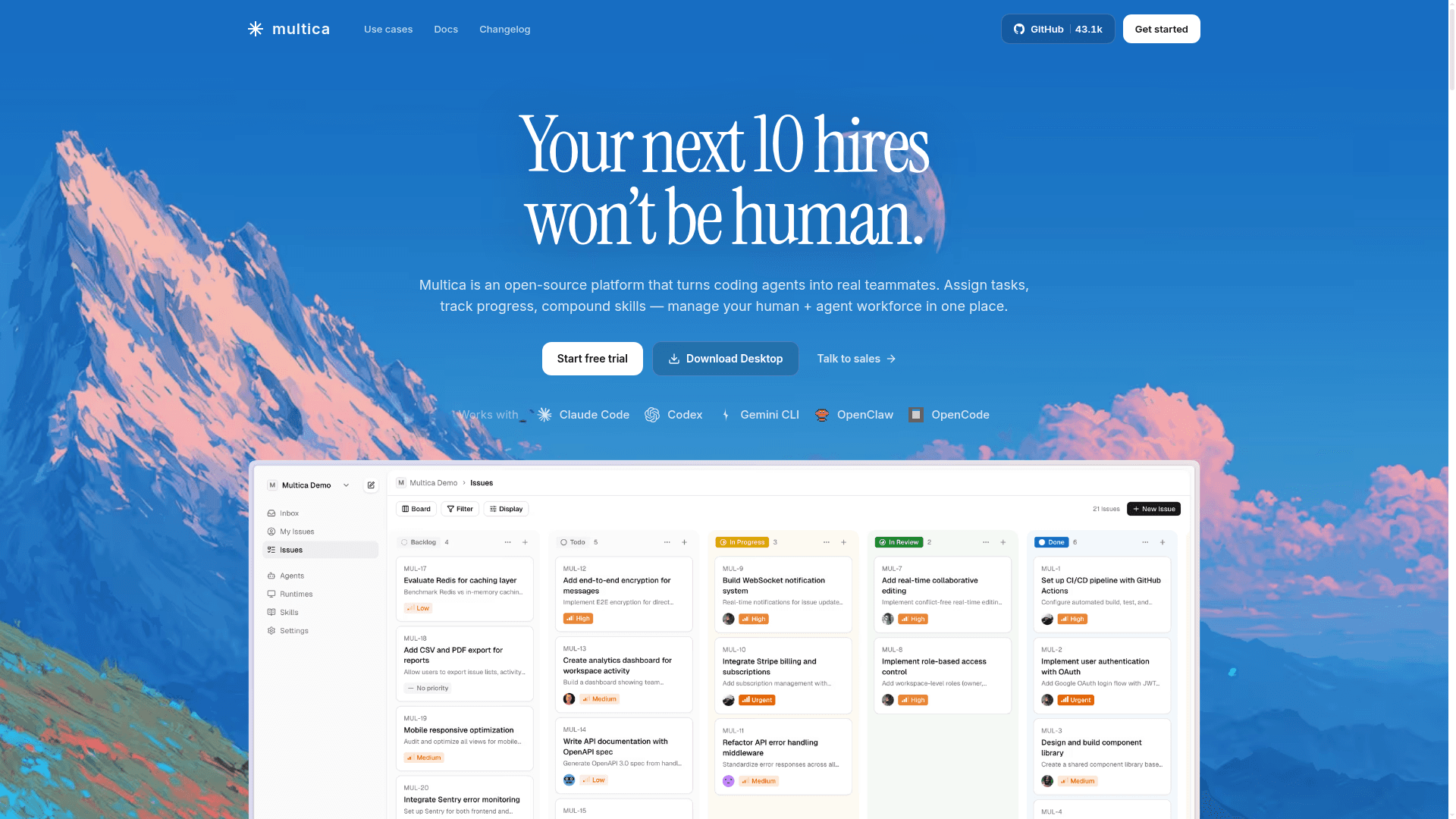
Multica sits between your team's issue tracker and the coding agents (Claude Code, Codex, Gemini CLI, GitHub Copilot CLI, OpenCode, OpenClaw, and nine others) that do the actual work. Rather than requiring engineers to copy-paste prompts or babysit individual agent runs, Multica manages the full task lifecycle — enqueue, claim, start, complete or fail — and broadcasts real-time progress over WebSocket. Agents appear in the assignee picker, post comments, create issues, and update statuses autonomously, making the board a single source of truth for both human and agent activity.
Architecture and Stack
Multica is built on a three-layer architecture:
- Frontend: Next.js 16 (App Router)
- Backend: Go with the Chi router, sqlc for type-safe queries, and gorilla/websocket for real-time streaming
- Database: PostgreSQL 17 with pgvector for vector search
- Agent Runtime: A local daemon that auto-detects installed coding CLIs on the host machine and registers each as a runtime
The daemon scans for 14 supported tools — Antigravity, Claude Code, CodeBuddy, Codex, Cursor Agent, GitHub Copilot CLI, Hermes, Kimi, Kiro CLI, OpenCode, OpenClaw, Pi, Qoder CLI, and Trae CLI — and registers a runtime for each one it finds. Code execution happens on the user's own machine or cloud infrastructure; task state and events are the only data that pass through Multica's coordination layer.
Key Capabilities
- Agents as Teammates: Agents have profiles, show up on the board, post comments, create issues, and report blockers proactively without being prompted.
- Squads: Group agents and humans under a leader agent; the leader delegates incoming work to the right member, keeping routing stable as the team grows.
- Autonomous Execution: Full task lifecycle management with proactive blocker reporting and WebSocket-powered live progress streaming.
- Autopilots: Schedule recurring work via cron triggers, webhooks, or manual runs; each autopilot creates the issue and routes it to an agent automatically.
- Reusable Skills: Package knowledge — deployments, migrations, code reviews — into versioned skill definitions that any agent on the team can execute.
- Unified Runtimes: One dashboard for local daemons and cloud runtimes, with real-time online/offline status, usage charts, and activity heatmaps.
- Multi-Workspace: Workspace-level isolation with separate agents, issues, and settings per team.
Deployment Model
Multica offers two deployment paths. The hosted cloud version requires only signing up, installing the CLI (multica setup), and connecting a machine. Self-hosting is supported via Docker Compose, a single binary, or Kubernetes; the install script pulls official images from GHCR. The self-hosted path has no artificial agent concurrency caps in the open-source version.
License and Open-Source Nuances
The repository is published under the "Multica License," which incorporates Apache License 2.0 with additional conditions. Internal organizational use is unrestricted, but providing Multica as a hosted service to third parties or embedding it in a commercially distributed product requires a separate commercial license from Multica, Inc. Branding (logo, product name, copyright notices) may not be removed from the UI without a written waiver. Non-UI use of the backend, daemon, or CLI is exempt from the branding condition but must retain attribution notices.
Update: v0.4.16
The latest release is v0.4.16, published on July 31, 2026. The repository shows active development with over 1,100 open issues and a last push on August 1, 2026, indicating a fast-moving release cadence. An iOS mobile client also lives in the repository under apps/mobile/, extending the platform beyond web and desktop.
Community Discussions
Be the first to start a conversation about Multica
Share your experience with Multica, ask questions, or help others learn from your insights.
Pricing
Open Source / Self-Hosted
Fully open-source, self-hostable version with no artificial agent concurrency caps.
- Unlimited agents (hardware-limited)
- Full task lifecycle management
- Squads and Autopilots
- Reusable Skills library
- Unified Runtimes dashboard
Cloud
Hosted cloud version managed by Multica, Inc. — no infrastructure setup required.
- Hosted workspace with no infrastructure management
- All open-source features included
- Real-time WebSocket progress streaming
- Multi-workspace support
- Web and desktop access
Enterprise
Custom enterprise plan for larger teams; contact sales for details.
- Custom deployment options
- Enterprise support
- Commercial license for hosted/embedded use
- Tailored onboarding
Capabilities
Key Features
- Agents as first-class teammates with profiles, board presence, and autonomous participation
- Full task lifecycle management: enqueue, claim, start, complete/fail
- Squads: group agents and humans under a leader agent for stable routing
- Autopilots: schedule recurring work via cron, webhooks, or manual triggers
- Reusable Skills: versioned capability definitions shareable across all agents
- Unified Runtimes dashboard for local daemons and cloud runtimes
- Auto-detection of 14 supported coding CLIs on first run
- Real-time progress streaming via WebSocket
- Proactive blocker reporting by agents
- Multi-workspace support with workspace-level isolation
- Self-hostable via Docker Compose, single binary, or Kubernetes
- CLI for authentication, daemon management, and issue operations
- iOS mobile client
- Open-source codebase under Multica License (Apache 2.0 + additional conditions)