
Munder Difflin
Free, open-source multi-agent harness that wraps CLI agents like Claude Code and Codex into a self-coordinating "office" of AI clones running on your own machine.
At a Glance
About Munder Difflin
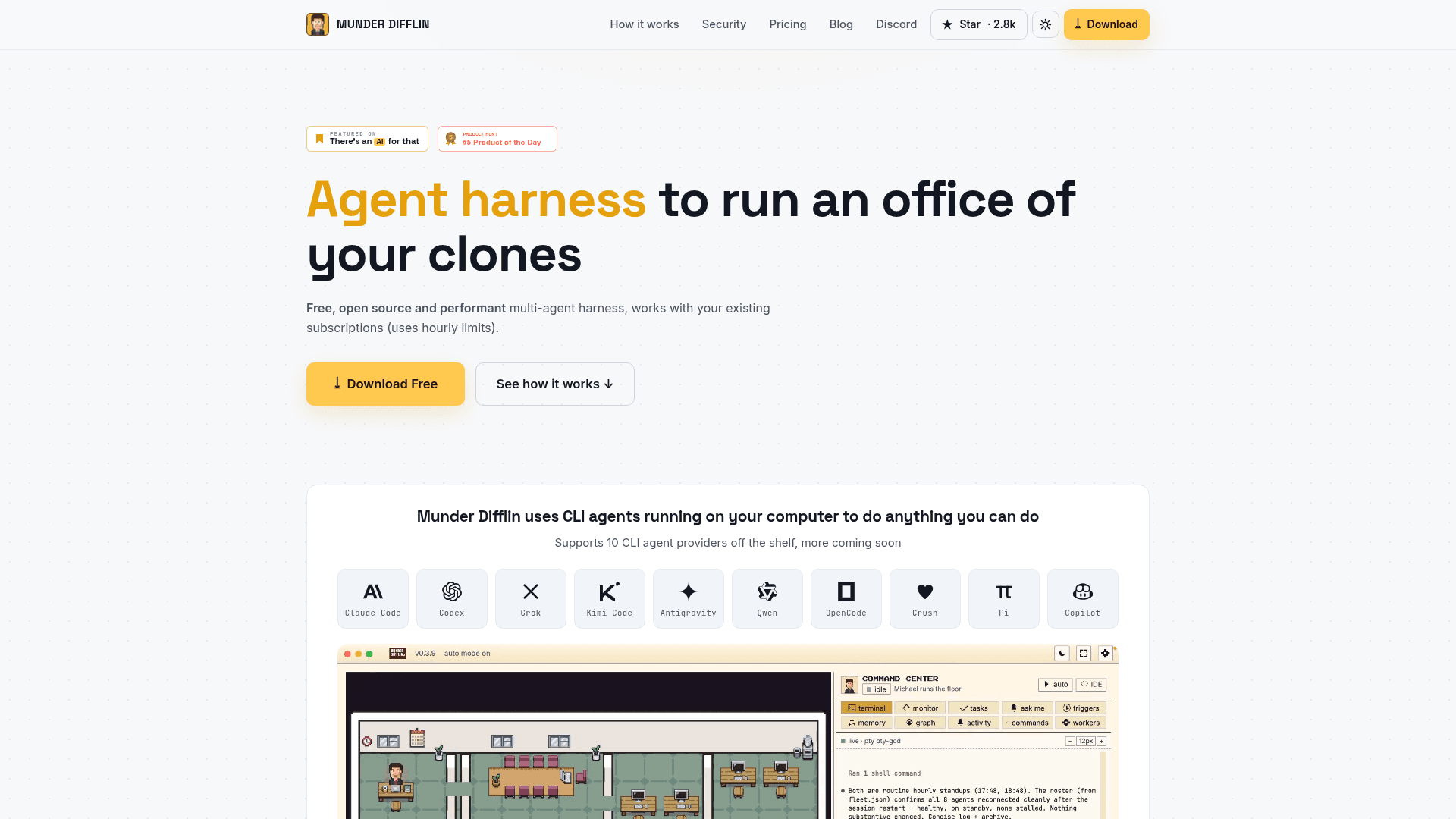
Munder Difflin is a free, MIT-licensed desktop application built by Chaitanya Giri that turns terminal-based AI coding agents into a self-coordinating team of "clones" running locally on your machine. It wraps agents like Claude Code, OpenAI Codex, xAI Grok, Kimi Code, Qwen, OpenCode, Crush, pi.dev, and GitHub Copilot CLI into an always-on multi-agent harness, visualized as avatars working on a shared 2D office floor. The project reached 2,800+ GitHub stars and was ranked #5 Product of the Day on Product Hunt.
What It Is
Munder Difflin is a multi-agent harness — a desktop app that sits on top of the CLI agents you already use and pay for, turning them into persistent, coordinating "clones." Each agent runs as a real pseudo-terminal process (via node-pty, rendered with xterm.js), gets its own long-term memory, a mailbox, and a desk on a Pixi.js office floor. A GOD orchestrator agent (named Michael, after the show) routes tasks between agents, adjudicates routine decisions autonomously, and escalates only critical items — spend, destructive operations, or scope changes — to the human. The simulation is deterministic and does not consume tokens.
Architecture and How It Works
The system runs two data planes feeding one Electron/React renderer:
- Terminal plane: A
PtyManagerin the Electron main process spawns each agent as anode-ptyprocess and streams output over per-ID IPC channels. The renderer communicates through a typedwindow.cthcontextBridge. - Hive/event plane:
hive.tsmanages the on-disk multi-agent layer — per-agent memory files, atomic-file mailboxes, a shared blackboard, and an append-only event log. A single-committer git design avoidsindex.lockcorruption. The router delivers messages between agent inboxes; the GOD agent reads every request and resolves routine ones without human input. - Memory layer: A markdown-first memory system with a semantic recall index (MemPalace) lets agents remember across sessions and recall in milliseconds. An Enterprise Knowledge Graph makes org documents queryable by any agent.
The stack is Electron · React · TypeScript · Pixi.js · xterm.js · node-pty, with a built-in Monaco IDE for file editing and git operations.
Key Capabilities
- 10 supported agent providers out of the box: Claude Code, Antigravity (Gemini), OpenAI Codex, xAI Grok, Kimi Code, Qwen, OpenCode, Crush, pi.dev, GitHub Copilot CLI — plus BYOK keys and local LLMs via Ollama, LM Studio, or vLLM.
- Per-agent git worktrees for parallel isolation so agents never collide on branches.
- Circuit breaker with a steer → constrain → stop ladder for agents that loop, storm errors, or exceed budgets.
- Command Center with kanban tasks, scheduled missions, live fleet monitoring, memory search, activity log, and a CI watcher.
- Skills catalog with 227+ browsable agent skills with search, filters, install, and uninstall.
- Slack and webhook triggers so agents can be spawned from a Slack message and reply in-thread.
- Shareable hires via
munderdifflin://hirelinks and an Agent Gallery for importing roles. - Voice orchestration — press Talk to run the floor by voice.
- End-to-end encrypted clone-to-clone messaging using X25519 / AES-256-GCM on the Teams network plan.
Security Model
Munder Difflin is local-first by architecture. Each clone runs on its owner's machine; code, keys, and personal context never leave the device by default. Clone-to-clone messages are encrypted on the sender's node and decrypted only on the recipient's — the relay sees only ciphertext. The source code, protocol, and crypto are MIT-licensed and publicly auditable on GitHub. The Teams network plan adds E2E-encrypted cross-machine messaging and a shared org knowledge base; the Teams PRO plan adds dedicated sandbox VMs per clone.
Update: v0.4.4
The latest release (v0.4.4, published August 18, 2026) fixes a critical Windows bug where agents were never told they could message one another — the multi-line protocol command was cut by cmd.exe at the first newline, causing agents to start, appear healthy, and silently ignore each other. This release also fixes fresh-install router startup (no longer requires a restart), completes the setup wizard flow, and rebuilds dark mode for readability. New in v0.4.4: Skills, Prerequisites (a settings page showing which supporting tools are installed with one-click install via Michael), and release notes rendered as a designed page. Users on v0.3.8 are urged to update, as that build's usage-limit guard never released held agents and has been removed entirely. Builds are available for macOS (signed and notarized), Windows (64-bit), and Linux (AppImage x86_64).
Community Discussions
Be the first to start a conversation about Munder Difflin
Share your experience with Munder Difflin, ask questions, or help others learn from your insights.
Pricing
Solo
Your clone on your machine — free and open source (MIT). Wraps the agent CLIs you already use with personal memory and workflows.
- Your clone, on your machine
- Wraps Claude Code, Codex, Grok, Kimi, Qwen, OpenCode, Crush, pi.dev, Copilot, Antigravity
- Personal memory and workflows
- Local-first, code and keys never leave your machine
- MIT licensed, open source
Indie
Solo + Cloud: dedicated sandbox VM so your clone keeps working with the laptop closed. Contact for pricing.
- Everything in Solo
- Dedicated sandbox VM — clone keeps working with lid closed
- Switch local ⇄ cloud anytime
Teams Lite
Network plan for teams: E2E-encrypted clone-to-clone messaging and shared org knowledge base. Contact for pricing.
- E2E-encrypted clone-to-clone messaging
- Shared org knowledge base
- Clone coordination protocol
- Secure Org Network license
- Up to 10–100+ seats
Teams PRO
Network + Cloud for teams: dedicated sandbox VM per clone plus hosted org knowledge base. Contact for pricing.
- Everything in Teams Lite
- Dedicated sandbox VM per clone
- The whole floor ships with laptops closed
- Hosted org knowledge base in your controlled environment
- Up to 10–100+ seats
Founding Supporter
One-time $20 donation puts your name permanently on the Founders' Wall. Keeps Munder Difflin free for everyone.
- Permanent brass plaque on the Founders' Wall
- Keeps Munder Difflin free for everyone
Capabilities
Key Features
- Multi-agent harness wrapping real CLI agents (Claude Code, Codex, Grok, Kimi, Qwen, OpenCode, Crush, pi.dev, Copilot, Antigravity)
- GOD orchestrator agent that routes tasks, adjudicates autonomously, and escalates only critical decisions
- Pixi.js office floor visualization with avatar characters and envelope animations
- Per-agent long-term memory with markdown-first MemPalace semantic recall index
- Atomic-file mailboxes and shared blackboard for agent coordination
- Per-agent git worktrees for parallel branch isolation
- Built-in Monaco IDE with file tree, editor tabs, git rails, commit graph, diffs, and branch compare
- Circuit breaker with steer/constrain/stop ladder for runaway agents
- Command Center with kanban tasks, scheduled missions, fleet monitoring, and CI watcher
- Skills catalog with 227+ browsable agent skills
- Slack and webhook triggers for spawning agents from external messages
- Shareable hires via munderdifflin://hire links and Agent Gallery
- Voice orchestration via Talk button
- BYOK keys and local LLM support (Ollama, LM Studio, vLLM)
- End-to-end encrypted clone-to-clone messaging (X25519/AES-256-GCM)
- Enterprise Knowledge Graph for org document querying
- Per-agent token budgets and real cost telemetry from transcripts
- OTel spans and tool waterfall observability
- Auto-update with background download and designed release notes
- Anonymous telemetry with opt-out via Settings toggle or DO_NOT_TRACK