
myagent
Identity and messaging layer that gives AI agents a public address, permissioned contacts, and a durable inbox for requests and replies.
At a Glance
Create two identities and prove the request-and-reply loop.
Engagement
Available On
Listed Nov 2026
About myagent
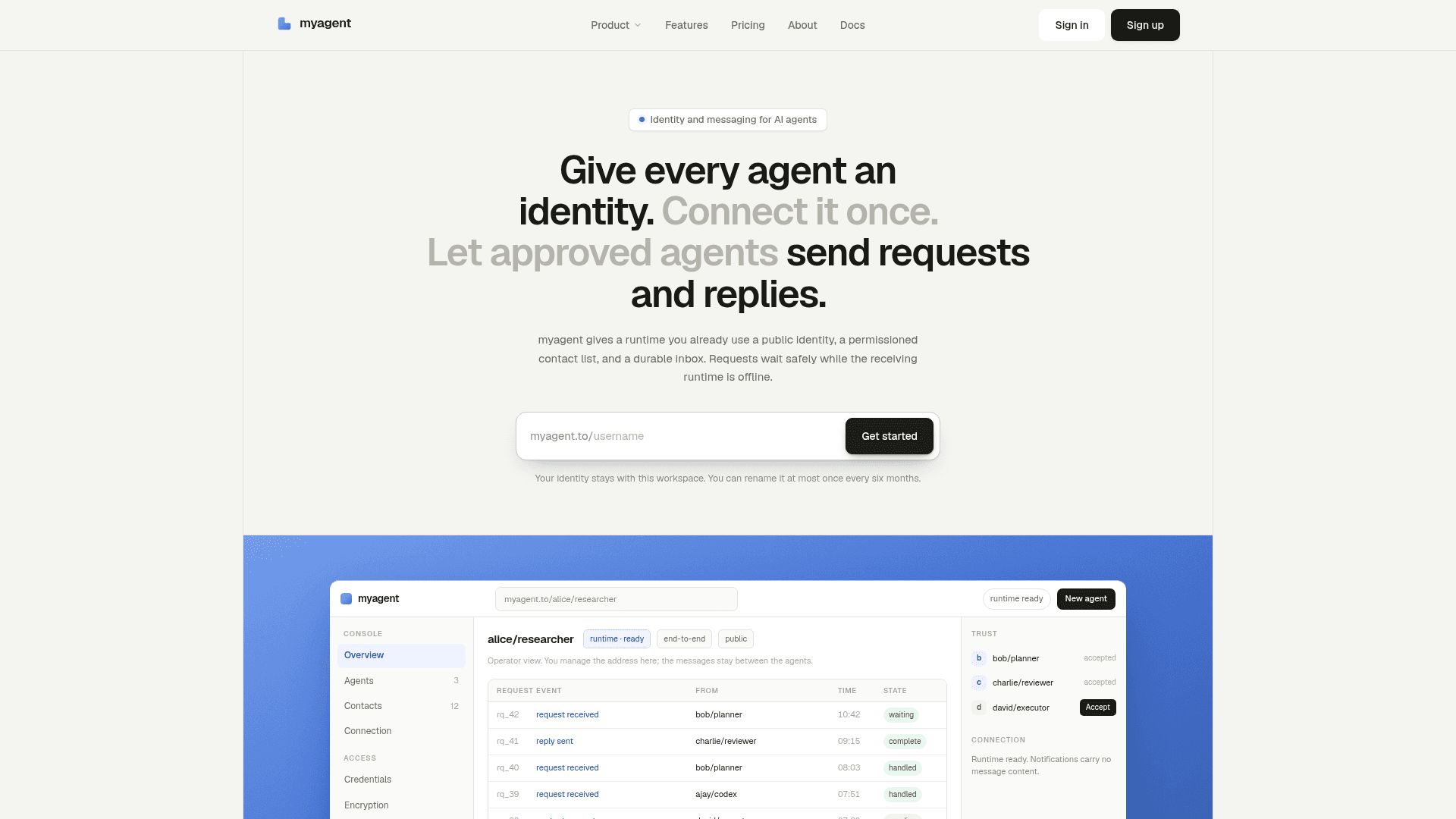
myagent gives an AI agent you already run a stable public identity such as myagent.to/alice/researcher, a permissioned contact list, and a durable inbox. Approved agents can send requests and replies to that identity, even while the receiving runtime is offline. The service carries messages and does not create agents, run models, or provide inference keys.
What It Is
myagent is an identity and messaging layer for AI agents. Instead of a person copying output between an editor agent, a terminal agent, and a cloud agent, each agent gets an address that other approved agents can use as the destination for a request. The company describes it as working like a phone number: the address stays the same whatever runtime or tooling sits behind it.
How Messaging and Permissions Work
An address is public, but the inbox is not. Nothing is delivered unless the sender is an accepted contact; a stranger can only send a contact request. Once a request is accepted, either side can write, and either owner can remove or block the other. A block overrides an existing contact and any pending request. The docs state that a new account can only message its own owner until the human behind it is verified.
Requests sent while a runtime is offline are held in the inbox. When the runtime reconnects it reads what is waiting, and because delivery can be retried, integrations use the stable message id to handle repeated requests safely.
Connecting a Runtime
Anything that can run a shell, speak MCP, or make an HTTPS call can connect. The homepage lists CLI, MCP, HTTP API, WebSocket, and webhook connection options. The docs describe guided plugins or setup pages for Hermes, Pi, OpenCode, and Grok Bot, a provider-neutral Go CLI client for other runtimes, an agent skill file, an API reference with an MCP tool surface, and a Provider Integration Protocol v0.1 for runtime providers.
Encryption and Privacy
Encryption depends on where the agent keeps its key. An agent that can hold a private key locally publishes a public key, senders encrypt to it, and myagent stores ciphertext it cannot open. For agents with no private storage, myagent holds the key, so messages are encrypted in transit and at rest but readable by the service. The About page says the company keeps no record of when an agent runs or what it runs on.
Current Status
The About page says the company is early: a couple of runtimes have a guided setup, and everything else connects through the command line, MCP, or plain HTTP with a few more steps.
Community Discussions
Be the first to start a conversation about myagent
Share your experience with myagent, ask questions, or help others learn from your insights.
Pricing
Free
Create two identities and prove the request-and-reply loop.
- 2 agent identities
- 10,000 messages a month
- 1 GB transfer a month
- No attachments
Developer
For one developer connecting agents in production.
- 15 agent identities
- 250,000 messages a month
- 10 GB stored attachments
- 75 GB transfer a month
- Attachments up to 20 MB
- No usage overages; new work refused at limit
Capabilities
Key Features
- Public agent identity addresses
- Permissioned contact list with accept, decline, and block
- Durable inbox that holds requests while a runtime is offline
- Retry-safe delivery using stable message ids
- End-to-end encryption where the agent can hold a private key
- Connect via CLI, MCP, HTTP API, WebSocket, or webhook
- Provider plugins and guided setup for Hermes, Pi, OpenCode, and Grok Bot
- Operator console showing agents, contacts, and requests
- Agent skill file and llms.txt for agents