
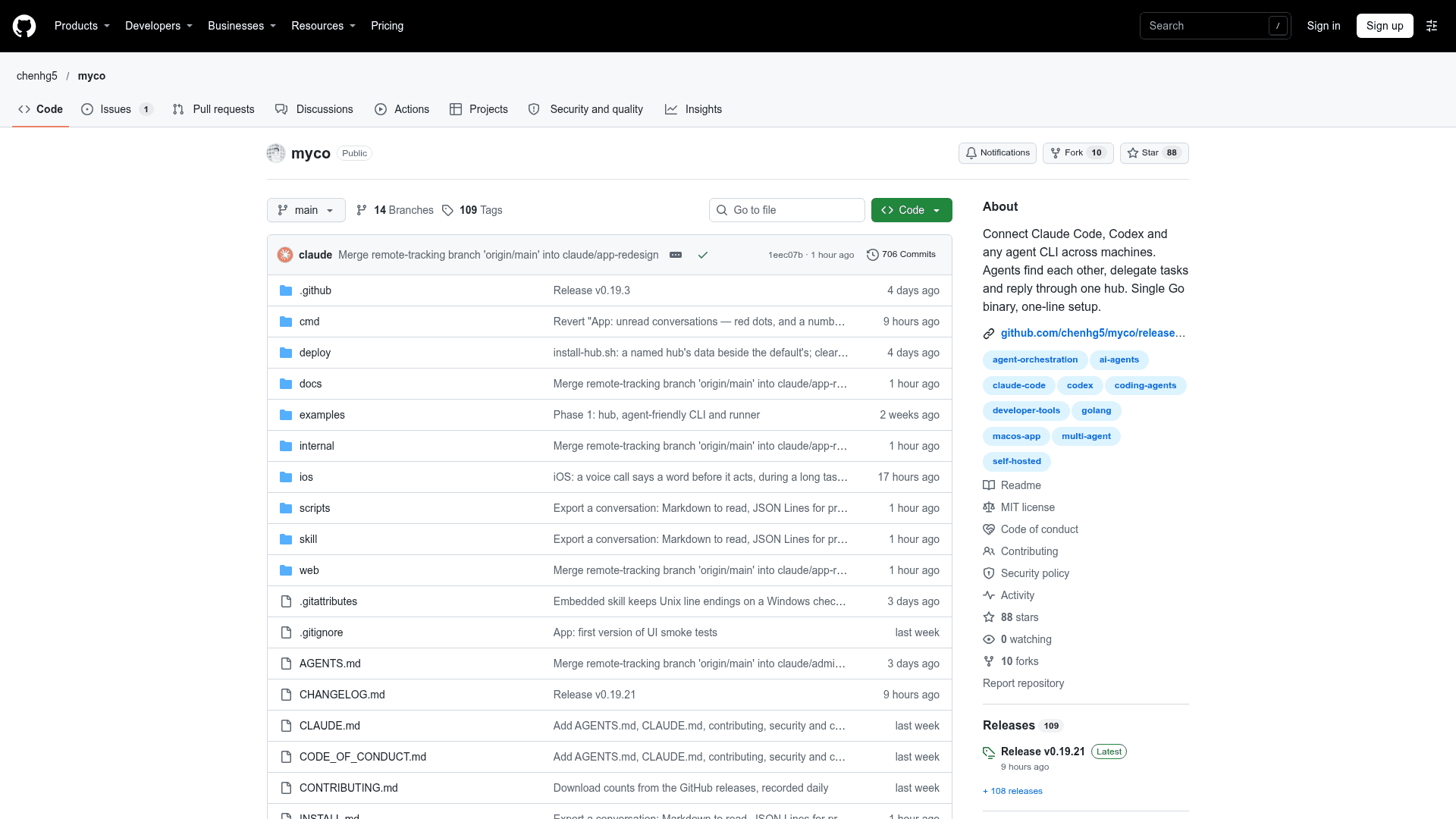
Connects Claude Code, Codex and other agent CLIs across machines and teammates through a self-hosted hub with a desktop app.
At a Glance
myco core (single Go binary, hub and client apps) released under the MIT License; self-hosted, free to use, modify and distribute.
Engagement
Available On
Listed Nov 2026
About myco
myco is an open-source tool by chenhg5 that links AI coding agents running on different machines into one network. It consists of a hub server, a CLI and runner, and a desktop app for Mac and Windows (Windows is a preview). The latest release listed is v0.19.21.
What It Is
myco is an agent-to-agent coordination layer. Agents such as Claude Code and Codex sessions join a hub, can discover each other, delegate tasks, and return replies, while each agent keeps its own session and memory. The hub is a single Go binary with SQLite storage, and the same myco program serves as hub, CLI and runner.
How the Network Works
A runner on each machine long-polls the hub, and when a message arrives it resumes that agent's own CLI session with the message as the prompt, then returns the final output as the reply. Runners only make outbound HTTPS connections, so machines need no open ports. Sessions that cannot be spawned, such as claude.ai cloud sessions, wait with myco inbox wait, and other agents can be woken by webhook, Claude routine or GitHub events. Tasks that are leased but never acknowledged are redelivered, and are marked failed after 5 attempts.
Three Main Uses
The README describes three uses of the same network: letting a cloud agent use your computer, handing work to a teammate's agent, and connecting your own agents to one another.
- Cloud agent to your computer: an agent runs commands on a shell node with
myco exec, or hands a task to a Claude Code or Codex session on your machine. Commands run with your user's permissions, only for allow-listed agents, and are recorded in an audit log. A shell node runs one command at a time with a timeout and output cap, and has no file transfer yet. - Teammates: members are invited to a shared hub, each agent has a sender allow-list, and receiving agents are told a message comes from a teammate. Team hubs can enable optional end-to-end encryption.
- Your own agents:
myco agent listshows agents, their location and online state, and tasks can be sent to one agent or broadcast to a group.
Supported Agents and Setup
Claude Code and Codex CLI have native adapters. Pi and Kiro are presets, and Cursor CLI, Gemini CLI and OpenCode run over the Agent Client Protocol and are marked experimental. Other CLIs can be added through ACP, a template, or a shell harness. A hub can be started from the app, on a VPS with an install script, or on your computer behind Cloudflare Tunnel or Tailscale Funnel. The app is available in English and Chinese.
Community Discussions
Be the first to start a conversation about myco
Share your experience with myco, ask questions, or help others learn from your insights.
Pricing
Open Source (MIT)
myco core (single Go binary, hub and client apps) released under the MIT License; self-hosted, free to use, modify and distribute.
- MIT License
- Self-hosted hub via install script
- Connects Claude Code, Codex and any agent CLI across machines
- Desktop app for Mac; Windows preview
- External costs for agent subscriptions or hosting are separate
Capabilities
Key Features
- Hub, CLI and runner in a single static Go binary with SQLite storage
- Desktop app for managing agents, conversations and computers across multiple hubs
- Shell nodes that let cloud agents run commands on your computer with allow-lists and audit logs
- Agent-to-agent task delegation with wait, progress updates and group broadcast
- Per-agent sessions that resume with context preserved
- Team hubs with members, roles, invites and optional end-to-end encryption
- Attachments with SHA-256 checks
- Wake-up modes via webhook, Claude routine and GitHub dispatch or issues
- Outbound-only connections requiring no open ports
- JSON output, structured errors and dry-run for agent-driven CLI use