
NanoJev
An open-source 0.6B parallel decision model that returns probability distributions over candidate choices without decoding output tokens.
At a Glance
Free to use, modify, and distribute under the MIT License; model and dataset are public and downloadable without signing in.
Engagement
Available On
Listed Oct 2026
About NanoJev
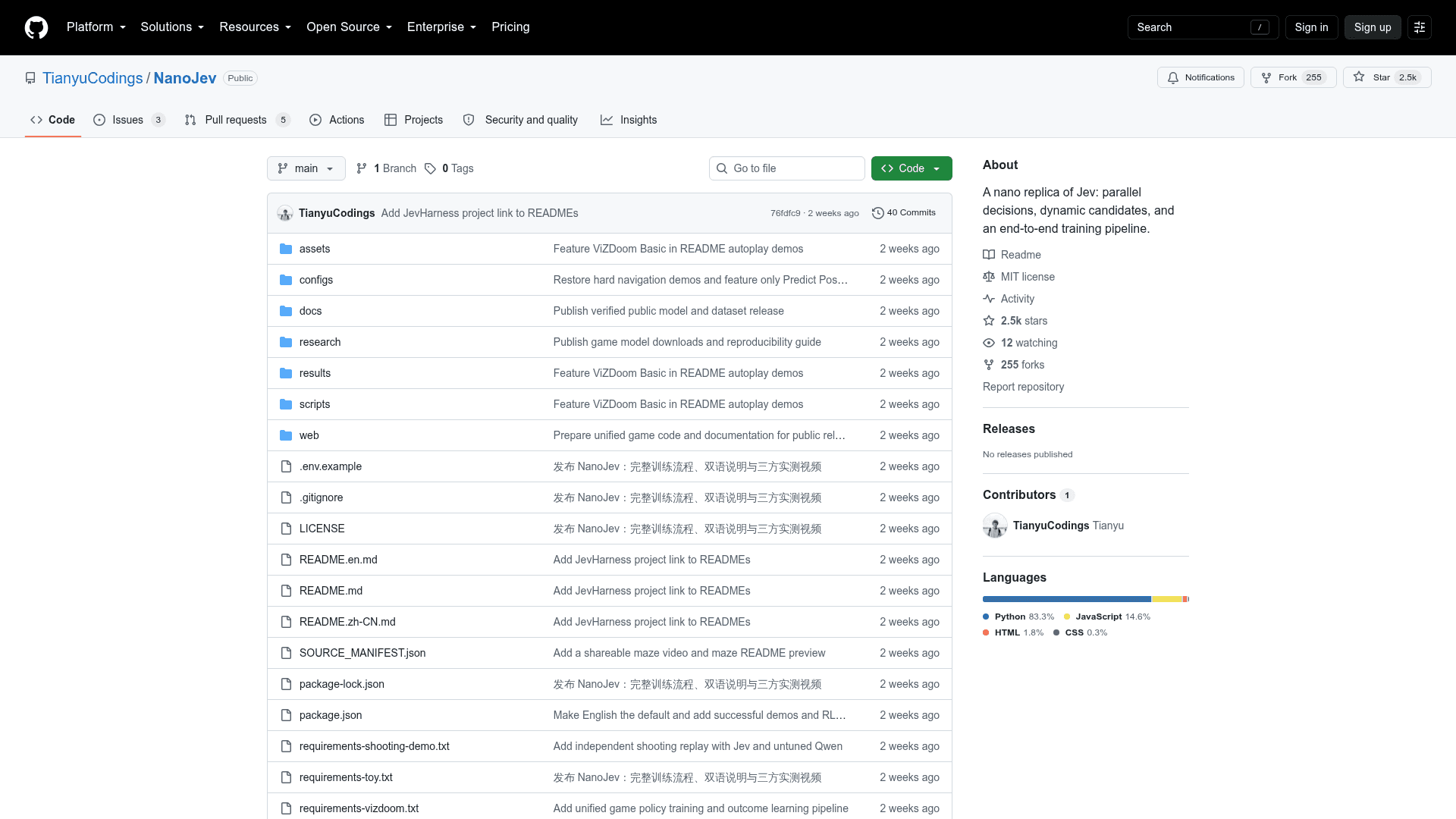
NanoJev is an open-source project by TianyuCodings, described in its README as a nano replica of Jev. It is a 0.6B parallel decision model that takes states and questions and returns complete probability distributions, with no output-token decoding. The repository is MIT-licensed, written in Python, and ships a checkpoint, a dataset, and a local inference service.
What It Is
NanoJev is a small decision model built on a Qwen3-0.6B backbone with decision heads. Each request supplies a state, a question and its candidates. The backbone encodes the candidate paths, and shared heads produce the requested probabilities. Per the README, Choice uses set attention and a softmax, Boolean uses a sigmoid, and Score returns a probability-weighted level.
How Parallel Decisions Work
The README lists these capabilities:
- Batch independent states, questions and candidate paths in a single backbone forward pass.
- Choice returns a distribution over 2-255 supplied candidates using a shared scoring head.
- Boolean predicts a proposition's probability, and Score gives a distribution and expectation over 2-10 ordered levels.
- Probabilities can be used directly to rank, select or sample actions.
Gameplay Results and Demos
The project demonstrates one shared checkpoint across four game tasks: Maze, Snake, ViZDoom Basic and ViZDoom Predict Position. On the 274-case test set, the README reports 128/128 successes on ViZDoom Basic, 27/128 on Predict Position, 4/10 on Maze and 8/8 on Snake. It compares these with Jev and untuned Qwen3-0.6B. The README states that its 50x50 maze demo reaches the exit in 225 attempts. These are the author's reported figures. Browser replays can also be run locally.
Dataset and Training Release
The README says the dataset has 18,760 decision questions per target variant, including 16,333 ViZDoom questions, split across train, dev, calibration, test and OOD. It also includes 896 Predict Position expert episodes with 17,498 recorded decisions. The release tag unified-games-v1 packages the step-400 checkpoint from the hard_lr1e5 training run. The model and dataset are hosted on Hugging Face and can be downloaded without signing in. Training mixes the four tasks with weights of 1/3, 1/3, 1/6 and 1/6.
Setup Path
Users clone the repository, install the requirements, and download the checkpoint and data with huggingface_hub. A CUDA environment is needed to run the inference service, which loads the model once and accepts state and question batches over a local HTTP evaluate endpoint. The recorded games can be explored through a local static web server.
Current Status
The README's roadmap marks the unified checkpoint, long Snake and 50x50 Maze demos, and mixed-task SFT as complete. Planned items include RLCD post-training, shared-prefix inference with larger candidate batches, and broader shooting scenarios. The README also points to a related project, JevHarness.
Community Discussions
Be the first to start a conversation about NanoJev
Share your experience with NanoJev, ask questions, or help others learn from your insights.
Pricing
Open Source (MIT)
Free to use, modify, and distribute under the MIT License; model and dataset are public and downloadable without signing in.
- Qwen3-0.6B backbone with decision heads
- Parallel decisions with dynamic candidates (2–255 candidates for Choice)
- Boolean and ordered scores (2–10 levels)
- Persistent inference service with POST /api/evaluate
- Public model and dataset on Hugging Face
Capabilities
Key Features
- Parallel batched decisions in one backbone forward
- Dynamic Choice over 2-255 candidates
- Boolean and ordered Score outputs
- Zero output-token decoding
- Qwen3-0.6B backbone with decision heads
- Persistent local inference service with HTTP evaluate endpoint
- Public model and dataset on Hugging Face
- Browser replays of Maze, Snake and ViZDoom tasks