
Nexent
Open-source zero-code platform for generating AI agents from natural language, with built-in tools, skills, memory, and orchestration.
At a Glance
Self-hosted Nexent core platform under the MIT License, deployable via Docker or Kubernetes.
Engagement
Available On
Listed Nov 2026
About Nexent
Nexent is an open-source platform from ModelEngine-Group for building AI agents without code. Users describe what they want in natural language, and the platform generates an executable agent with tools, skills, memory, and orchestration. It can be self-hosted with Docker or Kubernetes and is released under the MIT License. The latest release listed is v2.7.0.
What It Is
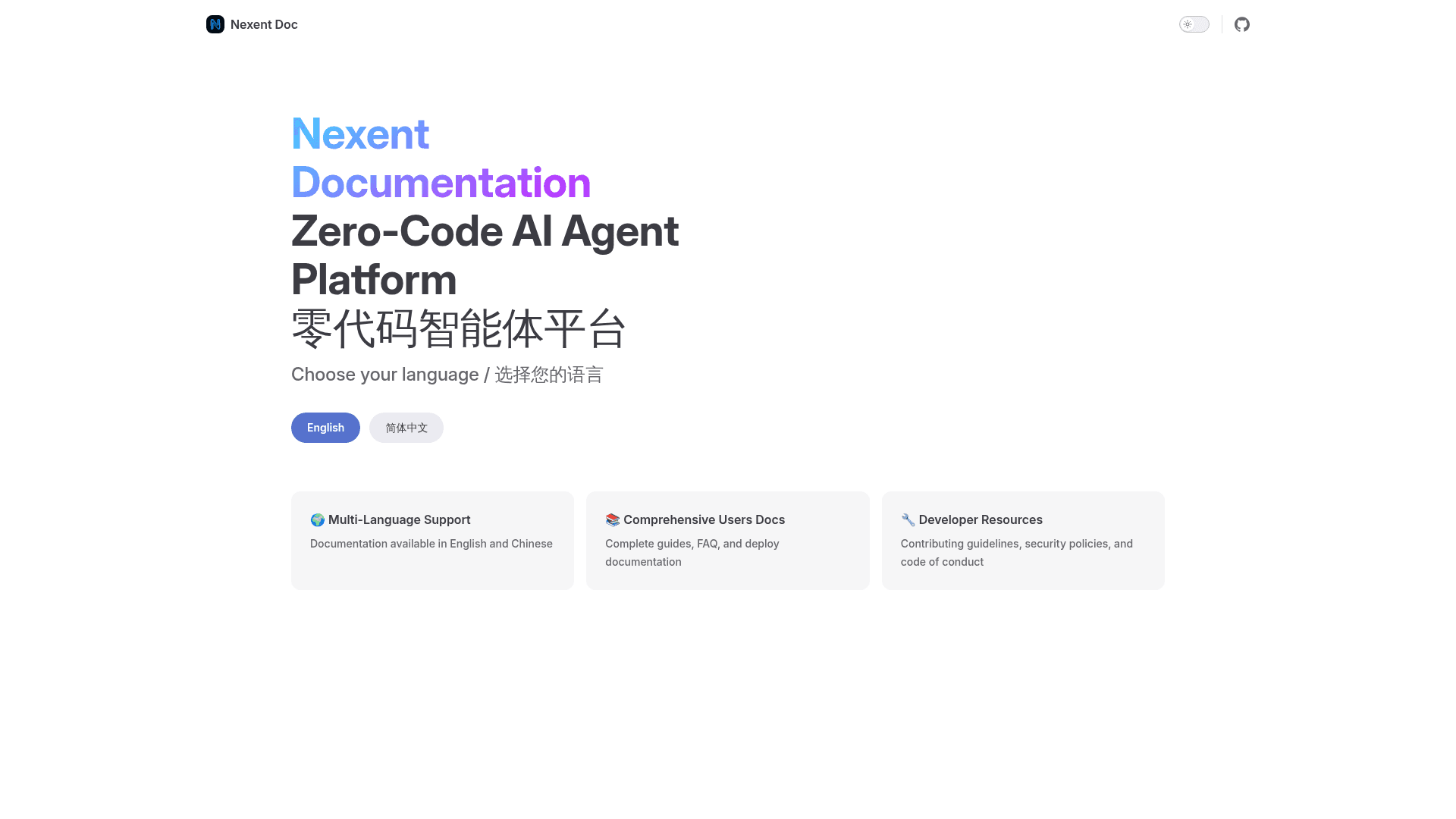
Nexent is a zero-code agent platform built on what its README calls Harness Engineering principles: unified tools, skills, memory, and orchestration with built-in constraints, feedback loops, and control planes. Rather than drag-and-drop workflow design, the user writes a plain-language requirement and the platform produces an agent. Documentation is available in English and Chinese.
Agent Capabilities
- Multi-model integration: OpenAI-compatible with any provider, covering LLM, embedding, VLM, speech-to-text, and text-to-speech models.
- A2A (Agent-to-Agent) protocol for multi-agent cooperation and distributed workflows.
- Two-tier memory, at user level and user-agent level, for persistent context across conversations.
- Progressive skill disclosure, which loads skills dynamically into context to use the context window efficiently.
- A knowledge base with import and retrieval for 20+ document formats, automatic summaries, and fine-grained access control.
- MCP tool ecosystem for custom and third-party MCP services.
- Internet search blended with private data, with citations and source verification.
- Multimodal interaction through voice, text, images, and files.
- Agent version management with history rollback, and an agent marketplace with official and community agents.
- Multi-tenancy with role-based access control.
Deployment Model
Docker deployment is recommended for individuals and small teams and runs through deploy.sh docker. Kubernetes deployment, installed through Helm, targets enterprise setups needing high availability. The README lists minimum requirements for Docker of 4 CPU cores, 8 GiB memory, and 40 GiB disk, and for Kubernetes of 4 cores, 16 GiB memory, and 100 GiB disk. Offline image packages can be built for air-gapped installs.
Update: Nexent v2.0
The README announces Nexent v2.0 as an upgrade from v1.0. It added A2A protocol support, progressive skill disclosure, layered memory, multi-tenant user management, agent version management, and the agent marketplace.
Community Discussions
Be the first to start a conversation about Nexent
Share your experience with Nexent, ask questions, or help others learn from your insights.
Pricing
Open Source (Self-Hosted)
Self-hosted Nexent core platform under the MIT License, deployable via Docker or Kubernetes.
- MIT License
- Self-host with Docker or Kubernetes
- Zero-code agent generation
- Multi-model integration
- A2A agent collaboration
Capabilities
Key Features
- Zero-code agent generation from natural language
- Multi-model integration (LLM, embedding, VLM, STT, TTS)
- A2A agent collaboration
- Layered user-level and user-agent-level memory
- Progressive skill disclosure
- Knowledge base for 20+ document formats
- MCP tool ecosystem
- Internet search integration
- Citations and source traceability
- Multimodal interaction
- Agent version management
- Agent marketplace
- Multi-tenancy and RBAC
- Docker and Kubernetes deployment
- Offline image packages