
Nitro
Nitro is an open-source server toolkit that builds production-ready servers from file-based routes and deploys them to Node.js, Bun, Deno, edge, and serverless targets.
At a Glance
Nitro core server toolkit released under the MIT License; free to use, copy, modify, and distribute.
Engagement
Available On
Alternatives
Listed Nov 2026
About Nitro
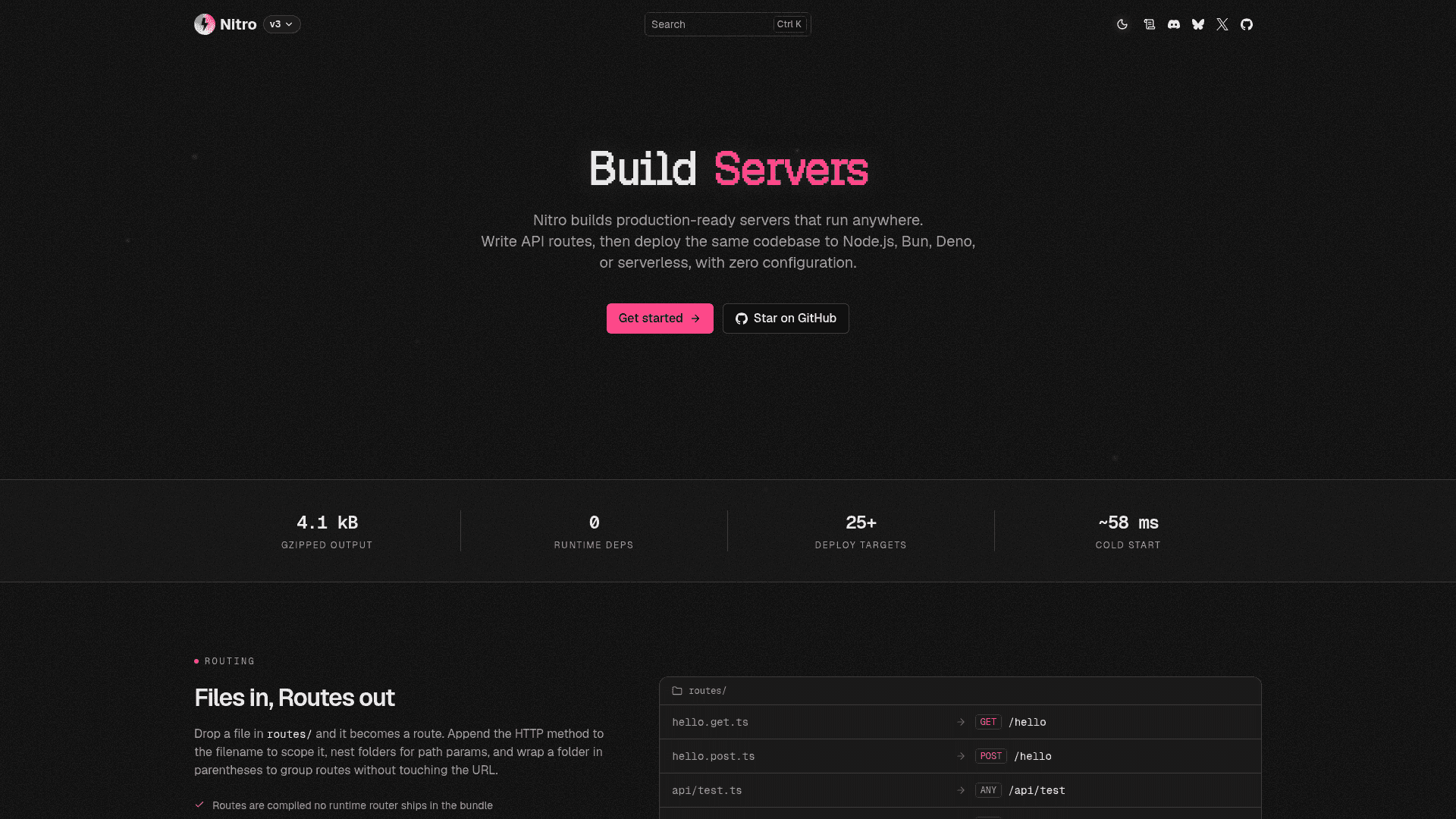
Nitro is an open-source server toolkit maintained by the nitrojs organization. It extends a Vite app with a production-ready server and lets one codebase deploy to many runtimes and hosting providers with zero configuration. The homepage lists 25+ deploy targets, and the latest release shown in the repository is v3.0.261103-rc.
What It Is
Nitro is a server framework and build tool. You write API routes as files and Nitro compiles them into a deployable server. The README describes it as adding server routes to a Vite app and deploying across multiple platforms. A scaffolding command (npx nitro@latest create) creates a new project, or you can add the Vite plugin to an existing app.
Routing and Server Entry
Files in routes/ become routes. A method suffix such as .get or .post scopes a file to one HTTP method, bracketed folder names define path params, and parenthesized folders group routes without changing URLs. The homepage says routes are compiled, so no runtime router ships in the bundle.
Any framework that exposes a Web fetch(request): Response interface can serve as the server entry. Examples shown are H3, Hono, and Elysia. Node-style (req, res) frameworks such as Express work through a server.node.ts file.
Deployment Model
The same server builds for Node.js, Deno, Bun, edge workers, and serverless functions. Nitro emits the output format each host expects. Providers are auto-detected in CI and targets are switched with a preset option. Compatibility dates keep provider behavior stable over time. Listed targets include Cloudflare, Vercel, Netlify, AWS Lambda, Azure, Firebase, DigitalOcean, and Render.
Built-in Server Features
Nitro includes cached handlers with stale-while-revalidate behavior and ETag and 304 handling. Caching uses the same storage layer as the rest of the app. Other built-ins are KV storage over filesystem, Redis, and Cloudflare KV, cross-runtime WebSockets via crossws, and plugins for server lifecycle hooks. Static assets and a catch-all renderer for SSR or SPA shells are also included. Experimental features include a SQL database layer powered by db0, tasks run from the CLI or on a cron schedule, and OpenAPI spec generation served through Scalar or Swagger UI.
Community Discussions
Be the first to start a conversation about Nitro
Share your experience with Nitro, ask questions, or help others learn from your insights.
Pricing
Open Source
Nitro core server toolkit released under the MIT License; free to use, copy, modify, and distribute.
- MIT License
- Deploy to Node.js, Bun, Deno, or serverless
- 25+ deploy targets
- File-based routing
- Bring your own framework (H3, Hono, Elysia, Express)
Capabilities
Key Features
- File-based routing compiled at build time
- Per-method route files, dynamic params, wildcards, and route groups
- Bring-your-own framework server entry (H3, Hono, Elysia, Express)
- Deploy to 25+ targets with a single preset option
- Auto-detected providers in CI
- Cached handlers with stale-while-revalidate
- KV storage abstraction
- WebSocket support
- Plugins for server lifecycle hooks
- Experimental SQL database layer
- Experimental scheduled tasks
- Experimental OpenAPI generation
- Static asset serving and catch-all renderer