
NobodyWho
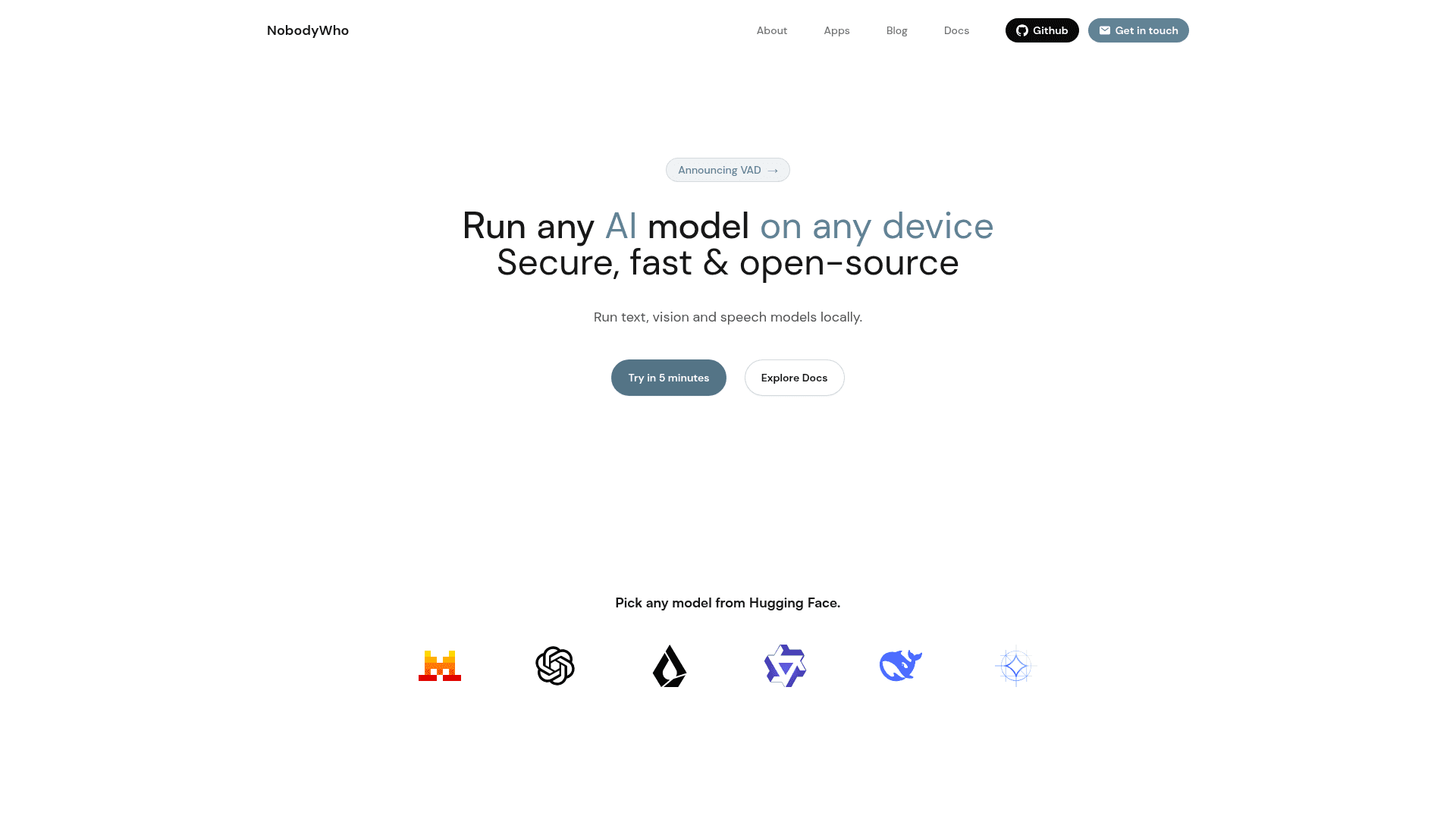
An open-source on-device AI inference engine that lets developers run LLMs, speech-to-text, and text-to-speech locally on any device using Kotlin, Swift, Python, Flutter, React Native, or Godot.
At a Glance
Completely free and open source under EUPL 1.2. No API keys, no usage fees, no cloud required.
Engagement
Available On
Listed Aug 2026
About NobodyWho
NobodyWho is an open-source on-device inference engine built in Rust and licensed under EUPL 1.2, developed by a small team headquartered in Copenhagen, Denmark. It enables developers to embed fast, private LLM inference directly into mobile and desktop applications without requiring any cloud servers or API keys. The project started in May 2023 as "Nimbus2000" for Godot and has since expanded to support Kotlin, Swift, Python, Flutter, React Native, and Godot across Android, iOS, Windows, macOS, and Linux.
What It Is
NobodyWho is a cross-platform, on-device AI inference library that wraps llama.cpp to run GGUF-format language models locally. Rather than routing prompts through a cloud API, inference happens entirely on the user's device — on the local GPU or CPU — with no network dependency. Developers integrate it with a few lines of code in their preferred language or framework, and the library handles model loading, context management, and hardware acceleration automatically.
Platform and Language Support
NobodyWho publishes official bindings for six platforms, each with its own package registry and documentation:
- Kotlin — available via Maven Central for Android and desktop JVM (Linux, macOS, Windows)
- Swift — available via Swift Package Manager; supports iOS, macOS, visionOS, and watchOS
- React Native — available via npm as
react-native-nobodywho - Flutter — available via pub.dev as
nobodywho - Python — available via PyPI as
nobodywho - Godot — available via the Godot AssetLib (Godot 4.5+) and GitHub releases
Core Capabilities
Beyond basic chat inference, NobodyWho provides:
- Speech-to-text (STT) — transcribe audio using Whisper models loaded from Hugging Face
- Text-to-speech (TTS) — synthesize WAV audio using Kokoro, Pocket TTS, and Supertonic backends
- Multimodal input — pass image and audio data to supported LLMs
- Fast, type-safe tool calling — automatically generates structured grammars from function signatures without manual schema writing
- Conversation-aware context shifting — retains full conversation memory without message length limits
- GPU acceleration — optimized kernels for Metal (Apple), CUDA, and Vulkan; runs efficiently on integrated graphics and mobile chips
- Hugging Face model loading — load any GGUF model directly from Hugging Face or any URL
Architecture and Privacy Model
Because inference runs entirely on-device, no servers are required and applications scale automatically with user adoption. The project's about page states this "significantly reduces both costs and overall footprint." Prompts never leave the device's local GPU memory, making it suitable for offline use, air-gapped environments, and privacy-sensitive applications. The library is powered by llama.cpp and is compatible with thousands of pre-trained LLMs in GGUF format, including Gemma, Qwen, Mistral, Deepseek, and Liquid models.
Update: React Native v3.0.0 and VAD Announcement
The latest GitHub release is nobodywho-react-native-v3.0.0, published on August 24, 2026. The project's homepage also announces Voice Activity Detection (VAD) support as a recent addition. The repository has been actively maintained, with the last push on August 25, 2026, and 1,078 stars on GitHub. The project's roadmap milestones show rapid expansion: Android support in July 2025, iOS in October 2025, Python in November 2025, Flutter in February 2026, React Native in April 2026, Swift in May 2026, Kotlin in June 2026, and STT/TTS in July 2026. The about page also notes a €2M fundraising round in December 2025 to challenge Big Tech's cloud AI.
Community Discussions
Be the first to start a conversation about NobodyWho
Share your experience with NobodyWho, ask questions, or help others learn from your insights.
Pricing
Open Source
Completely free and open source under EUPL 1.2. No API keys, no usage fees, no cloud required.
- On-device LLM inference
- Speech-to-text (Whisper)
- Text-to-speech (Kokoro, Pocket TTS, Supertonic)
- Kotlin, Swift, Python, Flutter, React Native, Godot bindings
- GPU acceleration via Metal, CUDA, Vulkan
Capabilities
Key Features
- On-device LLM inference (no cloud required)
- Speech-to-text with Whisper
- Text-to-speech with Kokoro, Pocket TTS, Supertonic
- Multimodal input (image and audio)
- Fast type-safe tool calling
- Conversation-aware context shifting
- GPU acceleration via Metal, CUDA, and Vulkan
- GGUF model format support
- Hugging Face model loading
- Offline and air-gapped operation
- Voice Activity Detection (VAD)
- Kotlin, Swift, Python, Flutter, React Native, and Godot bindings