
NVIDIA Auto Ontology
Open library that builds an ontology and context layer from enterprise metadata and exposes it to agents through MCP, CLI, and API.
At a Glance
Self-hosted Auto Ontology library distributed under the Apache License 2.0. Inference via NVIDIA NIM endpoints (hosted or self-hosted) and optional KumoRFM are external services.
Engagement
Available On
Alternatives
Listed Nov 2026
About NVIDIA Auto Ontology
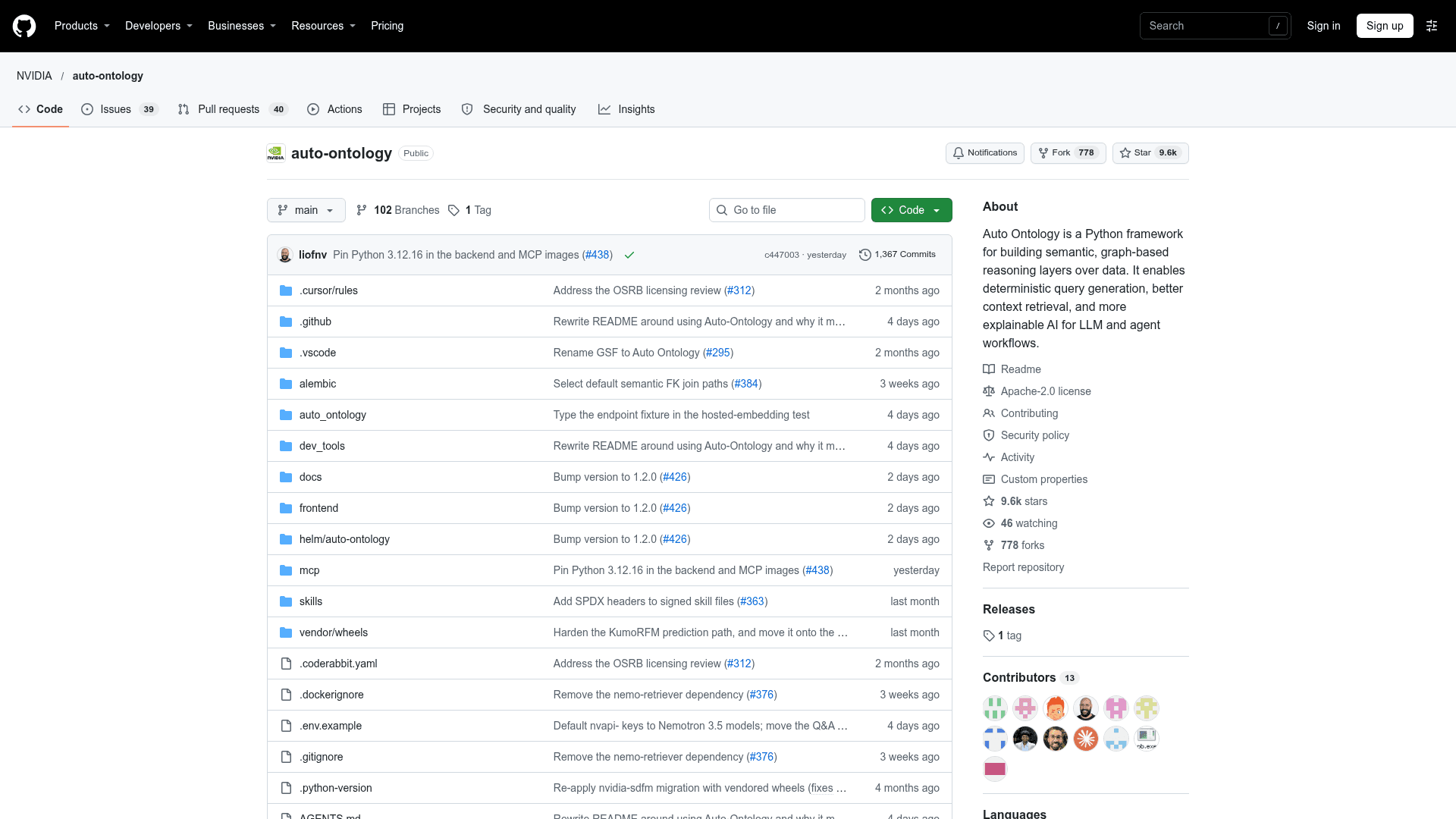
NVIDIA Auto Ontology is an open-source library from NVIDIA that generates an ontology from enterprise database metadata and serves it to AI agents as a trusted context layer. It translates natural-language questions into SQL grounded in certified business definitions, and returns each answer with its SQL and the steps behind it. The project is distributed under the Apache License 2.0.
What It Is
Auto Ontology is a semantic layer for agentic analytics. It reads schemas, profiles columns and samples values from connected databases, then drafts an ontology of terms (business concepts mapped to columns), SQL attributes (reviewed SQL expressions such as margins or rolling totals), and relationships (table joins, including bridge tables). The ontology is stored in Postgres with embeddings in pgvector, and can be explored as a semantic graph in the web UI.
How the generate, certify, answer workflow works
The ingestion service builds a first draft of the ontology. People then test it with real questions, refine terms, descriptions, and SQL attributes in the UI or API, and certify them. When a question is asked, the agent classifies intent, extracts entities, retrieves candidate terms and columns by embedding search, writes SQL, validates filter values and the query against the database (repairing on failure), and runs it. If the ontology cannot support a query, the agent reports that the question cannot be answered from the data. Answers can be viewed as rows, downloaded as CSV, or shown as charts.
Agent access and integrations
A read-only MCP server exposes tools such as check_readiness, search_terms, get_term, check_answerable, and ask_question to MCP clients like Cursor and Claude Desktop. A REST endpoint streams answers over server-sent events using API tokens, and three agent skills cover setup, ontology management, and querying. The library connects to PostgreSQL, MySQL, Databricks, Snowflake, ClickHouse, Trino, Apache Kyuubi, HeavyDB, DuckDB, and SQLite, and can import and export semantic models as Apache Ossie YAML.
Models and deployment
Inference uses NVIDIA NIM endpoints, either the hosted NVIDIA API catalog or self-hosted NIMs, with separate reasoning, non-reasoning, embedding, and reranking roles configurable per endpoint. Deployment is via Docker Compose or a Helm chart for Kubernetes, with optional HashiCorp Vault for credentials and Better Auth for authentication and RBAC. Predictive questions can optionally be routed to the hosted KumoRFM service when configured. The project states it is not accepting external pull requests, though issues are welcome.
Community Discussions
Be the first to start a conversation about NVIDIA Auto Ontology
Share your experience with NVIDIA Auto Ontology, ask questions, or help others learn from your insights.
Pricing
Open Source (Apache-2.0)
Self-hosted Auto Ontology library distributed under the Apache License 2.0. Inference via NVIDIA NIM endpoints (hosted or self-hosted) and optional KumoRFM are external services.
- Licensed under Apache License 2.0 (SPDX: Apache-2.0)
- Exposes context via MCP, CLI, and API
- Helm chart for Kubernetes or Docker Compose deployment
- Web UI, authentication and RBAC
- Project is currently not accepting external contributions
Capabilities
Key Features
- Ontology generation from enterprise database metadata
- Natural-language to SQL querying with returned SQL and steps
- Terms, SQL attributes, and relationship modeling
- Certification workflow for names, descriptions, and SQL attributes
- Answerability checks before querying
- Read-only MCP server for agent harnesses
- REST API with streaming chat completions
- Import/export of semantic models as Apache Ossie YAML
- Connectors for ten database engines
- Web UI for chat, data catalog, analytics, and settings
- Authentication and RBAC
- Docker Compose and Helm deployment
- Agent skills for setup, management, and query