
Obelisk
An open-source durable and deterministic workflow engine built on the WASM Component Model, offering crash-resilient workflows with a single binary and embedded SQLite or Postgres.
At a Glance
Fully open-source under AGPL-3.0. Free to use, modify, and distribute.
Engagement
Available On
Alternatives
Listed Jun 2026
About Obelisk
Obelisk is an open-source durable and deterministic workflow engine written in Rust, built on the WASM Component Model. It is licensed under the GNU Affero General Public License v3.0 and is actively developed under the obeli-sk GitHub organization. The project is currently in pre-release, with the README warning that CLI, gRPC, WIT, and database schema are subject to change.
What It Is
Obelisk is a workflow engine that persists every step of a long-running function — every activity call, sleep, result, and log message — to an execution log backed by SQLite or Postgres. When a server crashes or restarts, workflows replay from the last completed step, guaranteeing no work is lost. The engine enforces a strict separation between deterministic workflow orchestration logic and side-effectful activities, making it suitable for building crash-resilient background jobs, periodic tasks, batch processing, and AI-assisted automation pipelines.
Architecture and Deployment Model
Obelisk ships as a single binary with no brokers, sidecars, or YAML pipeline layers. Key architectural choices include:
- WASM Component Model: Components are sandboxed, language-agnostic, and interoperable. Schema is defined in WIT IDL.
- Storage: Embedded SQLite for single-node deployments; Postgres for multi-node and high availability.
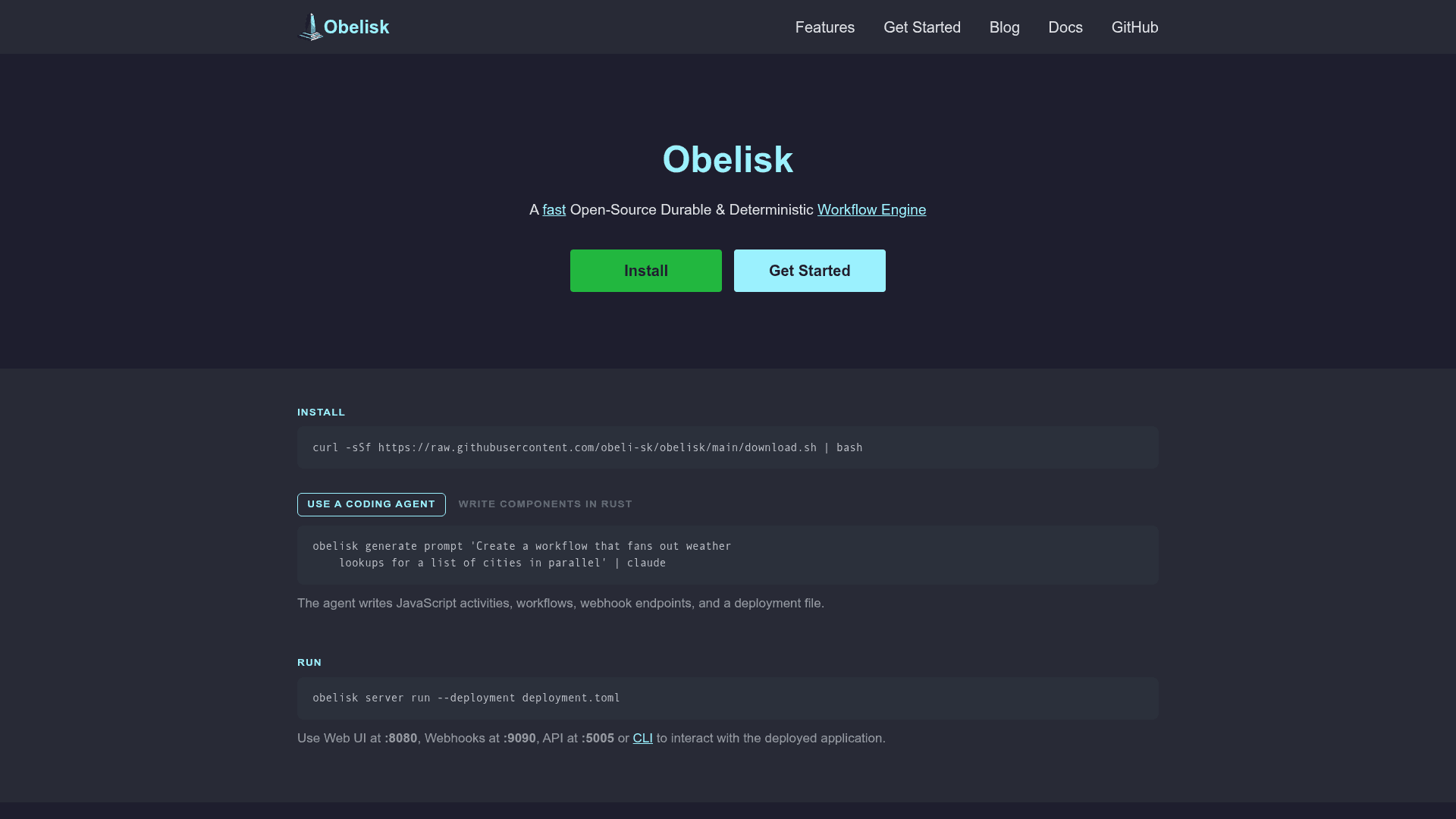
- Interfaces: Web UI on port 8080, Webhooks on port 9090, gRPC API on port 5005, and a CLI.
- Supported platforms: Linux x64/arm64 (musl, glibc v2.35+, NixOS) and macOS x64/arm64.
- Distribution: Components can be pushed and pulled from any OCI registry.
Core Workflow Capabilities
Obelisk provides a rich set of durable execution primitives:
- Crash recovery: The execution log records every step; workflows resume from the last completed step after a restart.
- Auto-retry: Activities are retried automatically on timeout, trap, or error, with configurable retry policies per component.
- Structured concurrency: Multiple child executions can be submitted in parallel and awaited individually or collectively; unawaited activities are automatically cancelled when the parent completes.
- Persistent sleep:
obelisk.sleep()is durable and survives server restarts. - Saga pattern: Nested workflows can guarantee cleanup via compensating activities even after a crash.
- Cron scheduling: Recurring tasks declared in
deployment.tomlusing standard five-field cron expressions or named shorthands.
JavaScript and Exec Activities
Beyond WASM components written in Rust or other WASM-compatible languages, Obelisk supports plain JavaScript activities and workflows with no build step required — just .js files pointed to in deployment.toml. An "Exec activities" feature (introduced in 0.38) allows any executable — shell scripts, Python scripts, Docker commands — to be a durable activity with the same retry, timeout, and observability guarantees as WASM and JS components. Self-contained deployments can inline JS and shell scripts directly in deployment.toml.
Developer Experience and Observability
The Web UI provides a visual trace view with color-coded join sets, a step-through debugger, and execution filtering by FFQN or execution ID. Structured log output and forwarded stdout/stderr are stored in the database alongside execution events. Outgoing HTTP calls made by activities are captured in the execution log on failure and timeout events. The full HTTP API exposes an OpenAPI schema, and the CLI covers execution submission, component management, and deployment operations.
Update: v0.38.2
The latest release is v0.38.2, published on 2026-05-29. The 0.38 series introduced exec activities (shell scripts, Python, Docker as durable activities), self-contained deployments with inline JS and shell scripts in deployment.toml, step-through debugging via Web UI/CLI/REST API, and idiomatic JS imports using import instead of FFQN strings. The project has been actively releasing across a long version history (from v0.19 through v0.38) and the GitHub repository shows ongoing commits as of May 2026.
Community Discussions
Be the first to start a conversation about Obelisk
Share your experience with Obelisk, ask questions, or help others learn from your insights.
Pricing
Open Source
Fully open-source under AGPL-3.0. Free to use, modify, and distribute.
- Single binary deployment
- Embedded SQLite or Postgres
- Durable workflow execution
- Web UI, CLI, and gRPC API
- WASM and JavaScript component support
Capabilities
Key Features
- Durable workflow execution with crash recovery
- Deterministic replay from execution log
- Auto-retry for activities on timeout, trap, or error
- Structured concurrency with parallel child executions
- Persistent sleep surviving server restarts
- Saga pattern for compensating actions on failure
- Cron scheduling with standard five-field expressions
- Step-through debugger in Web UI
- JavaScript activities and workflows (no build step)
- Exec activities: shell scripts, Python, Docker as durable activities
- Self-contained deployments with inline scripts in deployment.toml
- OCI registry distribution for JS and WASM components
- Hot redeploy without server restart
- Versioned deployments with full config snapshots
- Web UI with visual trace view and execution filtering
- Structured log output stored in database
- Outgoing HTTP trace capture on failure
- HTTP and gRPC API with OpenAPI schema
- CLI for execution and component management
- Fine-grained sandbox with restricted HTTP and secret injection
- Single binary with embedded SQLite or Postgres
- WASM Component Model with WIT IDL schema
- Webhook endpoints mountable as URL paths