
Ongrid
Self-hostable ops AI agent that investigates infrastructure incidents, finds root causes, and acts from Slack, Telegram and other chat channels.
At a Glance
Self-hosted Ongrid core released under the AGPL-3.0 license, which is OSI-approved.
Engagement
Available On
Listed Oct 2026
About Ongrid
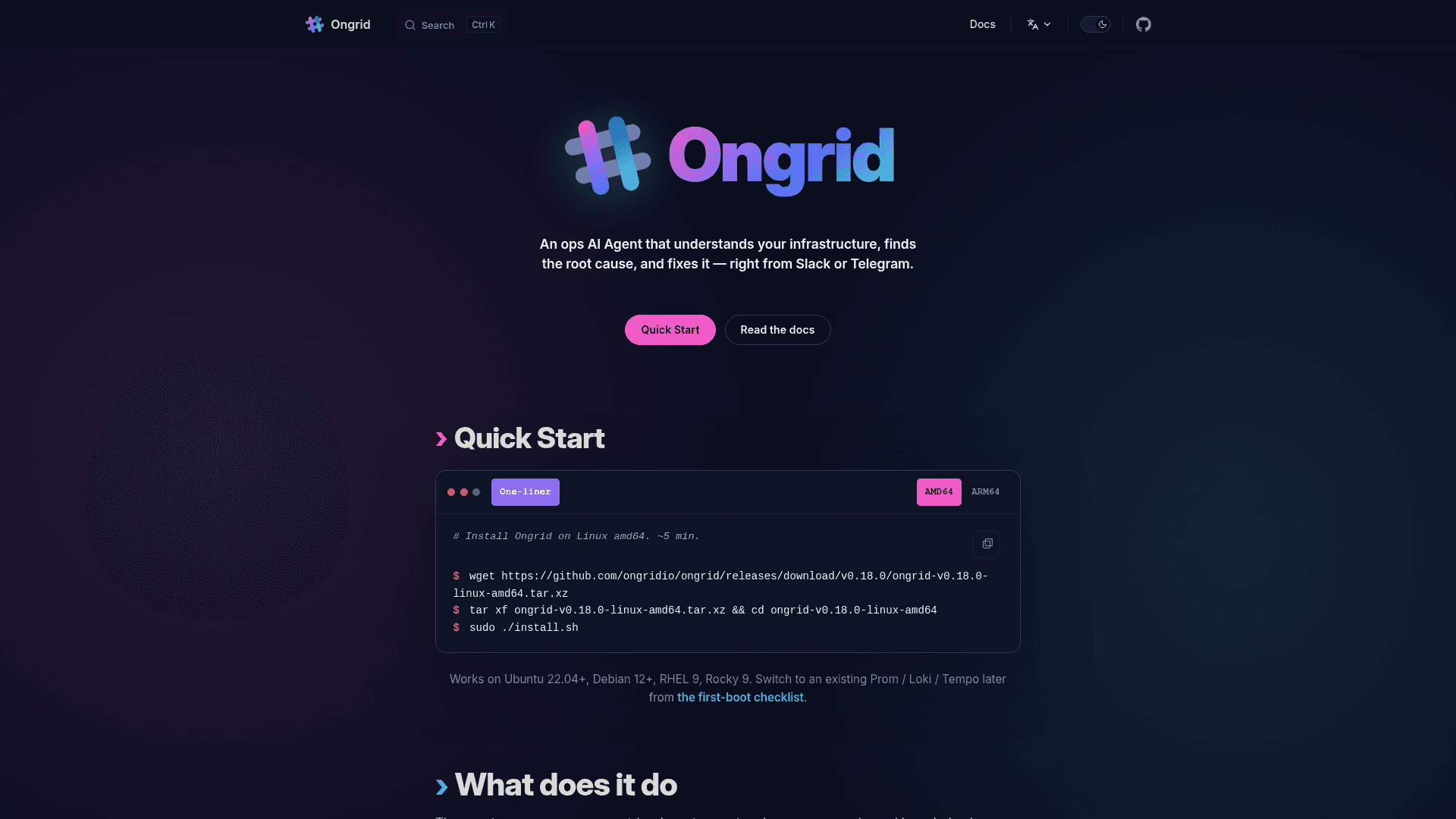
Ongrid is an open-source ops AI agent from the ongridio organization that reasons over metrics, logs, traces, topology, source code and a knowledge base to investigate infrastructure problems. Operators interact with it from chat channels such as Slack or Telegram, and it returns an evidence-backed answer rather than a transcript. The latest release listed is v0.18.0, and the repository is licensed under AGPL-3.0.
What It Is
Ongrid is an AIOps and incident-response agent for operations teams. It connects to observability data (Prometheus, Loki, Tempo, Grafana, OpenTelemetry) and uses tools to query that data, walk a topology map, and correlate signals to a root cause, which it can pin to a source-code line. A coordinator agent dispatches work to specialist sub-agents (SRE, network, database), and an alert can trigger an investigator that spawns an RCA worker and writes the cause back to chat.
How It Works
Edge components on each host dial out through a single outbound tunnel, so no inbound ports are required on hosts. The agent uses read-only host tools (a bash sandbox plus 26+ inspection tools) with every call audited, and a browser SSH feature provides a reverse-tunnel shell. Risky actions can be placed behind approvals through a write gate. A workflow builder wires triggers, agents, tools, conditions and notifications into repeatable automations, and external MCP servers can be registered so their tools are available to agents and workflows.
Models, Channels and Knowledge
Users bring their own model: Anthropic, OpenAI, GLM, DeepSeek, Gemini, Kimi or any OpenAI-compatible relay. Two-way channels include Slack, Telegram, Larksuite, DingTalk, WeCom and webhooks, with per-channel locale. A knowledge vault indexes runbooks, notes, incident history and repositories for RAG search. Kubernetes lifecycle management and network device management (SNMP-verified discovery and interface polling) are also documented.
Setup Path
Download the release archive for linux-amd64 or linux-arm64, extract it and run install.sh on Ubuntu 22.04+, Debian 12+ or RHEL/Rocky 9. The install brings up the full stack: manager, MySQL, Prometheus, Loki, Tempo, Grafana and Qdrant. It can later be pointed at existing Prometheus, Loki or Tempo instances.
Community Discussions
Be the first to start a conversation about Ongrid
Share your experience with Ongrid, ask questions, or help others learn from your insights.
Pricing
Open Source (Self-hosted)
Self-hosted Ongrid core released under the AGPL-3.0 license, which is OSI-approved.
- Self-host in one command with install.sh
- Coordinator and specialist agents
- Auto-investigate on alert and root-cause analysis
- Browser SSH
- Built-in observability (Prometheus, Loki, Tempo, Grafana)
Capabilities
Key Features
- Coordinator and specialist agents (SRE, network, DB)
- Auto-investigation on alert
- Root-cause analysis across metrics, logs, traces, topology and source code
- Zero inbound ports via outbound edge tunnel
- Browser SSH with audit
- Self-host install with full observability stack
- Bring your own model with hot routing
- Two-way chat channels with per-channel locale
- Read-only host tools with audited calls
- Kubernetes lifecycle management
- Network device management via SNMP
- Workflow builder
- MCP server registration
- Knowledge vault with RAG search
- Approval and write gate for risky actions