Open Duet
Open-source, self-hosted workspace for AI coworkers: named agents with instructions, memory, routines, isolated computers and human approval before risky actions.
At a Glance
Self-hosted core released under Apache License 2.0; users run it on their own machine or server.
Engagement
Available On
Alternatives
Listed Oct 2026
About Open Duet
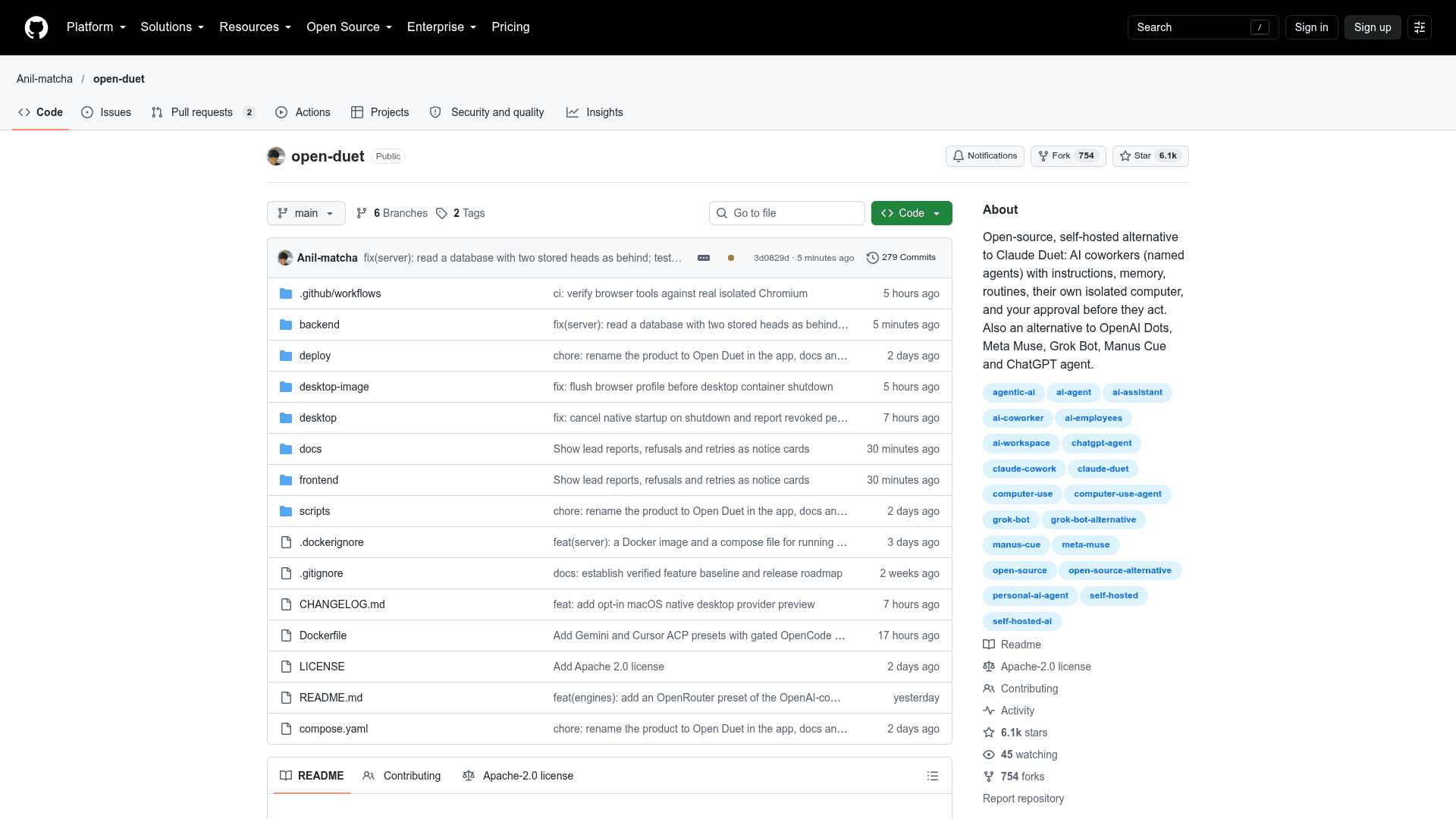
Open Duet is an open-source, self-hosted workspace for AI coworkers, published on GitHub by Anil-matcha under the Apache License 2.0. Each named agent has a job, instructions, memory, its own workspace, a schedule and a human approval step before risky actions. Users chat with agents in a browser, a desktop app or Telegram, and keep data and credentials on their own machine or server. The project lists its status as active development.
What It Is
Open Duet is a self-hosted agent workspace. An agent can be a researcher, a support triager, a reporting assistant or a developer; coding is one use, not the focus. Agents run on an engine you already have signed in: Claude, Codex, any Agent Client Protocol CLI, or an OpenAI-compatible endpoint. The README positions it as an open alternative to paid products such as Claude Duet and ChatGPT agent, and states it is not yet a feature-for-feature replacement.
How Agents Work
- Agents carry a title, instructions, engine and model, workspace folder and approval mode, and can be exported and imported as files.
- Each agent keeps notes (MEMORY.md plus topic notes) that load into its conversations, with recall across conversations and undo.
- Routines run prompts on cron, weekday, interval, one-off or webhook schedules, with run history, missed-run tracking and in-app notifications.
- Risky actions show a card and wait for Allow or Deny. Modes include ask-first, accept-edits and plan, plus saved rules and a decision log.
- An agent can optionally get an isolated Docker container so commands and file edits never run on your machine (experimental).
- If an engine hits a usage limit, a turn can fall back to another engine.
Setup Path
The desktop app runs from a source checkout with Node.js 22+ and uv, using a local SQLite database and OS secret storage for its encryption key. Unsigned installers are built for tagged releases. For always-on use, a server-hosted mode offers python -m app.server, a Docker image and compose file, nginx and Caddy overlays, and doctor, backup and restore commands. PostgreSQL is the default database, with SQLite experimental.
Current Status and Limitations
Desktop and server modes are marked experimental. Authentication is single-owner. Agent-to-agent delegation, rooms, teams and most connectors are planned rather than built. An optional legacy flow runs Telegram and web tasks in hosted Boat sandboxes.
Community Discussions
Be the first to start a conversation about Open Duet
Share your experience with Open Duet, ask questions, or help others learn from your insights.
Pricing
Open Source (Self-hosted)
Self-hosted core released under Apache License 2.0; users run it on their own machine or server.
- License: Apache License 2.0 (Apache-2.0)
- Named agents with instructions, memory, routines and approvals
- Self-hosted via python -m app.server, Docker image and compose file
- Runs on engines you already have signed in (Claude, Codex, ACP CLIs, OpenAI-compatible endpoints), which are external costs
- Optional Boat sandboxes require a separate Boat API key (external service)
Capabilities
Key Features
- Named agents with instructions, engine, model and workspace
- Per-agent memory notes with recall and undo
- Routines: cron, interval, one-off and webhook schedules
- Approval modes, saved rules and decision log
- Isolated Docker computer per agent (experimental)
- Durable streaming conversations with tool-call timeline
- Multiple engines with limit-aware fallback
- Desktop app, web UI and Telegram bot
- Self-hosting with Docker, nginx/Caddy, backup and restore
- Encrypted credentials in PostgreSQL or SQLite
- Export and import agents as portable files
Integrations
Demo Video