
Open Multi-Agent
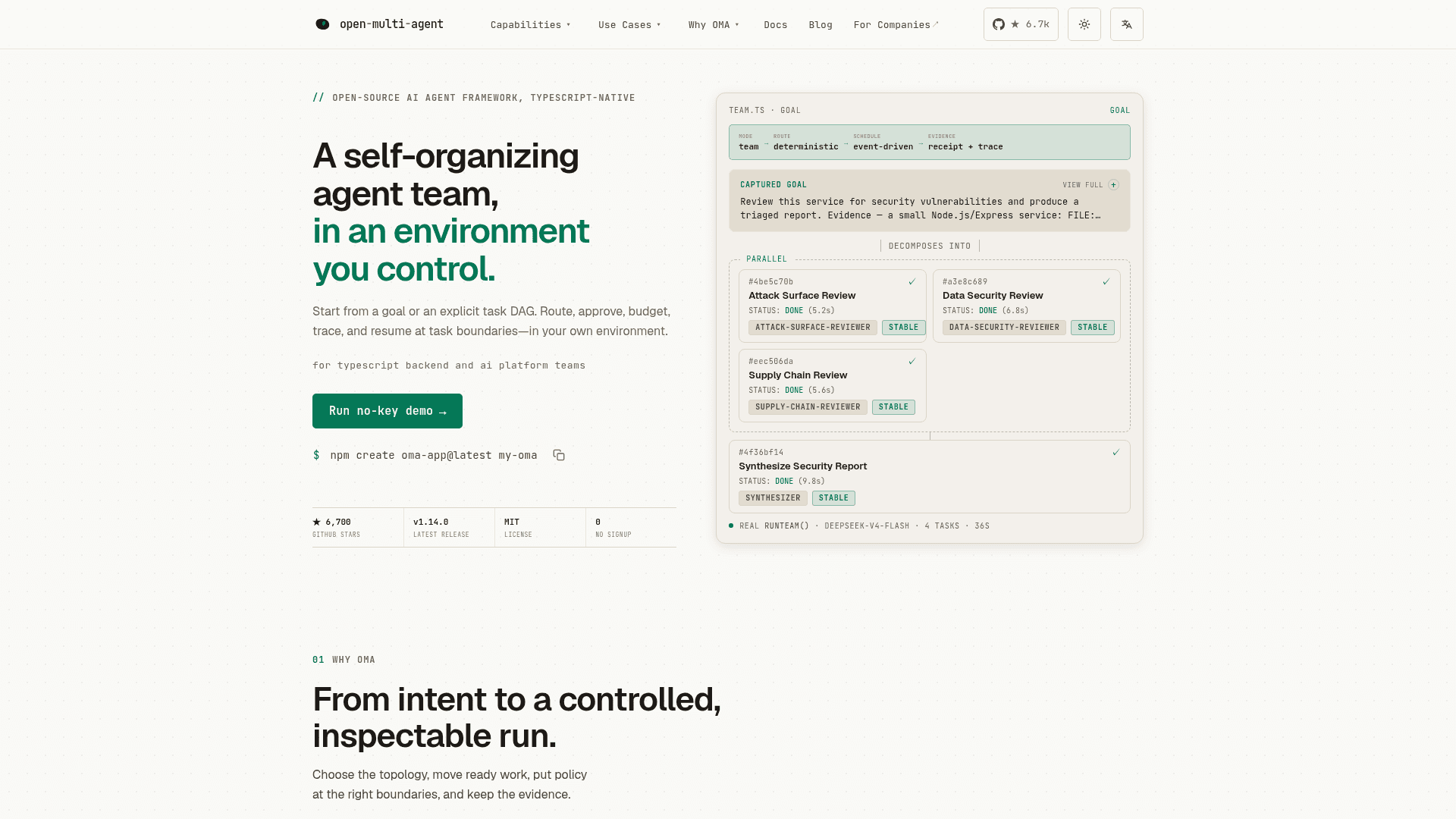
Open-source TypeScript AI agent orchestration framework that turns a goal into a dynamic task DAG at runtime, running multi-agent teams in your own environment.
At a Glance
Fully open-source MIT-licensed framework, free to use, modify, and distribute. No signup required.
Engagement
Available On
Alternatives
Listed Aug 2026
About Open Multi-Agent
Open Multi-Agent (OMA) is a TypeScript-native, MIT-licensed AI agent orchestration framework built by 元定义科技 (YuanASI). It lets developers describe an outcome rather than hand-wire a task graph: a coordinator agent plans the directed acyclic graph (DAG) at runtime, assigns work across a team of agents, and executes it with a deterministic event-driven scheduler. The project launched on 2026-04-01 and, according to the repository, has accumulated over 6,700 GitHub stars and 2,400+ forks.
What It Is
Open Multi-Agent sits at the orchestration layer for TypeScript backend and AI platform teams that need several agents, dependencies, approvals, or recovery steps to work together. It is not a single-agent LLM toolkit and not a node-by-node graph authoring tool — it occupies the middle ground where the task graph should emerge from the goal at runtime. The core package (@open-multi-agent/core) ships the orchestration runtime, tools, memory, checkpoints, traces, a CLI, and an offline Run Viewer. An optional @open-multi-agent/otel package adds OpenTelemetry export for teams with centralized monitoring stacks.
How the Runtime Works
OMA exposes three primary execution modes:
runTeam()— provide a goal string; the coordinator plans the task DAG, assigns agents, and synthesizes results.runTasks()— supply an explicit task graph and let OMA execute it with the same scheduler, governance, and observability.runAgent()— run a single agent call within the OMA runtime.
The event-driven scheduler removes round barriers: independent nodes run concurrently as soon as their dependencies are satisfied. Failed nodes are retried under task policy; budget exhaustion, malformed input, and non-retryable errors skip retries and surface FAILED state while independent branches continue. Token and cost budgets (maxTokenBudget, maxCostBudget) cap spending at turn and task boundaries.
Governance and Observability
OMA puts policy at the boundary it governs. Roles and review paths are declared per team; individual tool calls can be gated with onToolCall; plans can be previewed with planOnly before any agent executes; and approved plans can be frozen for replay. Every run produces execution receipts and traces. The offline Run Viewer replays the task DAG and span waterfall — including per-task status, assignee, token counts, and tool calls — without sending data to a hosted OMA service. The same records feed versioned EvalSets, offline reports, and CI quality gates.
Model and Provider Support
OMA supports cloud providers (OpenAI, Anthropic Claude, Google Gemini, DeepSeek), local endpoints via Ollama, OpenAI-compatible endpoints, natively integrated Chinese providers, and Vercel AI SDK providers. Tools are default-deny by design, and the core package has only three runtime dependencies. The framework can run fully offline or air-gapped on the developer's own credentials and infrastructure.
Adoption and Ecosystem
The repository lists several known users and integrations, attributed as vendor-published claims on the project homepage:
- temodar-agent (xeloxa) — WordPress security analysis platform running OMA built-in tools inside Docker, described as confirmed production use.
- PR-Copilot (kidoom) — AI pull-request review assistant using an OMA coordinator-plus-reviewer team with custom tools.
- StuFlow (znc15) — Terminal AI coding assistant driving OMA's orchestration core with DeepSeek.
- Engram — "Git for AI memory" integration syncing knowledge across agents.
- @agentsonar/oma — Sidecar detecting cross-run delegation cycles and rate bursts.
The project was featured in GithubAwesome's GitHub Trending Monthly #6, as noted on the homepage.
Update: v1.14.0
The latest release is v1.14.0, published 2026-08-01. The project launched 2026-04-01 under MIT and has been actively releasing since, with the repository showing 50 contributors and over 50 runnable examples across basics, cookbook workflows, patterns, providers, and integrations. The v1.13 runtime surface is documented as the current capabilities baseline, with v1.14.0 as the latest release tag.
Community Discussions
Be the first to start a conversation about Open Multi-Agent
Share your experience with Open Multi-Agent, ask questions, or help others learn from your insights.
Pricing
Open Source
Fully open-source MIT-licensed framework, free to use, modify, and distribute. No signup required.
- Full orchestration runtime (@open-multi-agent/core)
- runTeam(), runTasks(), runAgent() execution modes
- Offline Run Viewer
- Shared memory (MemoryStore)
- EvalSets and CI quality gates
Capabilities
Key Features
- Goal-to-DAG dynamic orchestration via runTeam()
- Explicit task graph execution via runTasks()
- Single-agent execution via runAgent()
- Event-driven scheduler with concurrent independent node execution
- Coordinator agent plans task DAG at runtime
- Default-deny tool policy with per-call gating
- Token and cost budgets (maxTokenBudget, maxCostBudget)
- Plan preview with planOnly before execution
- Approved plan freeze and replay
- Checkpoint and resume for interrupted runs
- Adaptive recovery with append-only plan repair
- Offline Run Viewer for task DAG and span waterfall replay
- OpenTelemetry export via optional @open-multi-agent/otel package
- EvalSets, scorers, offline reports, and CI quality gates
- Shared memory (MemoryStore) across agents and runs
- Multi-agent consensus verification
- Execution receipts and stable run identity traces
- Mixed-model teams (cloud + local in same run)
- Local and air-gapped deployment support
- MCP and external agent support (Claude Code, Gemini CLI, Codex via ACP)
- Vercel AI SDK integration
- Loop detection and retry/timeout policies
- Model routing for cost optimization
- 50+ runnable examples