OpenAdapt
Compiles a demonstrated GUI task into a deterministic program that reports VERIFIED only when an independent check confirms the result.
At a Glance
About OpenAdapt
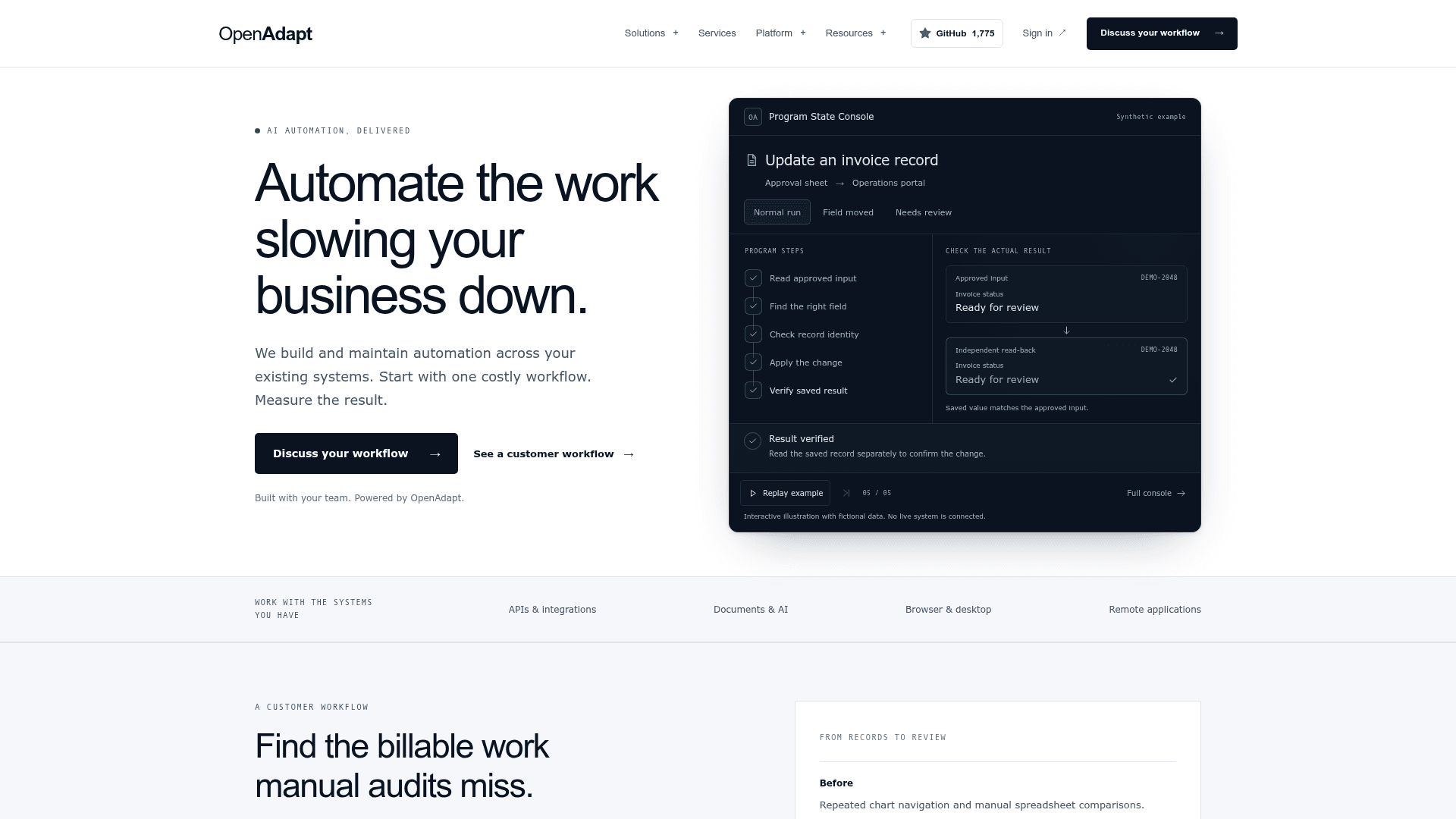
OpenAdapt, built by MLDSAI Inc. in Toronto, turns a demonstrated GUI task into a program that runs again without a generative-model API in the control loop. A calling agent invokes the program, and a run reports VERIFIED only after an independent check of the record confirms the effect. The local engine is MIT-licensed and installs with pip, and the company also offers implementation services and a hosted Cloud.
What It Is
OpenAdapt is a demonstration-to-automation tool for GUI work that APIs can't reach. A person, or a local agent that the person watches, records a task in a real application. OpenAdapt compiles the recording into a reviewable program, and a named human admits that program before it is reused. Computer-use agents are the intended callers of the program, not the executor inside it.
How a Run Works
The workflow has four stages: demonstrate, compile, check the record, then VERIFIED or halt. Before a consequential action the runtime can check authorization, workflow state, record identity, target uniqueness, and a fresh view of the application. Afterwards it reads the result through a separate source, such as an API, a database, a file, or a second session. A run reports VERIFIED only when every declared effect check passes. Other documented outcomes include HALTED_BEFORE_EFFECT, RECONCILIATION_REQUIRED, REJECTED_POLICY and COMPLETED_UNVERIFIED.
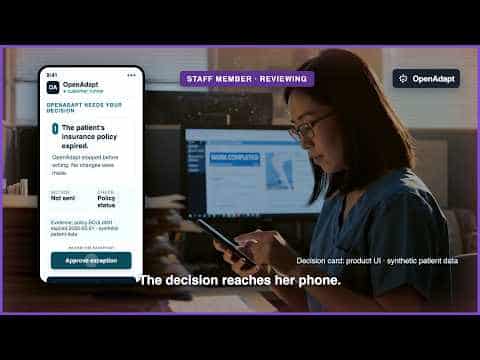
When a run reaches a judgment call, it can send a signed question to a phone view. The customer-controlled runner then rechecks the live application before continuing. Repairs are versioned changes that are reviewed, tested, promoted, and can be rolled back.
Setup Path
The README documents python -m pip install --upgrade openadapt (Python 3.10–3.12), followed by openadapt doctor, openadapt flow tutorial, and openadapt-agent serve --allow-run. The tutorial records, compiles, certifies and runs a task on a synthetic practice-management fixture, and needs no account or API key. openadapt quickstart --break-it demonstrates a halt when the backend rejects a write after the screen shows success. Authoring commands include openadapt flow record, compile, replay, and compose, which sequences bundles across surfaces.
Surfaces and Data Boundaries
Each workflow bundle binds to one execution surface: browser, native desktop (Windows, macOS, Linux), RDP, or Citrix/VDI. Raw recordings and live observations stay local by default. Operating models include local or self-hosted, customer-controlled, and OpenAdapt-managed runners. The launcher, compiler, runtime, Desktop app and adapters are MIT-licensed, while OpenAdapt Cloud is the commercial control plane.
Services and Evidence
Beyond the software, OpenAdapt offers workflow assessment, build and integration, deployment and maintenance for operations teams. The vendor cites a customer RVU audit workflow for a cardiology practice, with preliminary, unconfirmed financial figures. The vendor also cites a public OpenEMR field test in which 19 of 20 attempts passed the check.
Community Discussions
Be the first to start a conversation about OpenAdapt
Share your experience with OpenAdapt, ask questions, or help others learn from your insights.
Pricing
Local
MIT-licensed engine run on your own machine; record, compile, replay with no account.
- Record, compile, replay
- No account
- MIT engine on your machine
Hosted
OpenAdapt Cloud: OpenAdapt runs the machine for you.
- Managed runner
- Dashboard and run history
- API key and verify URL
- Your agent can call it
Enterprise
Qualified workflow on a customer-controlled or dedicated runner; reviewed go/no-go.
- One app, one environment, qualified
- Identity and effect checks
- Customer-controlled or dedicated runner
- BAA and a private verify URL
- Citrix, VDI, volume, SLA
Capabilities
Key Features
- Compiles a demonstrated GUI task into a deterministic program
- Independent effect verification before reporting VERIFIED
- Halts when the result can't be proven
- Browser, native desktop, RDP and Citrix/VDI surfaces
- Compose sequences bundles across surfaces
- Human-in-the-loop phone approval for judgment calls
- Versioned, reviewable repairs with rollback
- Local-first execution with privacy scrubbing
- Agent runtime interface via openadapt-agent
- Hosted Cloud dashboard with workflows and run history
Integrations
Demo Video