OpenAPPA
Deterministic information-flow engine that checks each agent tool call against declarative policy so sensitive data cannot reach unauthorized destinations.
At a Glance
MIT-licensed self-hosted OpenAPPA engine and CLI
Engagement
Available On
Alternatives
Listed Nov 2026
About OpenAPPA
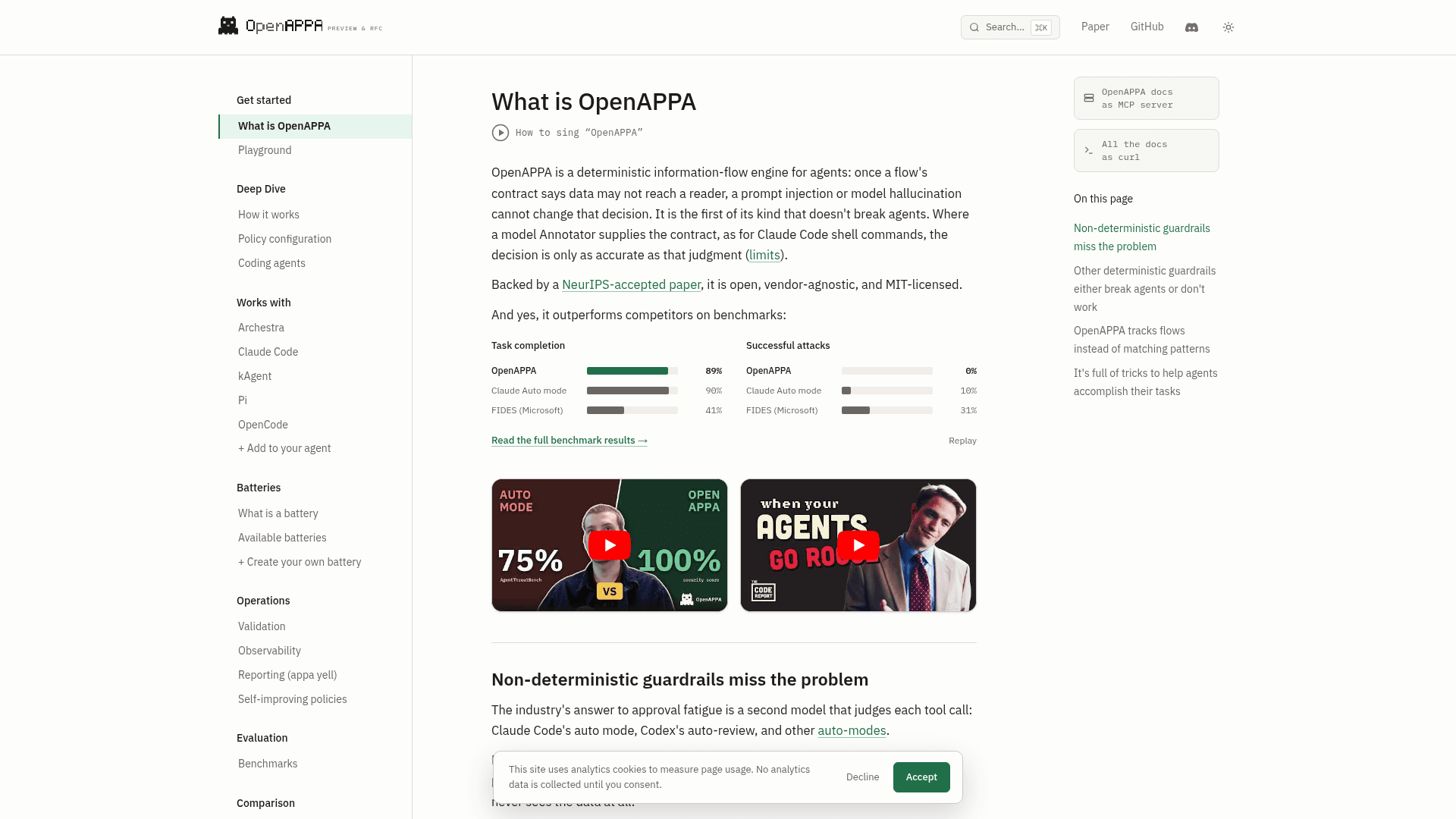
OpenAPPA is an open-source, MIT-licensed engine from archestra-ai that sits between an agent and its tools and decides, before each action, whether data may flow to a given destination. It is powered by APPA (Agentic Permissions Policy Algebra) and is described by its authors as a preview and RFC. Its decisions come from a declarative TOML policy rather than a second model judging each call.
What It Is
OpenAPPA is a guardrail layer for AI agents that tracks the sensitivity and trust of everything an agent reads. Each trajectory carries a security label (audience x trust) that only becomes more restrictive, and each tool call is checked against it before it runs. The engine decides from the event log alone and makes no network or file calls, so the same log yields the same decision. It can run in-process or as a sidecar process.
How Policies and Remedies Work
Instead of allow and block lists, the configuration describes data sources, audiences, trust levels, and authorities. When a flow is denied, OpenAPPA returns a machine-readable remedy plan listing legal ways to proceed: sanitizers that mask secrets or redact PII, authorities that approve one specific action via a human or internal API, and subagents that isolate an untrusted read in a disposable branch. Where a model Annotator supplies the contract, such as for Claude Code shell commands, the decision is only as accurate as that judgment.
Setup and Testing Path
The Claude Code integration installs through an install script and the appa plugin command, then a protected session starts with the clappa command and the /appa-guide skill. Other agents can embed the APPA runtime from any language or connect through hooks. Archestra's 1.4 release candidate implements OpenAPPA at the LLM proxy level. The CLI offers appa describe --check to validate configuration and appa replay to test scripted tool calls, both usable as CI checks.
Benchmarks and Research
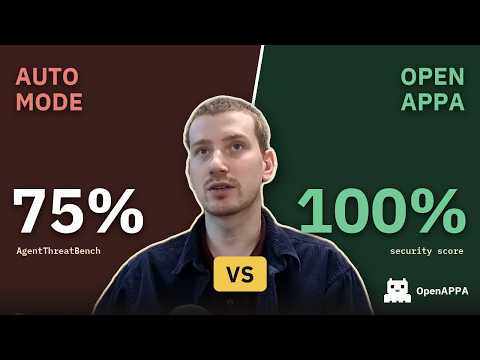
The project reports results on Bench-Corp and AgentThreatBench: 89% task completion and 0% successful attacks for OpenAPPA, versus 90% and 10% for Claude Auto mode and 41% and 31% for Microsoft FIDES. These are vendor-published figures. The accompanying paper was accepted to the NeurIPS 2026 Workshop on Agents in the Wild.
Community Discussions
Be the first to start a conversation about OpenAPPA
Share your experience with OpenAPPA, ask questions, or help others learn from your insights.
Pricing
Open Source
MIT-licensed self-hosted OpenAPPA engine and CLI
- MIT License
- Run in-process or as a sidecar process
- Preview and RFC status; config and wire surfaces may break without shims
Capabilities
Key Features
- Deterministic information-flow checks before each tool call
- Declarative TOML policy with audiences, trust levels, and authorities
- Security labels that only become more restrictive
- Machine-readable remedy plans
- Sanitizers for masking secrets and redacting PII
- Authorities for human or API approval of single actions
- Subagents to isolate untrusted reads
- In-process or sidecar deployment
- appa describe --check and appa replay for CI validation
- Claude Code plugin with protected session
Integrations
Demo Video