OpenBrief
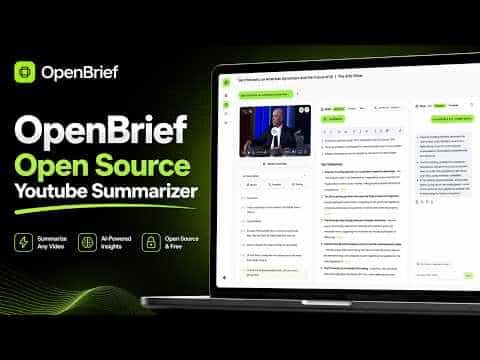
A local-first, open-source desktop app that turns long videos and audio into transcripts, grounded summaries, and exportable notes—no account required.
At a Glance
The desktop app is free with no paid plan and no trial clock. Open source under AGPL-3.0.
Engagement
Available On
Alternatives
Listed Jun 2026
About OpenBrief
OpenBrief is an open-source desktop application built with Tauri v2 that converts long videos, audio files, and recordings into structured briefs. It runs entirely on your machine—no sign-up, no cloud dependency—and is licensed under the GNU Affero General Public License v3.0. The project is maintained by GitHub user tantara and reached v0.4.0 in May 2026.
What It Is
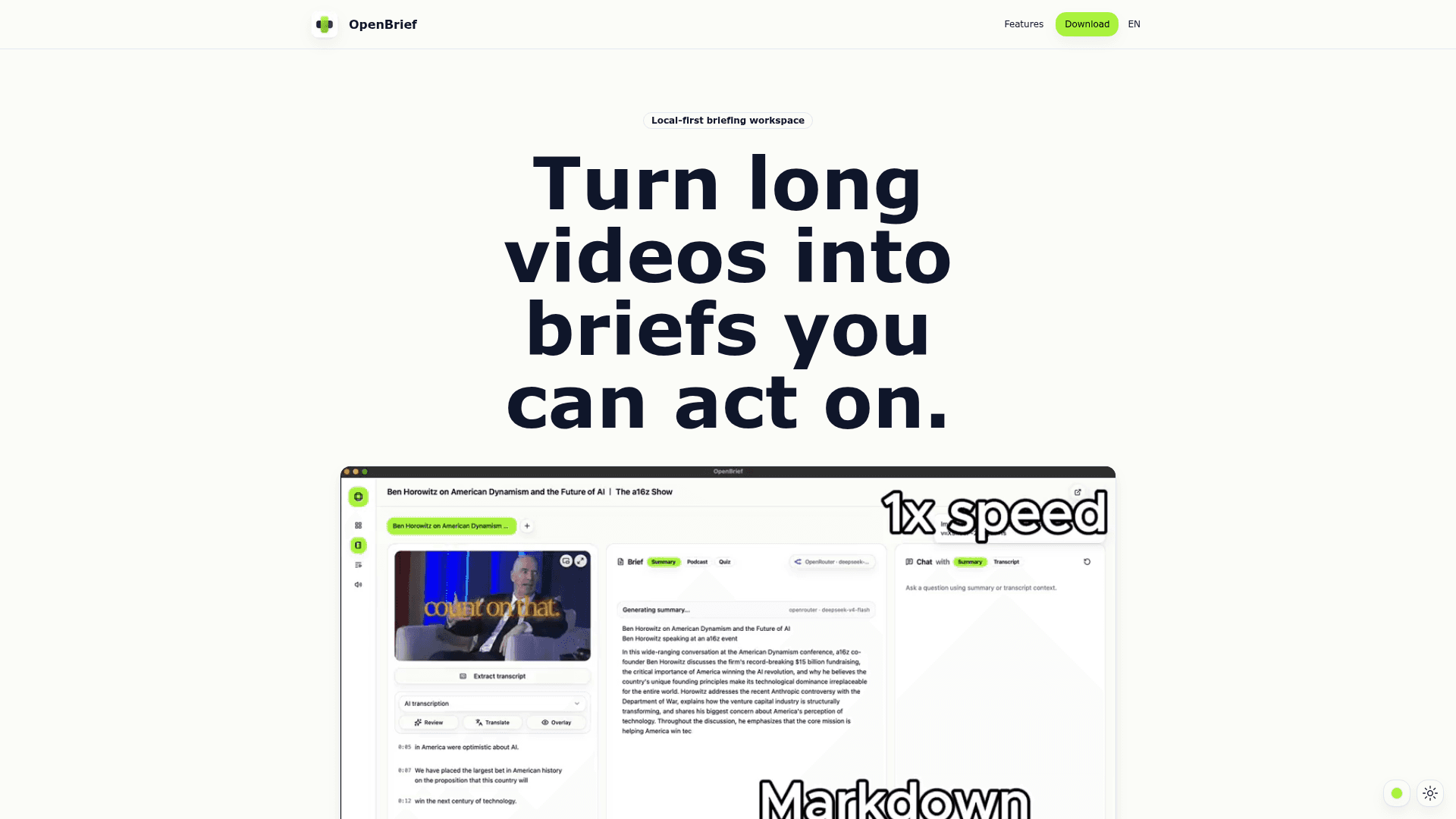
OpenBrief is a local-first briefing workspace in the category of AI-powered media summarization tools. Its core job is to take a video or audio source—whether a local file or a supported web link—and produce a transcript, a grounded summary, and an interactive chat interface, all within a single desktop window. The output can be exported to Markdown for use anywhere. The app is designed for research calls, lectures, product demos, interviews, and screen recordings.
How the Local-First Architecture Works
Everything OpenBrief generates stays on the user's device. The app bundles helper sidecars for media downloading (via yt-dlp) and on-device speech-to-text (via whisper.cpp and transcribe-rs). When captions already exist on a source, OpenBrief uses them directly and only runs transcription when necessary. LLM calls for summarization and chat are routed through user-supplied API keys to providers such as OpenAI GPT, Anthropic Claude, Google Gemini, and OpenRouter DeepSeek—no data passes through OpenBrief's own servers.
Model Support and AI Capabilities
The README documents the following model support matrix:
- Speech to text: Whisper, Parakeet, Qwen3-ASR
- Text to speech: Supertonic 3, Qwen3-TTS
- Large language models: OpenAI GPT, Anthropic Claude, Google Gemini, OpenRouter DeepSeek
- Local LLMs: Gemma 4 is listed on the roadmap but not yet supported
Grounded summaries are generated as blog-style Markdown briefs with timestamped takeaways, and chat answers are tied directly back to the transcript rather than generated from general knowledge.
Repository Layout and Tech Stack
OpenBrief is a pnpm/Turborepo monorepo. The primary deliverable is a Tauri v2 desktop app with a React renderer and a Rust backend. The repository also contains shells for a Next.js web app, a TanStack Start app, a React Native (Expo) app, and worker entry points—indicating a planned multi-platform expansion. The desktop app requires Node.js 22.21.0+, pnpm 11.0.9, Rust/Cargo, and Tauri v2 platform prerequisites.
Update: OpenBrief v0.4.0
The latest release is v0.4.0, published on May 25, 2026. Recent completed roadmap items include improved audio file support for transcription, summaries, playback, and exports; Parakeet ASR support; Qwen3-ASR and Qwen3-ForcedAligner support; and Supertonic 3 TTS support. Upcoming roadmap items include support for local LLMs (Gemma 4), PDF and HTML document sources, video frame/clip embeddings for semantic search, voice cloning, web and mobile sharing, and additional artifact formats such as flashcards.
Community Discussions
Be the first to start a conversation about OpenBrief
Share your experience with OpenBrief, ask questions, or help others learn from your insights.
Pricing
Free
The desktop app is free with no paid plan and no trial clock. Open source under AGPL-3.0.
- Import local video/audio files or web video links
- On-device transcription
- Grounded summaries and chat
- Markdown export
- No account required
Capabilities
Key Features
- Import local video/audio files or paste a web video link
- Extract captions or run on-device speech-to-text transcription
- Generate grounded Markdown summaries with timestamped takeaways
- Chat with media content grounded in the transcript
- Text-to-speech playback of summaries
- Export notes to Markdown
- Searchable library of all imported sources
- No account or sign-up required
- All files and generated notes stay on-device
- Bring-your-own API keys for LLM providers
Integrations
Demo Video