
opencode-config
A personal OpenCode configuration that turns Claude into a self-learning multi-agent swarm system with parallel workers, outcome-based pattern learning, and cross-agent memory.
At a Glance
Free to clone and use under MIT license. Requires OpenCode and optional paid AI model API keys.
Engagement
Available On
Alternatives
Listed Aug 2026
About opencode-config
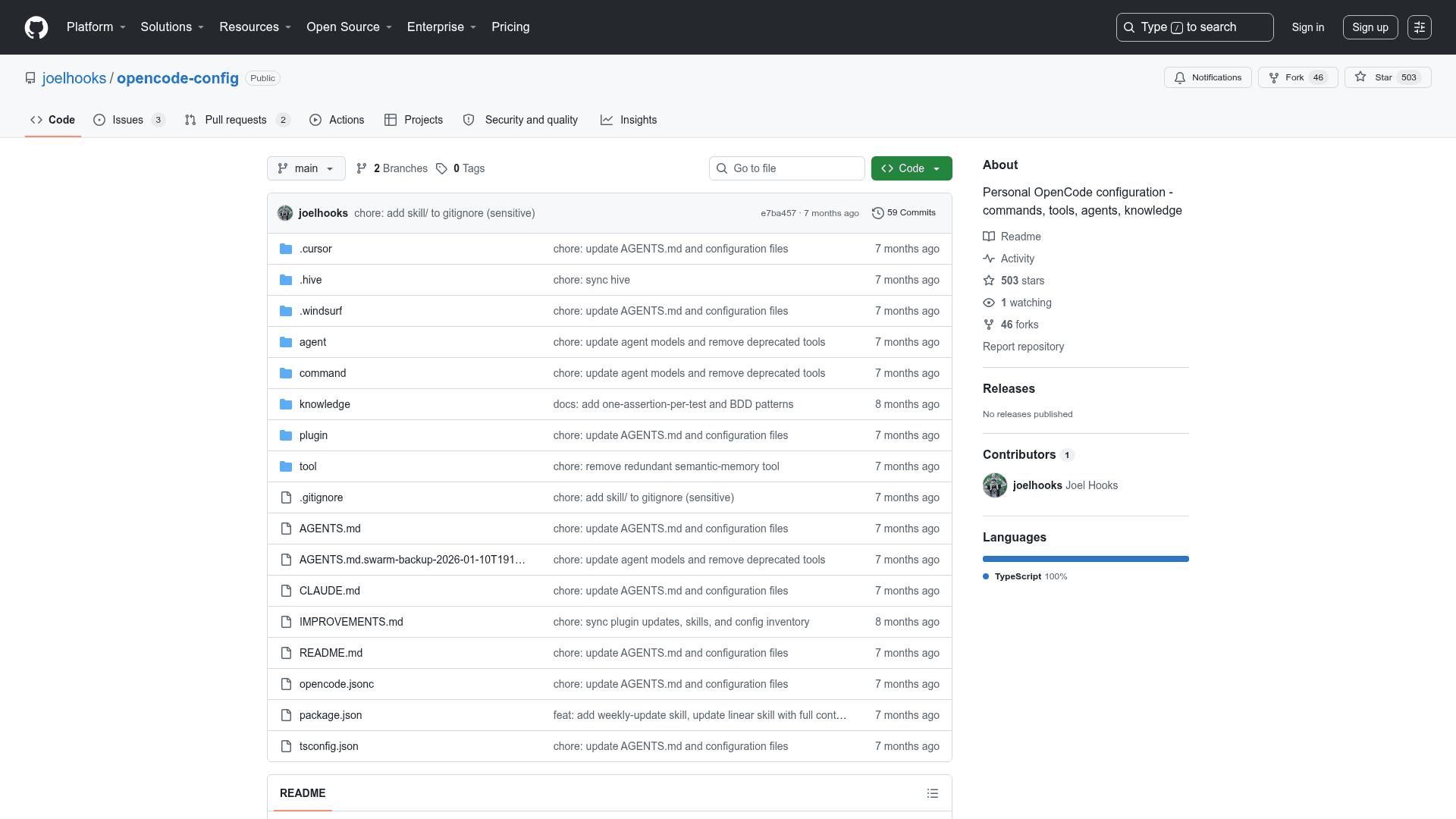
opencode-config is a personal OpenCode configuration by Joel Hooks that transforms the OpenCode AI coding environment into a multi-agent swarm system. It is built on top of joelhooks/swarmtools and runs entirely inside OpenCode — it is not a standalone tool. The repository has accumulated over 500 GitHub stars since its creation in December 2025, signaling strong community interest in the approach.
What It Is
opencode-config is a configuration layer for OpenCode that wires together a coordinator-worker agent architecture, outcome-based learning, cross-agent session memory, and a suite of custom MCP tools. When you describe a task inside OpenCode, the system decomposes it into subtasks, spawns parallel worker agents, tracks which strategies succeed or fail, and adapts over time. Anti-patterns get detected and inverted; proven patterns get promoted. Confidence in patterns decays on a 90-day half-life unless revalidated.
How the Swarm Learns
The core innovation is an outcome-based learning pipeline that feeds every task execution back into a pattern maturity system:
- Fast + success → pattern gets promoted toward "proven"
- Slow + retries + errors → pattern gets flagged
- >60% failure rate → auto-inverted to anti-pattern
- 90-day half-life → confidence decays unless revalidated
Patterns move through four maturity stages: candidate → established → proven → deprecated. This means the swarm improves with use rather than repeating the same mistakes.
Architecture: Coordinator vs. Worker
The system separates expensive, long-lived coordinator context from disposable worker context. The coordinator (running on Claude Sonnet) never edits code directly — it decomposes tasks, orchestrates workers, and monitors progress. Workers get focused, isolated context windows, execute their assigned tasks, checkpoint progress, and report learning signals back. The README claims this architecture produces a 70% cost reduction compared to a single-agent approach, while also improving recovery and generating better learning signals.
Cross-Agent Memory with CASS and Hivemind
Two memory systems extend the swarm's knowledge across sessions and agents:
- CASS (Cross-Agent Session Search) indexes conversation histories from Claude Code, Codex, Cursor, Gemini, Aider, ChatGPT, Cline, OpenCode, Amp, and Pi-Agent, enabling semantic and full-text search across all past AI sessions before solving a new problem.
- Hivemind (Semantic Memory) persists architectural decisions, debugging breakthroughs, and project-specific gotchas using vector search backed by the
nomic-embed-textembedding model via Ollama.
Custom Tools and MCP Servers
The config ships 12 custom MCP tools and integrates several MCP servers:
- UBS (Ultimate Bug Scanner) — multi-language static analysis covering JS/TS, Python, C++, Rust, Go, Java, and Ruby, checking for null safety, XSS, injection, async race conditions, and memory leaks
- Hive — git-backed work tracker for atomic epic and subtask creation with status tracking
- Agent Mail — file reservation and message-passing system to prevent edit conflicts between parallel agents
- repo-autopsy — deep GitHub repo analysis using AST grep, blame, hotspots, and secret detection
- pdf-brain — PDF and Markdown knowledge base with URL support
MCP servers include next-devtools, chrome-devtools, context7 (library docs), fetch, Snyk (security scanning), and Kernel (cloud browser automation via Playwright).
Setup Path
Installation requires OpenCode itself (via install script or Homebrew), then cloning this repo into ~/.config/opencode and running bun install. Two npm CLIs are required as agent backends: opencode-swarm-plugin (swarm orchestration) and optionally cass-search (cross-agent session search). Ollama with the nomic-embed-text model is required for semantic memory features. Once installed, running /init inside OpenCode on a target repo generates an AGENTS.md workflow file. Swarms are triggered with /swarm "describe your task" from within OpenCode.
Update: Active Development as of Early 2026
The repository was created in December 2025 and last pushed in January 2026, with the GitHub metadata showing a last-updated timestamp of August 2026. The swarm CLI is pinned at version 0.30.0, cass at 0.1.35, and Ollama at 0.13.1. The project is MIT-licensed and actively maintained by Joel Hooks as a personal configuration that others can clone and adapt.
Community Discussions
Be the first to start a conversation about opencode-config
Share your experience with opencode-config, ask questions, or help others learn from your insights.
Pricing
Open Source
Free to clone and use under MIT license. Requires OpenCode and optional paid AI model API keys.
- Full swarm orchestration configuration
- 25 slash commands
- 12 custom MCP tools
- Cross-agent session search (CASS)
- Semantic memory (Hivemind)
Capabilities
Key Features
- Multi-agent swarm orchestration with parallel workers
- Outcome-based pattern learning with confidence decay
- Cross-agent session search (CASS) across 10+ AI tools
- Semantic memory (Hivemind) with vector search via Ollama
- UBS multi-language bug scanner (JS/TS, Python, Rust, Go, etc.)
- Coordinator-worker architecture for cost optimization
- Git-backed work tracker (Hive) with epic/subtask management
- Agent Mail file reservation to prevent edit conflicts
- 25 slash commands (/swarm, /debug, /iterate, etc.)
- 7 injectable skill packages (testing-patterns, cli-builder, etc.)
- MCP server integrations (next-devtools, chrome-devtools, Snyk, Kernel)
- Knowledge files for TDD, TypeScript, Next.js, Effect-TS patterns
- Anti-pattern detection and auto-inversion at >60% failure rate
- Cross-session learning with 90-day confidence half-life
- AGENTS.md workflow file generation via /init command