
OpenGAP
A framework-agnostic, git-native standard and CLI for defining AI agents as plain files in a git repository.
At a Glance
OpenGAP CLI (reference implementation of the Git Agent Protocol) released under the MIT License; free to use, copy, modify and distribute.
Engagement
Available On
Alternatives
Listed Oct 2026
About OpenGAP
OpenGAP (the Git Agent Protocol) is an open standard for defining AI agents as files in a git repository, with opengap as its reference CLI. It is maintained under the open-gitagent organization and created by Shreyas Kapale at Lyzr Research Labs. The repository's latest listed release is v0.5.0, and the CLI keeps a gitagent alias for backward compatibility.
What It Is
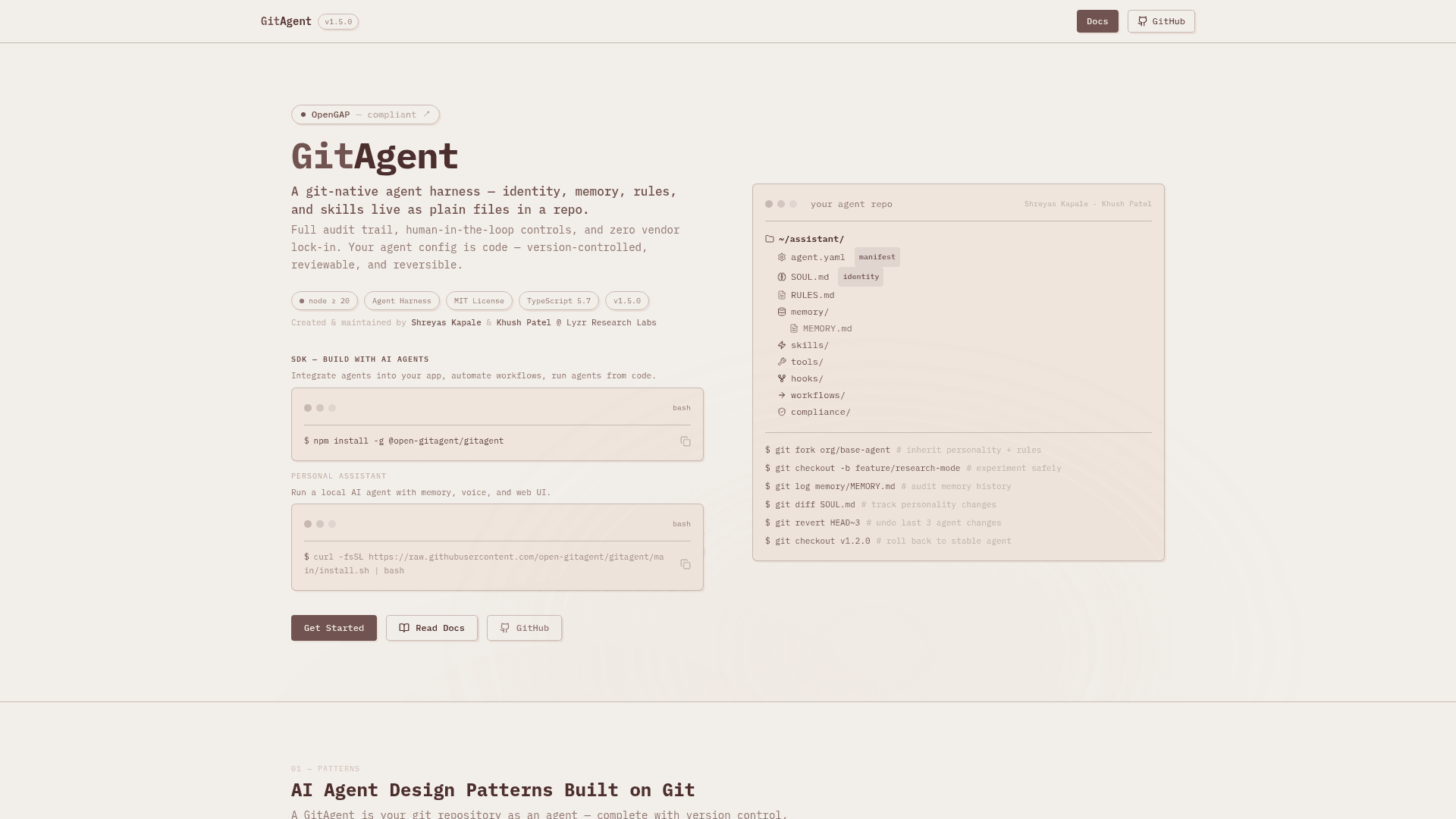
OpenGAP lets a repository become a portable agent definition. Only two files are required: agent.yaml (the manifest) and SOUL.md (identity). Optional files and folders cover rules, duties, skills, tools, workflows, knowledge, memory, hooks, config, compliance artifacts, and sub-agents. The opengap CLI scaffolds, validates, inspects, exports, imports, and runs these agent definitions.
Workflow and Outputs
You install the CLI with npm, run opengap init with a template (minimal, standard, full, or llm-wiki), and run opengap validate to check the definition against the spec. opengap export converts an agent to other formats through adapters, including system prompt, Claude Code, OpenAI Agents SDK, CrewAI, Gemini CLI, Cursor rules, GitHub Copilot, Codex and others. opengap import accepts Claude, Cursor, CrewAI and OpenCode definitions. opengap run executes an agent from a git repo or local directory through a chosen adapter.
Git-Native Patterns
Because agents are files in git, changes are commits that can be diffed, blamed, reverted, tagged and promoted through branches. Documented patterns include human-in-the-loop review via branch and PR, live memory in a memory/runtime/ folder, shared context across a monorepo, forking and remixing public agents, CI validation on every push, and SkillsFlow, which defines deterministic multi-step YAML workflows chaining skills, agents and tools.
Compliance and Segregation of Duties
The manifest supports compliance settings such as risk tier, supervision with human-in-the-loop and kill switch, audit logging and retention. The README lists support for FINRA, Federal Reserve, SEC and CFPB-related requirements. Segregation of duties lets you define roles (maker, checker, executor, auditor), conflict matrices and handoffs in agent.yaml and DUTIES.md. The validator can catch violations before deployment, and opengap audit produces a compliance report.
Relationship to GitAgent
The GitAgent harness at gitagent.sh is a runtime built on the OpenGAP standard. It offers an SDK, a local personal assistant with a web UI, voice and messaging channels, and support for 12+ model providers.
Community Discussions
Be the first to start a conversation about OpenGAP
Share your experience with OpenGAP, ask questions, or help others learn from your insights.
Pricing
Open Source (MIT)
OpenGAP CLI (reference implementation of the Git Agent Protocol) released under the MIT License; free to use, copy, modify and distribute.
- MIT License
- Framework-agnostic, git-native agent definition standard
- CLI published on npm as @open-gitagent/opengap
- Segregation of duties and compliance support
- CI/CD validation and SkillsFlow workflows
Capabilities
Key Features
- Git-native agent definition via agent.yaml and SOUL.md
- Framework-agnostic export through adapters
- Import from Claude, Cursor, CrewAI and OpenCode
- Spec and compliance validation
- Segregation of duties roles and conflict matrices
- Compliance audit report generation
- SkillsFlow deterministic YAML workflows
- Agent inheritance and dependency composition
- Skill management commands
- Init templates: minimal, standard, full, llm-wiki
- Run agents from git repo or local directory