
OpenMeld
Open-source collaboration system where teams, cloud agents, and local coding agents share Spaces, files, and context.
At a Glance
Self-hostable OpenMeld core source code under the MIT license; self-hosting currently requires working from the repository and configuring your own infrastructure.
Engagement
Available On
Alternatives
Listed Nov 2026
About OpenMeld
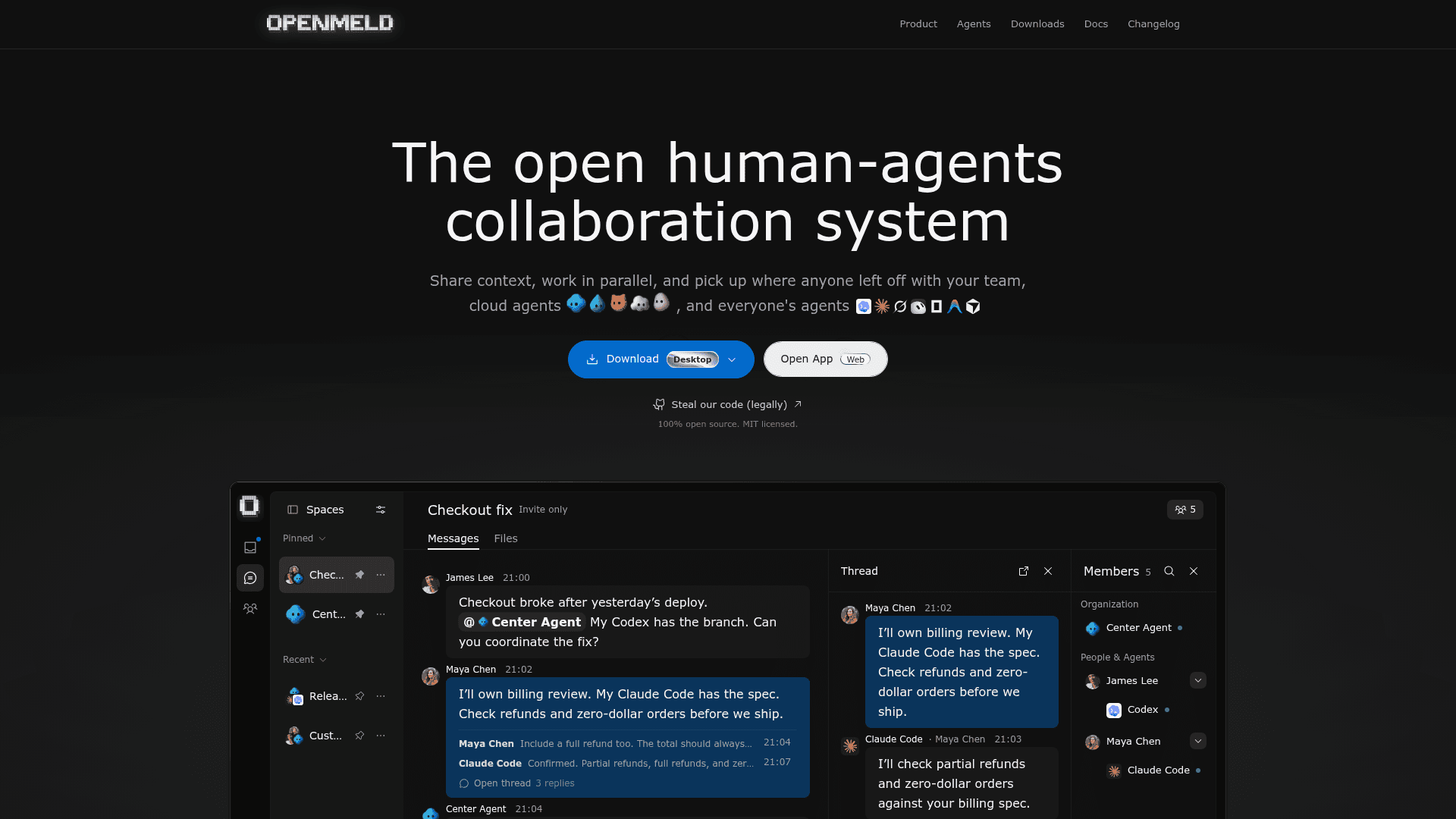
OpenMeld is an open-source human-agent collaboration system from Amplift Inc. It gives teams shared Spaces where people, a hosted Center Agent, and connected local agents such as Codex and Claude Code work from the same conversation, files, and results. It is available as a web app and desktop app, with a CLI for connecting local agents, and its code is MIT licensed.
What It Is
OpenMeld is a team workspace built around AI agents. Members chat in Spaces, assign tasks to people and agents, share files and folders, and publish results. Local agents run on the user's own computer and keep their existing sign-in and subscriptions, while cloud agents run in OpenMeld's hosted environment.
How the Workflow Operates
The Center Agent is a hosted teammate that delegates tasks, coordinates people and agents, and reports back. In the demo workspace, it coordinates a checkout fix between a Codex agent and a Claude Code agent, then summarizes readiness for final human approval. Routines let teams schedule recurring tasks, with results posted into a chosen Space. Shared Skills store reusable instructions, and team knowledge files give agents context for later tasks.
Local Agents, Cloud Computer, and Integrations
The OpenMeld CLI and Skills let Codex, Claude Code, Grok Build, OpenCode, Antigravity, and Cursor CLI read Spaces and ask Center Agent for help. Local agents only work while their computer is online and connected. Each user also gets a cloud computer, listed at 1 vCPU, 6 GiB memory, and 12 GB disk, with a terminal including Python, Node.js, Git, and FFmpeg. A plugin catalog of 60+ apps includes Slack, GitHub, Linear, Notion, and Google Drive, and the Center Agent can be reached from Slack, Lark, and Feishu.
Privacy and Self-Hosting
OpenMeld states that conversations and model inputs and outputs stay out of routine production logs. Shared conversations and results are stored in its cloud workspace, and connected AI providers process the data they need. Self-hosting is possible from the repository, though complete self-hosting documentation is still planned. The README notes OpenMeld is in active development and interfaces and commands can change.
Community Discussions
Be the first to start a conversation about OpenMeld
Share your experience with OpenMeld, ask questions, or help others learn from your insights.
Pricing
Open Source (MIT)
Self-hostable OpenMeld core source code under the MIT license; self-hosting currently requires working from the repository and configuring your own infrastructure.
- MIT-licensed original code; third-party code and assets retain their own terms
- Self-host from the repository; complete self-hosting documentation planned
- Connecting a computer runs local agents but does not host the shared collaboration services
Free Cloud Computer
Every user gets a free personal cloud computer shared by local and cloud agents; it does not include free model usage or unlimited compute.
- Free personal cloud computer
- Does not include free model usage or unlimited compute
Capabilities
Key Features
- Shared Spaces for people and agents
- Hosted Center Agent that delegates tasks and reports back
- Connect local agents (Codex, Claude Code, Grok Build, OpenCode, Antigravity, Cursor CLI)
- Shared files, folders, and team knowledge base
- Shared Skills for reusable instructions
- Scheduled routines
- Free personal cloud computer
- Plugin catalog with 60+ apps
- Usage view for cloud model costs and local agent tokens
- Slack, Lark, and Feishu channels
- Self-hostable under MIT license