
OpenRLHF
Open-source RLHF and agentic reinforcement learning framework for LLMs and VLMs built on Ray, vLLM and DeepSpeed.
At a Glance
Self-hosted OpenRLHF framework released under the Apache License 2.0 with no-charge, royalty-free usage rights.
Engagement
Available On
Alternatives
Listed Nov 2026
About OpenRLHF
OpenRLHF is an open-source Python framework for reinforcement learning from human feedback and agentic RL on large language and vision-language models. It combines a Ray + vLLM distributed architecture with DeepSpeed training and an agent-based execution pipeline. The project is released under the Apache 2.0 license, and its documentation says it is under active development.
What It Is
OpenRLHF is a training framework for aligning and fine-tuning language models. It covers supervised fine-tuning (SFT), reward model training, direct preference optimization (DPO/IPO/cDPO), and RL training with PPO, REINFORCE++, REINFORCE++-baseline, GRPO, Dr. GRPO, RLOO and FlashREINFORCE. Models load directly from HuggingFace checkpoints, and training is driven by command-line scripts or Ray job submissions. The README and docs describe it as the first framework of its kind, which is a project claim.
How the Architecture Works
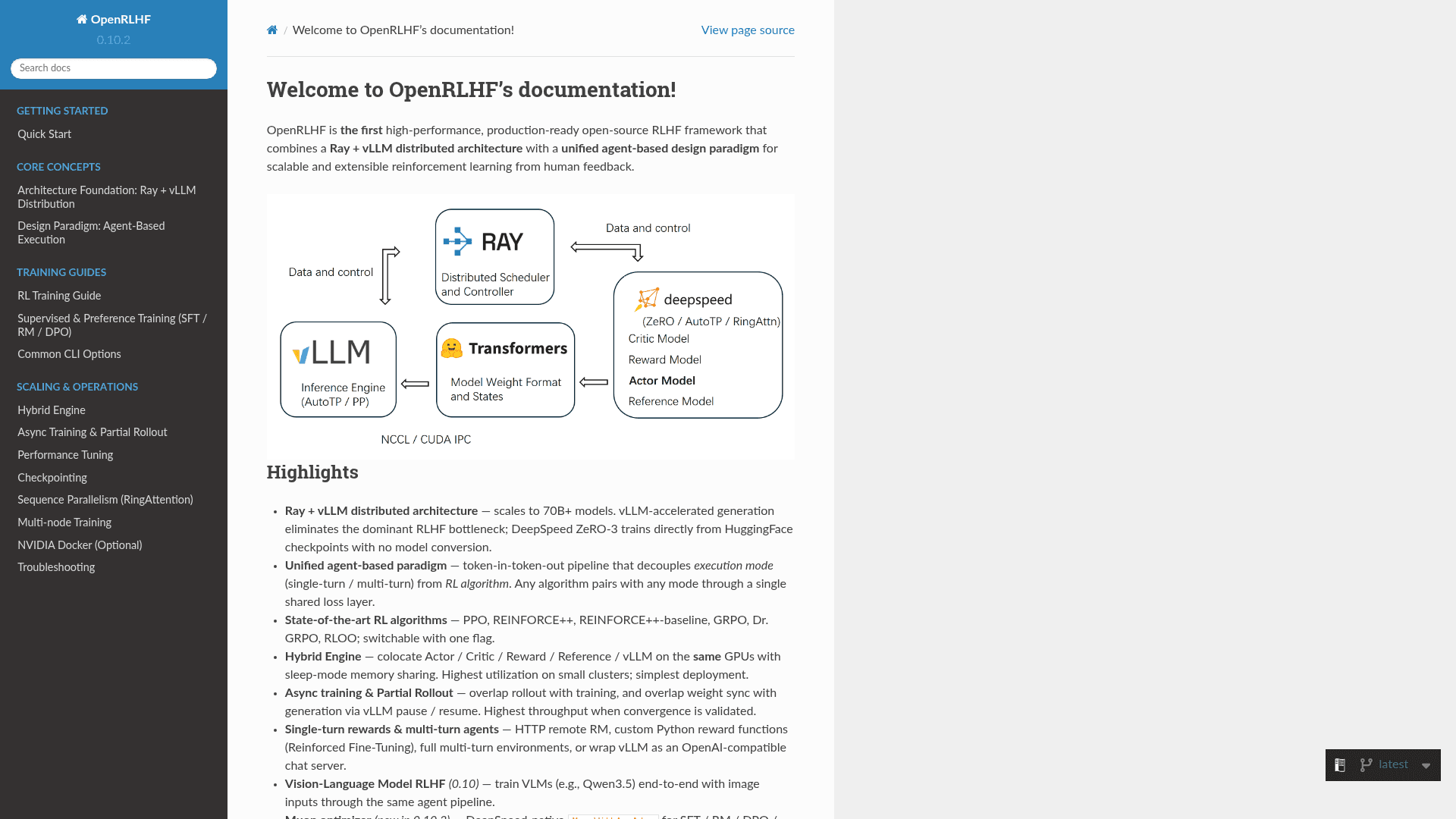
Ray schedules the Actor, Critic, Reward and Reference models across GPUs, and vLLM handles sample generation. The README states that RLHF training spends about 80% of its time on sample generation. DeepSpeed ZeRO-3 handles memory-efficient training. A Hybrid Engine mode can colocate all models and vLLM engines on the same GPUs using sleep-mode memory sharing, which suits smaller clusters. Multi-node runs are supported through Ray and SLURM.
Agent-Based Execution
Every RL run goes through a token-in-token-out agent pipeline, which separates the execution mode from the RL algorithm. Single-turn mode supports standard RLHF, remote HTTP reward models and custom Python reward functions for reinforced fine-tuning with rule-based or verifiable rewards. Multi-turn mode lets users implement reset/step environments, and an OpenAI-compatible server executor wraps vLLM to collect token traces. VLM RLHF, including multi-turn image feedback, was added in version 0.10.
Throughput and Production Options
Async training and partial rollout overlap generation with training, with the docs noting a tradeoff in stability. Off-policy correction (TIS, ICEPOP, Seq-Mask-TIS) handles vLLM-to-training log-prob mismatches. Other options include DAPO dynamic filtering, sample packing, RingAttention for long context, LoRA/QLoRA, MoE support, and the Muon optimizer. Resumable checkpoints, best-checkpoint tracking, and Wandb and TensorBoard logging are also available.
Setup Path
The README recommends an NVIDIA PyTorch Docker container, then pip install openrlhf with optional extras such as vllm, ring and liger. Installing from source is also supported. The documentation includes a quick start, CLI option reference, performance tuning, checkpointing and troubleshooting guides.
Community Discussions
Be the first to start a conversation about OpenRLHF
Share your experience with OpenRLHF, ask questions, or help others learn from your insights.
Pricing
Open Source (Apache-2.0)
Self-hosted OpenRLHF framework released under the Apache License 2.0 with no-charge, royalty-free usage rights.
- Apache License 2.0
- Ray + vLLM distributed architecture
- PPO, REINFORCE++, GRPO, RLOO algorithms
- Hybrid Engine and async training
- Self-hosted; compute/GPU costs are external
Capabilities
Key Features
- Ray + vLLM distributed architecture
- PPO, REINFORCE++, REINFORCE++-baseline, GRPO, Dr. GRPO, RLOO and FlashREINFORCE
- Unified single-turn and multi-turn agent execution
- Hybrid Engine GPU colocation with sleep mode
- Async training and partial rollout
- Custom Python and remote HTTP reward functions
- Vision-Language Model RLHF
- SFT, reward model and DPO/IPO/cDPO training
- LoRA/QLoRA and MoE support
- Muon optimizer support
- Off-policy correction (TIS, ICEPOP)
- DAPO dynamic filtering
- RingAttention sequence parallelism
- Checkpoint recovery and best-checkpoint tracking
- Wandb and TensorBoard logging
- SLURM multi-node training