Ordewell
Multi-agent task orchestration that turns one goal into a dependency graph of coding-agent tasks, each with its own runner, model, and mode, then executes and verifies them in parallel.
At a Glance
Fully free and open source under Apache-2.0. Install via npm or VS Code Marketplace.
Engagement
Available On
Alternatives
Listed Sep 2026
About Ordewell
Ordewell is an open-source, Apache-2.0-licensed multi-agent orchestration tool that converts a single plain-prose goal into an ordered, editable dependency graph of coding-agent tasks. It supports Claude Code, Codex, and OpenCode as built-in runners, and is available as a CLI, terminal UI (TUI), and VS Code extension — all backed by the same local API server.
What It Is
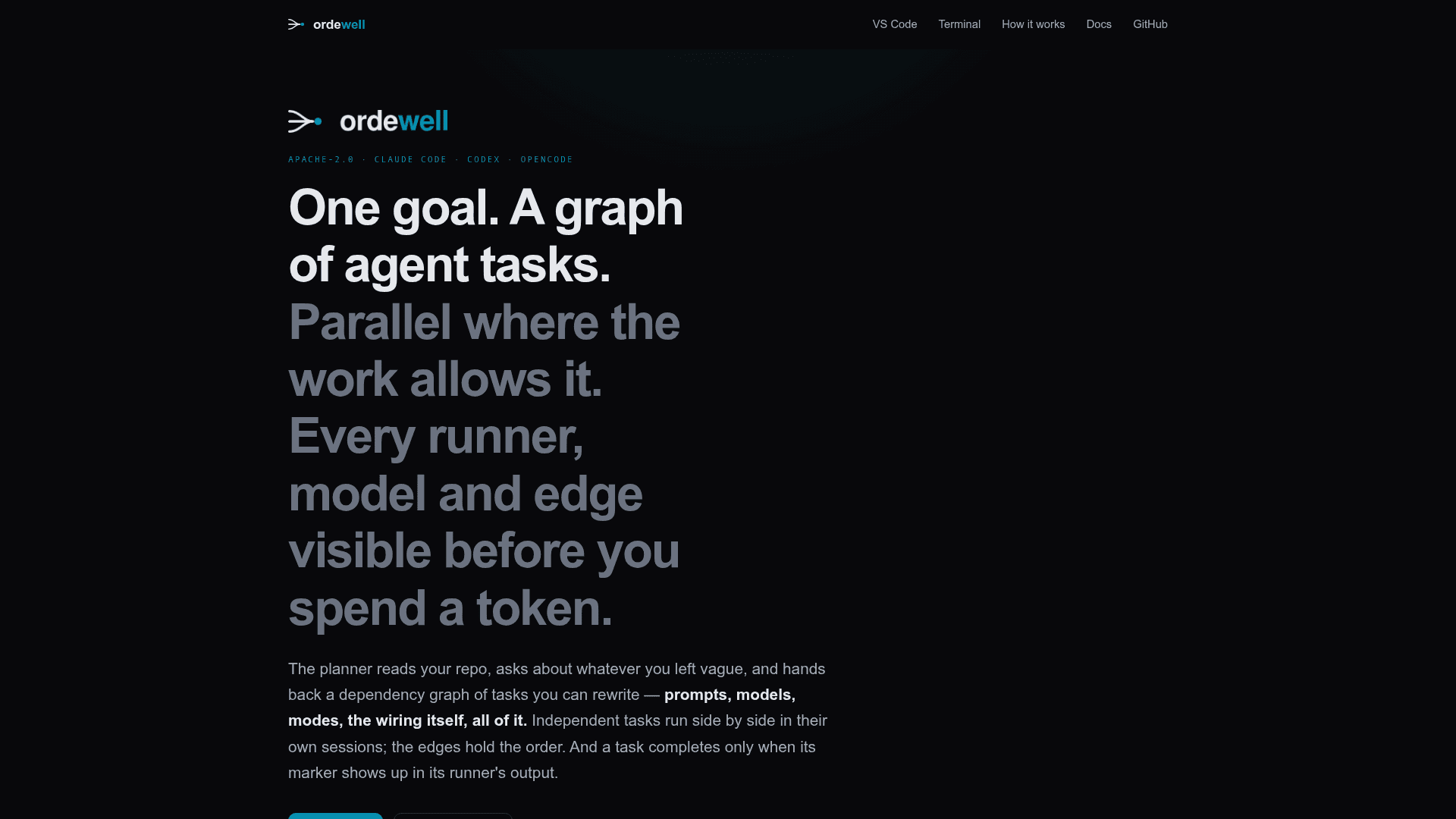
Ordewell sits between you and your coding agents: a planner reads your repository read-only, asks clarifying questions when your goal is vague, and produces a typed plan artifact — a dependency graph of tasks, each carrying its own runner, model, thinking effort, and execution mode. You rewrite the plan before anything runs, then Ordewell executes independent tasks in parallel (up to five concurrent sessions) and verifies each one by checking for a unique completion marker in the runner's output, never by asking the model if it's done.
How the Plan-First Workflow Works
The core loop has three stages:
- Plan — The planner researches the workspace read-only, refuses any write commands, and asks at least one clarifying question before committing a plan. Its final message is the plan.
- Execute — Each AI task spawns a real coding-agent session in a fresh context, handed its predecessors' results. Independent tasks run side by side; the dependency graph enforces order.
- Verify — A task passes only when its unique completion marker appears in the runner's output. Exit code is retained as diagnostic evidence. The model never grades its own work.
Skills like grill-me, prd, tdd, review, and verify are prompt blocks injected before planning — not files read from the agent — and are toggled per session.
Surfaces and Architecture
Ordewell ships four front ends over one core TypeScript package:
- Terminal UI (TUI) — Full-screen split view: planner conversation on the left, live plan on the right. Single-key bindings drive the whole loop; each task's live terminal is tmux-backed.
- VS Code Extension — A docked panel that streams live thinking, research steps, and task cards. Retargeting a task's runner re-derives its model, effort, and mode in place from that runner's real catalog.
- CLI — Every slash command has an identical
ordewellsubcommand, enforced by a parity test, so headless pipelines reach everything a human can. - HTTP + WebSocket API —
ordewell webstarts a local server on port 3742; the CLI, TUI, and extension are all clients of it.
The architecture is split into core/ (pure TypeScript, zero UI deps), cli/, vscode/, and web/ packages. Design decisions are documented as architecture decision records in docs/adr/.
Runner and Model Flexibility
Claude Code, Codex, and OpenCode ship built-in. Any other CLI agent — Aider, a custom tool — is added via a JSON plugin manifest with {{variable}} templating, requiring no code change or pull request. When multiple runners are enabled, the planner assigns one per task across the whole plan and shows every assignment before execution starts. The model picker is scoped to the selected runner's real catalog, so an invalid model ID cannot be saved. Thinking effort is configurable per task and is constrained to the levels that model actually supports.
No separate API key is required up front: Claude Code, Codex, or OpenCode can act as the planner in read-only mode, running on the subscription already held for the runners. Twenty-five API providers are also recognized via their own environment variables (OpenRouter, Anthropic, OpenAI, Gemini, xAI, Groq, DeepSeek, Mistral, and more), plus any OpenAI-compatible endpoint including local model servers.
Update: v0.4.19
The latest release is v0.4.19, published on 2026-09-10, with the repository last pushed on 2026-09-18. The project was created in July 2026 and has been actively developed since, accumulating 131 GitHub stars and 7 forks. Platform support covers macOS, Linux, and Windows (TUI requires tmux; on Windows, the TUI runs under WSL while the CLI, extension, and API server run natively).
Community Discussions
Be the first to start a conversation about Ordewell
Share your experience with Ordewell, ask questions, or help others learn from your insights.
Pricing
Open Source
Fully free and open source under Apache-2.0. Install via npm or VS Code Marketplace.
- CLI, TUI, VS Code extension, and local API server
- Claude Code, Codex, and OpenCode built-in runners
- Parallel task execution with dependency graph
- Per-task model, runner, effort, and mode assignment
- Plugin manifest system for custom runners
Capabilities
Key Features
- Dependency graph of coding-agent tasks from a single goal
- Parallel task execution respecting dependency order
- Per-task runner, model, thinking effort, and mode assignment
- Editable plan artifact before any execution begins
- Completion marker verification — no model self-grading
- Read-only planner that refuses write commands
- VS Code extension with streaming planner timeline
- Terminal UI with tmux-backed live task terminals
- CLI with full parity to all slash commands
- HTTP + WebSocket local API server
- Skills: grill-me, prd, tdd, review, verify, research-subagents
- Plugin manifest system for custom CLI runners
- Human-in-the-loop (HITL) checkpoint support
- Session auto-save and restore
- 25 API provider integrations plus OpenAI-compatible endpoints
- No API key required when using Claude Code, Codex, or OpenCode as planner
- Multi-runner plans with per-task runner assignment
- Headless/pipeline mode via environment variables