
Ornith-1
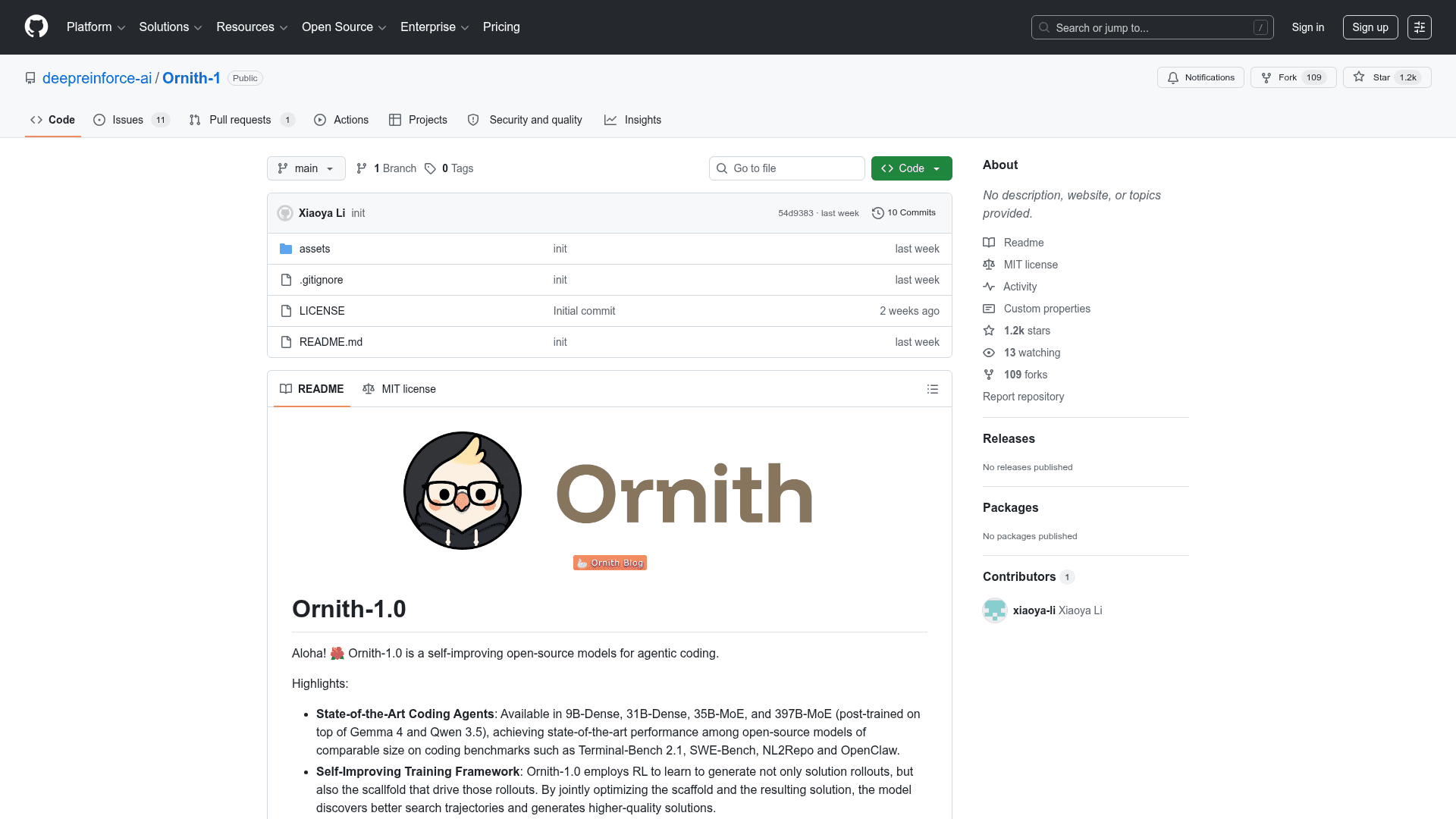
Ornith-1.0 is a self-improving open-source agentic coding model family (9B, 35B, 397B) trained with reinforcement learning to jointly optimize scaffolds and solutions for coding tasks.
At a Glance
About Ornith-1
Ornith-1.0 is a family of open-source, MIT-licensed language models built specifically for agentic coding, released by DeepReinforce AI. The models are available in four sizes — 9B-Dense, 31B-Dense, 35B-MoE, and 397B-MoE — post-trained on top of Gemma 4 and Qwen 3.5 base checkpoints. All checkpoints are published on Hugging Face and are free from regional limitations.
What It Is
Ornith-1.0 is a reasoning model family designed for autonomous software engineering tasks: resolving GitHub issues, navigating large codebases, writing and running shell commands, and completing multi-step coding workflows in a terminal environment. Unlike standard instruction-tuned models, Ornith-1.0 uses reinforcement learning to jointly optimize both the agent scaffold (the search strategy and tool-use plan) and the resulting code solution, allowing the model to discover better search trajectories during training. Each model produces a <think>…</think> chain-of-thought block before its final answer, and tool calls are emitted in a structured format that servers parse into OpenAI-style tool_calls.
Self-Improving Training Framework
The core technical differentiator of Ornith-1.0 is its RL-based self-improvement loop. Rather than training only on solution quality, the framework trains the model to generate the scaffold — the sequence of tool invocations, search steps, and intermediate reasoning — that drives the solution. By jointly optimizing scaffold and solution, the model learns to explore more effectively and produce higher-quality outputs on hard agentic benchmarks. The README describes this as enabling the model to "discover better search trajectories."
Benchmark Performance
According to the project's own published benchmark tables, Ornith-1.0 models are evaluated against size-matched baselines on:
- Terminal-Bench 2.1 (Terminus-2 and Claude Code harnesses)
- SWE-bench Verified, Pro, and Multilingual (OpenHands harness)
- NL2Repo (natural-language-to-repository tasks)
- Claw-eval (agentic code benchmark over real-user task distributions)
- SWE Atlas (QnA, RF, and TW subtasks via mini-SWE-agent)
The project claims state-of-the-art performance among open-source models of comparable size on these benchmarks. For example, the README reports Ornith-1.0-9B scoring 69.4 on SWE-bench Verified versus 53.2 for Qwen3.5-9B, and Ornith-1.0-397B scoring 82.4 on SWE-bench Verified.
Deployment Model and Setup Path
All checkpoints expose an OpenAI-compatible /v1/chat/completions endpoint and support a 256K (262,144-token) context window. Multiple serving backends are supported:
- vLLM (≥ 0.19.1) with
--enable-auto-tool-choiceand--reasoning-parser qwen3 - SGLang (≥ 0.5.9) with
--tool-call-parser qwen3_coder - Hugging Face Transformers (≥ 5.8.1) for local offline generation
- llama.cpp / Ollama via GGUF quantized variants (available for 9B and 35B)
- Unsloth for fast local inference or fine-tuning with 4-bit quantization
The 9B dense model fits on a single 80GB GPU; the MoE checkpoints require multi-GPU tensor parallelism. FP8 variants of the 35B and 397B models are published for lower-VRAM serving.
Agent Framework Compatibility
Because Ornith-1.0 uses a standard OpenAI-compatible API, it integrates directly with popular agent harnesses by setting OPENAI_BASE_URL and OPENAI_API_KEY environment variables:
- OpenHands (via LiteLLM with the
openai/prefix) - Hermes Agent
- OpenClaw
- OpenCode (via provider config in
~/.config/opencode/opencode.json)
The model is described as optimized for terminal-based coding agents and excels at tool-calling workflows.
Current Status
The repository was created in June 2026 and last updated in early July 2026, with 1,181 stars and 109 forks at the time of indexing. The project is actively maintained under the MIT license by the DeepReinforce Team and is globally accessible with no regional restrictions.
Community Discussions
Be the first to start a conversation about Ornith-1
Share your experience with Ornith-1, ask questions, or help others learn from your insights.
Pricing
Open Source
Fully open-source under MIT license, free to use, modify, and distribute.
- MIT licensed
- All model sizes (9B, 35B, 397B)
- Multiple precision formats (bf16, FP8, GGUF)
- OpenAI-compatible API
- 256K context window
Capabilities
Key Features
- Self-improving RL training framework that jointly optimizes scaffold and solution
- Available in 9B-Dense, 35B-MoE, and 397B-MoE architectures
- 256K (262,144-token) context window across all checkpoints
- OpenAI-compatible API with tool calling and reasoning content fields
- Chain-of-thought reasoning via <think>...</think> blocks
- Multiple precision variants: bf16, FP8, and GGUF quantized
- Compatible with vLLM, SGLang, Transformers, llama.cpp, and Ollama
- Works with OpenHands, Hermes Agent, OpenClaw, and OpenCode agent frameworks
- MCP server integration support
- MIT licensed with no regional restrictions
- Post-trained on Gemma 4 and Qwen 3.5 base models