Ouroboros
An open-source Agent OS that replaces ad-hoc AI prompting with a structured, specification-first workflow: interview, crystallize, execute, evaluate, and evolve.
At a Glance
Fully free and open-source under the MIT License. Self-hosted, no usage limits.
Engagement
Available On
Listed May 2026
About Ouroboros
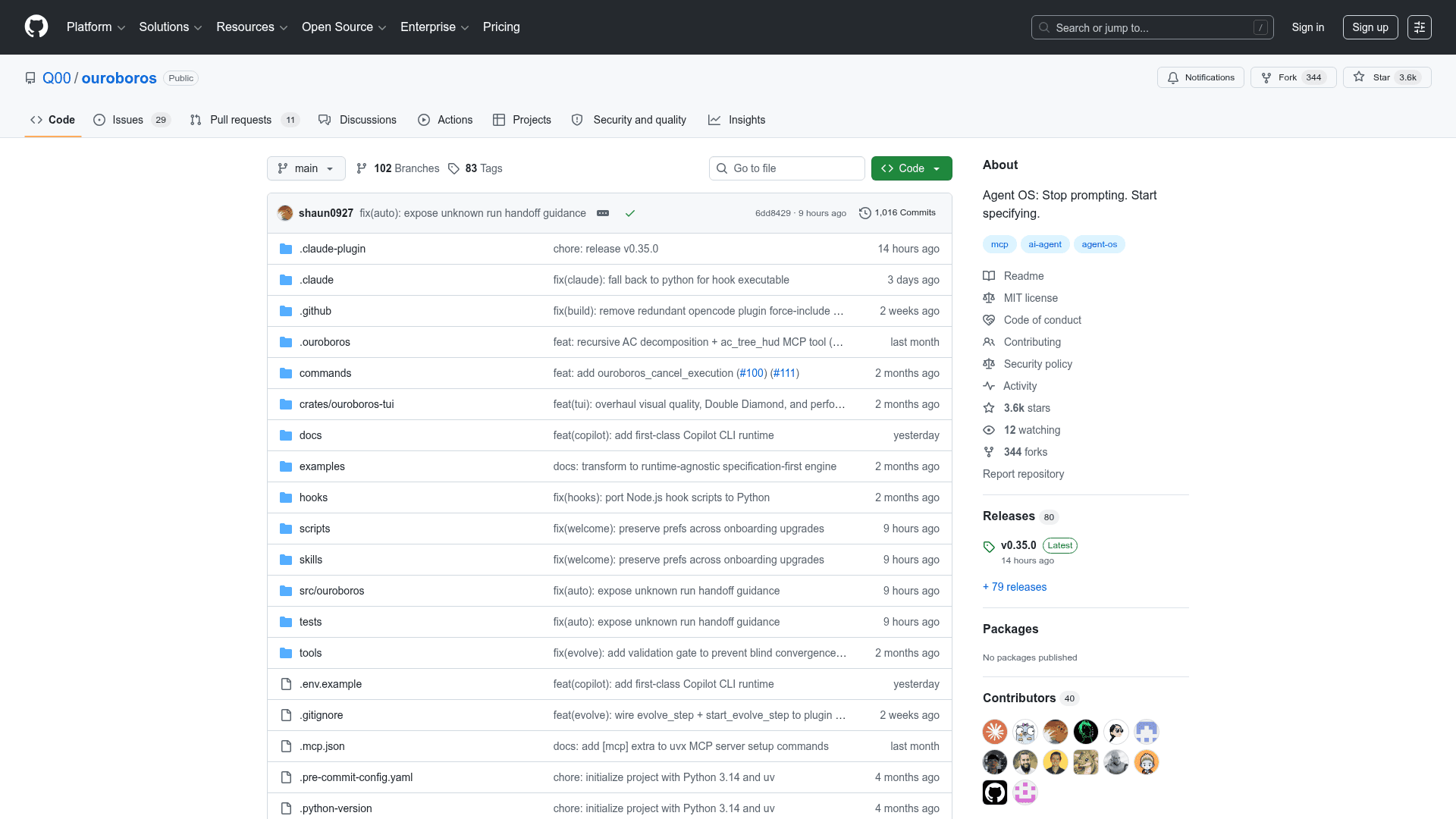
Ouroboros is an open-source Agent OS for AI coding that turns non-deterministic agent work into a replayable, observable, policy-bound execution contract. It replaces vague prompting with a structured specification-first workflow — interview, seed, execute, evaluate, evolve — ensuring that hidden assumptions are surfaced before a single line of code is written. Compatible with Claude Code, Codex CLI, OpenCode, Hermes, Gemini CLI, Kiro CLI, and GitHub Copilot CLI, it works as a local-first runtime layer installable via pip, pipx, or uv. The project is MIT-licensed and available on GitHub with over 3,500 stars.
- Socratic Interview — Run
ooo interviewto expose hidden assumptions through structured questioning before any code is generated. - Immutable Seed Spec — Crystallizes interview answers into a locked specification with acceptance criteria, ontology, and constraints; blocked by an Ambiguity gate (≤ 0.2).
- 3-Stage Evaluation Gate — Automated verification pipeline: Mechanical (free) → Semantic → Multi-Model Consensus, replacing manual "looks good" QA.
- Evolutionary Loop (Ralph) —
ooo ralphruns the full cycle persistently across session boundaries until ontology similarity reaches ≥ 0.95 convergence. - Nine Specialized Agents — On-demand agents including Socratic Interviewer, Ontologist, Seed Architect, Evaluator, Contrarian, Hacker, Simplifier, Researcher, and Architect.
- PAL Router — 3-tier cost optimization (Frugal → Standard → Frontier) with auto-escalation on failure and auto-downgrade on success.
- Double Diamond Execution — Discover → Define → Design → Deliver decomposition for structured, hierarchical task execution.
- MCP Integration — Full MCP server/client support; auto-registers with compatible runtimes during setup.
- Brownfield Support —
ooo brownfieldscans existing repos and auto-detects config files across multiple language ecosystems. - Terminal UI Dashboard — Optional Textual-based TUI for monitoring executions and session state.
- Event Sourcing Persistence — SQLAlchemy + aiosqlite EventStore reconstructs full lineage so sessions survive machine restarts.
- 100+ Model Support — LiteLLM adapter enables use with any supported provider beyond the default Claude/Codex backends.
Community Discussions
Be the first to start a conversation about Ouroboros
Share your experience with Ouroboros, ask questions, or help others learn from your insights.
Pricing
Open Source (MIT)
Fully free and open-source under the MIT License. Self-hosted, no usage limits.
- Full Ouroboros Agent OS
- All CLI commands and MCP tools
- All nine specialized agents
- Evolutionary loop (Ralph)
- 3-stage evaluation gate
Capabilities
Key Features
- Socratic interview to expose hidden assumptions before coding
- Immutable seed specification with ambiguity gate (≤ 0.2)
- 3-stage automated evaluation: Mechanical → Semantic → Multi-Model Consensus
- Evolutionary loop (Ralph) with ontology convergence detection (≥ 0.95)
- Nine specialized on-demand agents
- PAL Router for 3-tier cost optimization
- Double Diamond execution decomposition
- MCP server/client integration with auto-registration
- Brownfield repo scanning and management
- Terminal UI dashboard (Textual)
- Event sourcing persistence with SQLAlchemy + aiosqlite
- LiteLLM adapter supporting 100+ models
- Stagnation detection (spinning, oscillation, diminishing returns)
- GitHub Epic/Task issue publishing via `ooo publish`
- Interactive tutorial via `ooo tutorial`