Ouroboros App
An open-source, self-modifying AI agent that can rewrite its own code, architecture, prompts, and tools while maintaining a continuous identity and memory across tasks and restarts.
At a Glance
About Ouroboros App
Ouroboros is an open-source, general-purpose AI agent built by Anton Razzhigaev and Andrew Kaznacheev, first booted on February 16, 2026. It runs as a native desktop app or headless CLI on macOS, Linux, and Windows, keeping its runtime, memory, and history entirely on the user's machine. What distinguishes it from conventional agents is its capacity to inspect and rewrite the very implementation it runs on — including source code, architecture, prompts, tools, and dependencies — while preserving a continuous identity across restarts and releases.
What It Is
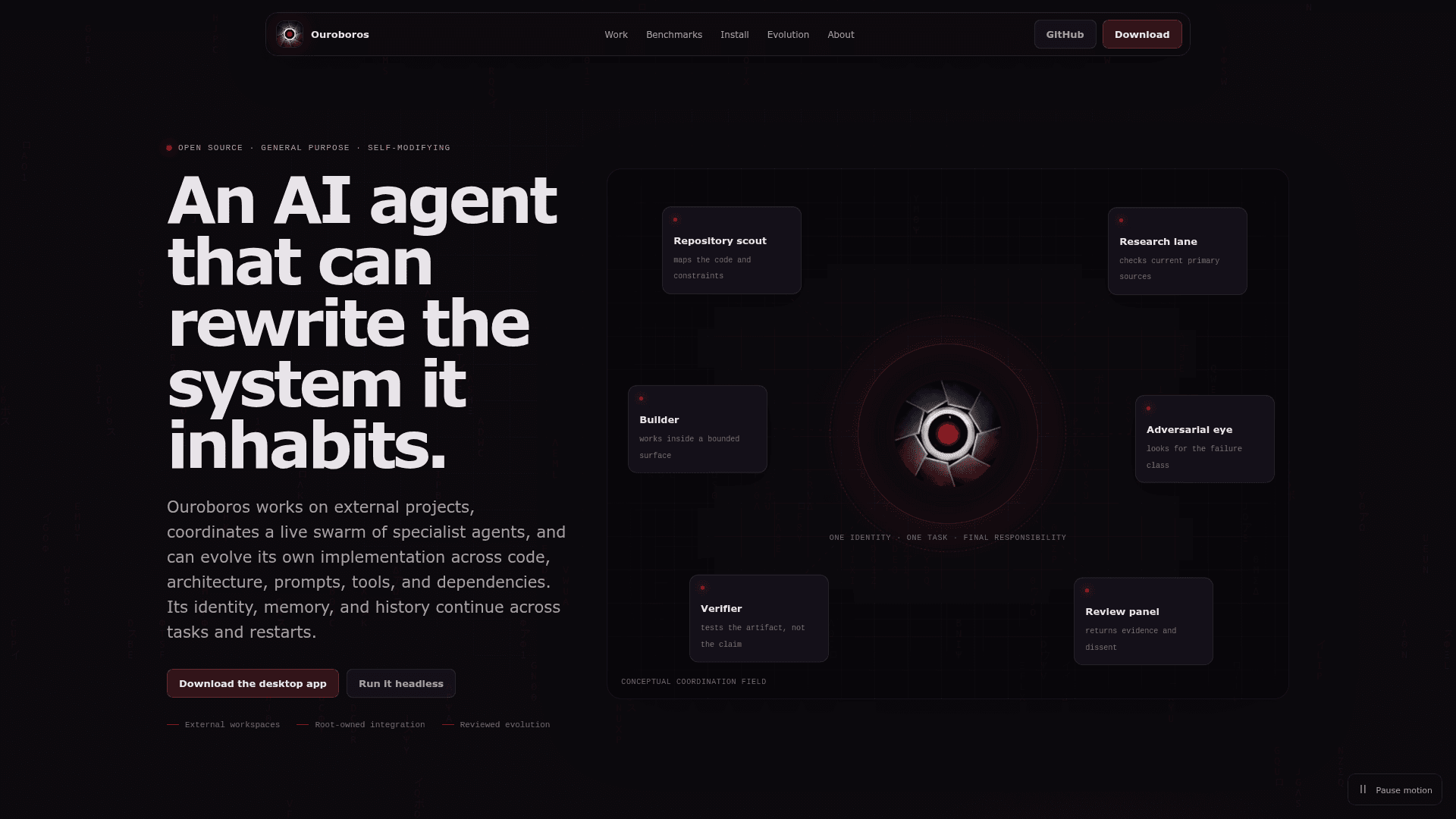
Ouroboros is a self-modifying, multi-agent system designed for general-purpose autonomous work. At its core, one root agent remains accountable for a task while delegating bounded investigations or builds to specialist subagents that can research, build, test, and review work in parallel. The root agent absorbs their results, resolves conflicts, and verifies the final artifact. Its editable surface spans application code, architecture, prompts, tools, dependencies, memory processes, and the operational environment — making it one of the few agents whose evolution reaches the implementation itself rather than just its configuration.
Self-Modification and the Immune System
Ouroboros's self-modification pipeline is governed by a constitutional document (BIBLE.md) and a deterministic review gate. Non-trivial evolution begins with scope, invariants, and affected surfaces made explicit. Independent reviewers examine the candidate change and return findings that remain attached to the record. Accepted changes become part of the versioned Git history and survive the restart that activates them. Protected constitutional and launcher boundaries have stricter rules and cannot be bypassed by the agent itself. Every skill from OuroborosHub — the companion marketplace for reviewed extensions — passes a security review before it can be enabled.
Continuity and Identity
A core design principle is that autonomous change without continuity produces a succession of disconnected systems. Ouroboros addresses this by preserving identity, narrative memory, dialogue, knowledge, reflections, task traces, and Git history across restarts and new versions. Background consciousness supports reflection, initiative, and preparation outside the immediate request-response loop. Project rooms keep working folders, journals, knowledge, task history, and conversations connected to the same identity thread.
Interfaces and Deployment
Ouroboros offers three primary surfaces:
- Desktop app — native installers for macOS (DMG), Linux (tar.gz), and Windows (zip), with a first-run wizard for model access, review policy, and budget setup.
- Headless CLI — the
ouroboroscommand attaches to the local runtime and exposes managed tasks, progress streams, artifacts, logs, schedules, and evolution controls. - Agent-to-agent — another agent, script, or CI job can invoke Ouroboros through the same gateway-backed CLI, with
--jsonlfor machine-readable event streams and--detachfor async task following.
External workspaces stay separate from Ouroboros's own repository, so the agent can work on another project without confusing that project with its own runtime. Docker support is also available for web-mode deployments. Model inference can use configurable remote provider APIs or a local GGUF model.
Update: Version 6.88.0
The latest stable release is v6.88.0, published August 4, 2026. Notable recent changes include:
- 6.88.0: MiniMax joins as a first-class direct provider; managed auto-updates become crash-safe end-to-end with exact-SHA stable promotion; the commit gate goes two-pass with a mandatory blocking post-commit test gate for assisted merges and auto-rollback.
- 6.87.6: macOS DMG installation flow simplified with a drag-to-Applications shortcut.
- 6.87.0: OSWorld working prompt separates a task's live surface from its stored one, fixing a class of failures on the benchmark.
- 6.86.0: OSWorld working prompt gains an atomic task contract written before the first mutating action.
- 6.85.0: Telegram becomes a first-party native capability via a bundled skill.
The project has been under rapid development since its February 2026 boot, advancing from the v4.1 line to v6.88 in roughly six months, with the self-authored record counting 32 evolution cycles in the first 48 hours alone.
Benchmark Claims
The project publishes self-reported benchmark results with open submissions and public trace datasets. According to the project's own evidence page, Ouroboros claims state-of-the-art results on Terminal-Bench 2.1 (86.74% with Claude Opus-5, self-reported), OSWorld-Verified (90.69% with Claude Opus-5, self-reported), and CL-Bench (normalized reward 0.2301, rank 1, self-reported). The SWE-bench Pro matched pair is described as a statistical tie with Codex CLI. The project explicitly labels all results as self-reported while upstream review is open, and notes that the same model can score differently inside a different harness.
Community Discussions
Be the first to start a conversation about Ouroboros App
Share your experience with Ouroboros App, ask questions, or help others learn from your insights.
Pricing
Open Source
Fully open-source under the MIT license. Free to use, modify, and distribute.
- Native desktop app for macOS, Linux, and Windows
- Headless CLI
- Self-modifying agent runtime
- Multi-agent swarm coordination
- Persistent identity and memory
Capabilities
Key Features
- Self-modifying implementation (code, architecture, prompts, tools, dependencies)
- Live swarm of specialist subagents (research, build, test, review)
- Persistent identity and memory across tasks and restarts
- Native desktop app for macOS, Linux, and Windows
- Headless CLI for scripted and agent-to-agent invocation
- External workspace support with separate Git worktree roots
- Background consciousness for reflection and initiative
- OuroborosHub skills marketplace with security-reviewed extensions
- Local GGUF model support and configurable remote provider APIs
- Docker deployment for web-mode runtime
- Scheduled tasks and cron-based automation
- Git history and review evidence for all implementation changes
- Project rooms with journals, knowledge, and task history
- Autonomous evolution campaigns with constitutional review gate
- MCP tool integration via reviewed extensions