
Paritok
A non-destructive compression gateway for AI coding agents that cuts input-token bills by compressing tool schemas, file reads, and history on the fly.
At a Glance
Full gateway and 4B model under Apache 2.0, run on your own hardware. No telemetry, no key, no fees.
Engagement
Available On
Alternatives
Listed Aug 2026
About Paritok
Paritok is an open-source compression gateway that sits between your coding agent and the LLM API, rewriting requests to strip token bloat before forwarding them upstream. Built by two engineers — Jiayu Shi (training, modeling, data pipeline) and Luzhuo Chen (evaluation, deployment, product) — it ships under Apache 2.0 and is available both as a self-hosted stack and as a managed hosted endpoint.
What It Is
Paritok acts as a drop-in proxy: you point your agent's BASE_URL at Paritok instead of Anthropic or OpenAI, and everything else stays the same. On every request it applies three independent compression levers — tool-schema filtering, content compression, and history summarization — then forwards the rewritten request upstream. The LLM's response comes back untouched. Nothing is permanently discarded: any compressed or filtered content is recoverable on demand via read_original or gateway_search_tools calls.
The compression engine is Paritok-4B-v1, described by the project as the first open-source 4B model trained specifically on real coding-agent trajectories (45K samples, Qwen3-4B backbone, LoRA adapter, Apache 2.0 weights). On SWE-bench Lite end-to-end evaluation, the project reports 86.5% quality retained at a 25.7% compression rate — meaning it compresses content to roughly one-quarter of its original size while retaining most agent solve quality.
The Three Compression Levers
Paritok attacks the token bill through three stacking mechanisms:
- Tool-schema filter: Coding agents often send 70+ tool schemas in full JSON on every request. Paritok uses an embedding model (BAAI/bge-small-en-v1.5, CPU-only) to keep only the schemas relevant to the current task and stub the rest. The project reports this drops a typical ~29K-token tool block to ~8K per turn — the largest single-turn saving.
- Content compression: File reads, tool output, and stale history turns are compressed by the 4B model to approximately 26% of their original size, tagged with recoverable references. Identifiers, paths, and error strings are preserved by design.
- History summarization: Turns beyond a configurable recent window are summarized once the context budget fills, keeping long sessions inside the model's context window without forcing aggressive client-side compaction.
Compounding Savings Over Sessions
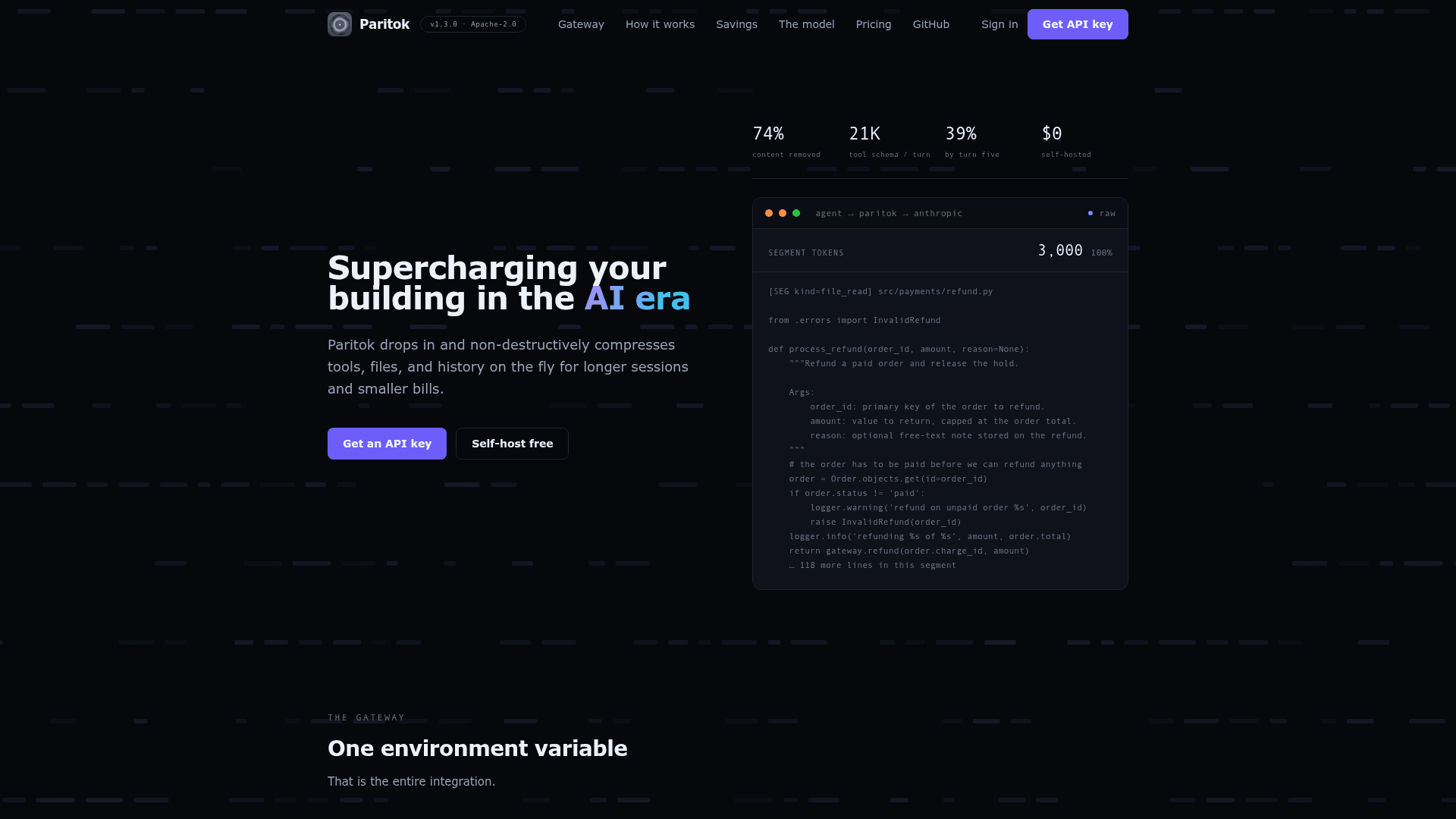
The project's own measurements show savings grow non-linearly with session length. According to the README, content compression savings are roughly quadratic (each turn's compressed reads keep paying off on every later turn), while the tool filter adds a fixed linear cut on top. The project reports approximately 25% end-to-end savings on turn 1, growing to ~39% by turn 5 and past 60% by turn 20 in a default ~40-tool configuration. A secondary benefit: because each turn's prefix is smaller, the agent fits roughly 3× more turns in the same context window before hitting compaction limits.
Deployment Model
Paritok supports two deployment paths:
- Self-host (free, Apache 2.0): The full gateway and 4B model ship open. The model runs via Ollama (~2.5GB at Q4, any 8GB GPU) or vLLM (24GB GPU, full precision). The tool filter runs entirely on CPU. Setup is a
pip install "paritok[proxy]"and a single environment variable. - Hosted GPU endpoint: A managed, always-on endpoint served by Paritok's own GPUs, accessible via API key from paritok.com. No local GPU required.
Compatible agents include Claude Code, Cursor, Codex, OpenHands, and any agent that honors BASE_URL or uses the OpenAI Chat Completions API. Any OpenAI-compatible upstream (Groq, OpenRouter, Gemini, etc.) is also supported via --openai-url.
Update: v1.3.0
The project's changelog shows active development since its July 2026 launch:
- v1.3.0 (2026-07-31): Stability release; edit-recovery improvements;
read_originalAPI rename (previouslyexpand_context). - v1.2.0 (2026-07-19): Shipped the embedding-based tool filter, described as the biggest single-turn lever, with prompt-cache-friendly tool selection and
gateway_search_toolsrecall. - v1.0.0 (2026-07-15): Gateway open-sourced as a drop-in proxy for Claude Code, Cursor, and Codex.
- Paritok-4B-v1 (2026-07-14): Model released on Hugging Face Hub with full SWE-bench Lite evaluation.
The roadmap lists a Paritok-4B-v2 targeting sub-20% compression rate, larger backbone models (10B+) for multi-day sessions, multi-language expansion beyond Python, and native MCP plugin integrations.
Community Discussions
Be the first to start a conversation about Paritok
Share your experience with Paritok, ask questions, or help others learn from your insights.
Pricing
Self-host
Full gateway and 4B model under Apache 2.0, run on your own hardware. No telemetry, no key, no fees.
- Gateway + 4B model, both open source
- ~2.5GB at Q4 — any 8GB GPU card runs it
- Tool filter runs on CPU — no GPU required
- GitHub & Discord support
- No telemetry or vendor lock-in
Hosted GPU
Managed, always-on compression endpoint on Paritok's GPUs. No GPU to buy or rent.
- Managed, always-on endpoint
- No GPU to buy or rent
- Usage dashboard
- No credit card required to start
- GitHub & Discord support
Capabilities
Key Features
- Drop-in proxy via single BASE_URL environment variable
- Tool-schema semantic filter (embedding-based, CPU-only)
- 4B model content compression to ~26% of original size
- Non-destructive: all compressed content recoverable via read_original
- History summarization for long multi-turn sessions
- Prompt-cache-friendly frozen tool-schema block
- Self-host on Ollama or vLLM (Apache 2.0)
- Managed hosted GPU endpoint
- Compatible with Claude Code, Cursor, Codex, OpenHands
- Any OpenAI-compatible upstream supported
- Live /stats endpoint with compression totals and cost savings
- SDK mode via ParitokClient wrapper
- Python 3.11+ support
- PyPI package with proxy and toolselect extras