
PeerHarness
Peer-to-peer tool that turns corrections to AI coding agents into one-sentence rules that a team votes on and installs for every member's agent.
At a Glance
Free and open source core (CLI and node), licensed under MIT or Apache-2.0 at your option; Apache-2.0 per GitHub license metadata.
Engagement
Available On
Alternatives
Listed Nov 2026
About PeerHarness
PeerHarness is an open-source, Rust-based tool by aryehlev for teams that work with AI coding agents. When you correct your agent, it turns the correction into a one-sentence rule that you can keep for yourself or propose to your team. Once a majority approves, the rule is installed for every member's agent. The README labels the current release as early and not audited.
What It Is
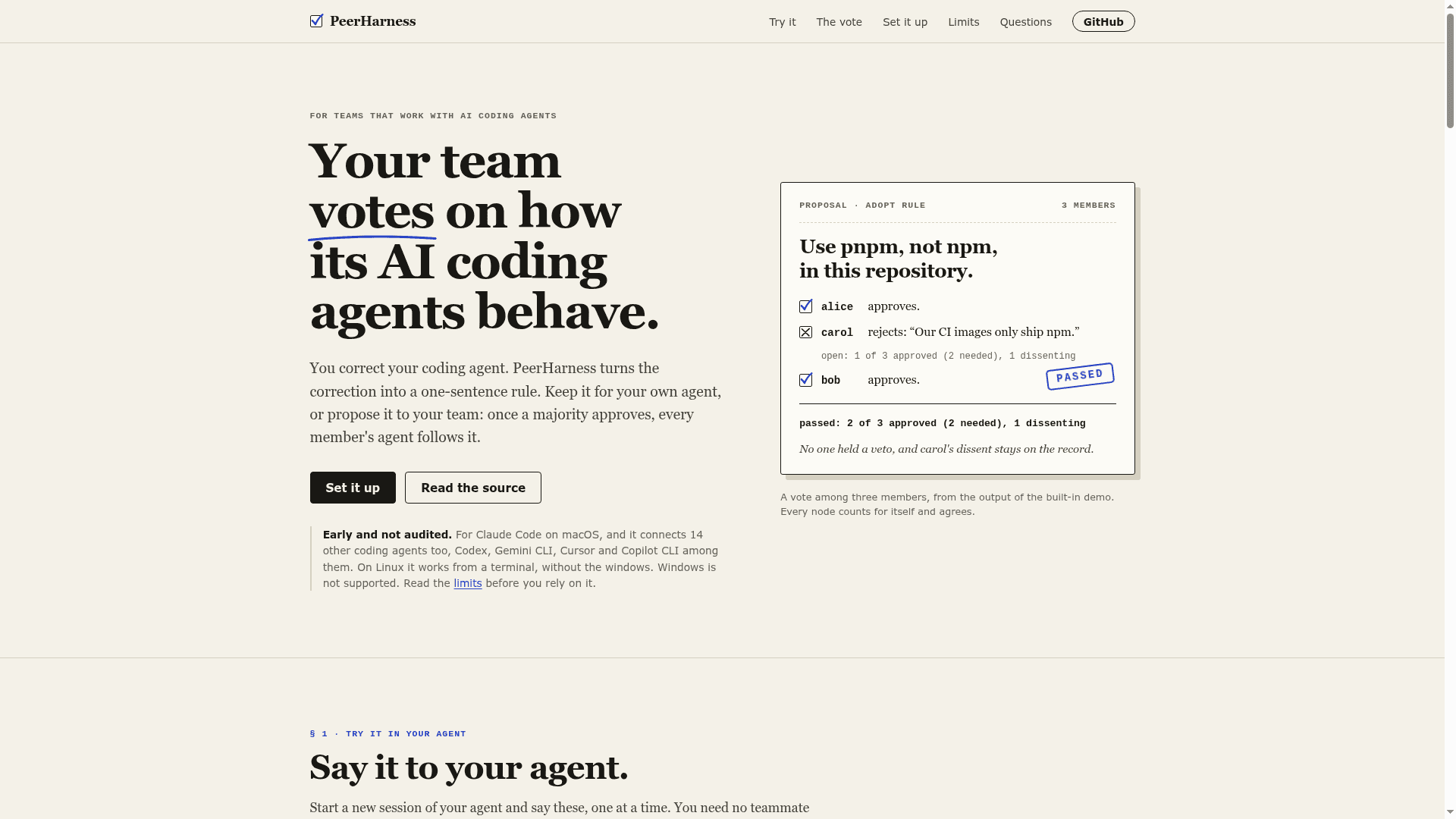
PeerHarness is a governance layer for coding-agent behavior. A correction such as "use pnpm, not npm" becomes a rule written as one instruction-only SKILL.md file, an Agent Skill. Each person runs their own node with their own keys, and there is no server or account. Every node checks every signature and counts every vote for itself. It is also a command-line tool: every step has a command equivalent, and peerharness demo runs a sample vote on your machine in a temporary folder.
How the vote works
- One person has one vote, regardless of how many devices they use.
- A rule passes by a majority of everyone entitled to vote; not voting counts as not approving, and a reject is recorded with its reason but does not block.
- There are no deadlines and no coordinator, so nodes holding the same records reach the same result.
- Admitting or removing members and changing thresholds are also voted. The founder's key signs the charter but cannot replace the vote.
- Any member can opt out of a single rule on their own machine.
Agent workflow and safety
You tell your agent a rule, ask it to keep it or propose it to a team, then vote. Each of those steps opens a window showing the exact text, with Cancel and Proceed buttons, and the agent cannot answer it. Per the project, PeerHarness never executes a rule, tool pre-approval and shell-injection syntax are refused, and high-risk content is never installed without asking you. The project states that the guard is not a sandbox.
Setup path and limits
You paste a prompt into your agent, which installs a release binary checked against SHA256SUMS into ~/.local/bin; you then run peerharness setup yourself. Setup connects Claude Code and the other agents it finds, and one hook keeps a redacted copy of your prompts locally, for 14 days by default, in an unencrypted database. Claude Code on macOS is the primary target; Linux works from a terminal without windows, and Windows is not supported. Documented limits include a maximum of 64 members, no secret ballot, and nodes being reachable only while a daemon runs.
Community Discussions
Be the first to start a conversation about PeerHarness
Share your experience with PeerHarness, ask questions, or help others learn from your insights.
Pricing
Open Source
Free and open source core (CLI and node), licensed under MIT or Apache-2.0 at your option; Apache-2.0 per GitHub license metadata.
- Peer-to-peer, no server or sign-up
- Turns corrections into one-sentence rules voted on by team majority
- Works with Claude Code and 14 other coding agents
- Written in Rust
- Early (v0.5.0) and not audited; Windows not supported
Capabilities
Key Features
- Turns agent corrections into one-sentence rules
- Keep a rule privately or propose it to a team
- Majority-of-everyone voting with no veto
- Peer-to-peer, no server or account
- Confirmation windows showing exact text before any action
- Rules installed as instruction-only Agent Skills
- Per-rule opt-out on each member's machine
- Voted membership and charter changes
- Built-in demo of a three-member vote
- Connects 15 coding agents including Claude Code, Codex, Gemini CLI, Cursor and Copilot CLI