EveryDev.ai
Subscribe
Home
Tools

3,107+ AI tools

  • New
  • Trending
  • Featured
  • Compare
  • Arena
Categories
  • Agents2189
  • Coding1574
  • Infrastructure698
  • Marketing534
  • Projects498
  • Research456
  • Design416
  • Analytics389
  • Testing296
  • MCP290
  • Security286
  • Data262
  • Integration197
  • Prompts189
  • Communication183
  • Extensions173
  • Learning170
  • Voice151
  • Commerce135
  • DevOps123
  • Web86
  • Finance26
AI Tools by Topic
  • AI Coding Assistants
  • Agent Frameworks
  • MCP Servers
  • AI Prompt Tools
  • Vibe Coding Tools
  • AI Design Tools
  • AI Database Tools
  • AI Website Builders
  • AI Testing Tools
  • LLM Evaluations
Follow Us
  • X / Twitter
  • LinkedIn
  • Reddit
  • Discord
  • Threads
  • Bluesky
  • Mastodon
  • YouTube
  • GitHub
  • Instagram
Get Started
  • About
  • Editorial Standards
  • Corrections & Disclosures
  • Community Guidelines
  • Advertise
  • Contact Us
  • Newsletter
  • Submit a Tool
  • Start a Discussion
  • Write A Blog
  • Share A Build
  • Terms of Service
  • Privacy Policy
Explore with AI
  • ChatGPT
  • Gemini
  • Claude
  • Grok
  • Perplexity
Agent Experience
  • llms.txt
Theme
With AI, Everyone is a Dev. EveryDev.ai © 2026
    1. Home
    2. Tools
    3. Personal Codex Vault
    Personal Codex Vault icon

    Personal Codex Vault

    Agent Memory
    Featured

    A starter monorepo template that gives OpenAI Codex durable shared memory across projects, people, skills, and writing style.

    Visit Website

    At a Glance

    Pricing
    Free

    Free GitHub template that can be cloned and used without cost.

    Engagement

    Available On

    CLI

    Resources

    WebsiteGitHubllms.txt

    Topics

    Agent MemoryAI Coding AssistantsKnowledge Management

    Alternatives

    PiecesMemoriqPMB
    Developer
    Jason LiuJason Liu develops Instructor, an open-source Python library…

    Listed Jul 2026

    About Personal Codex Vault

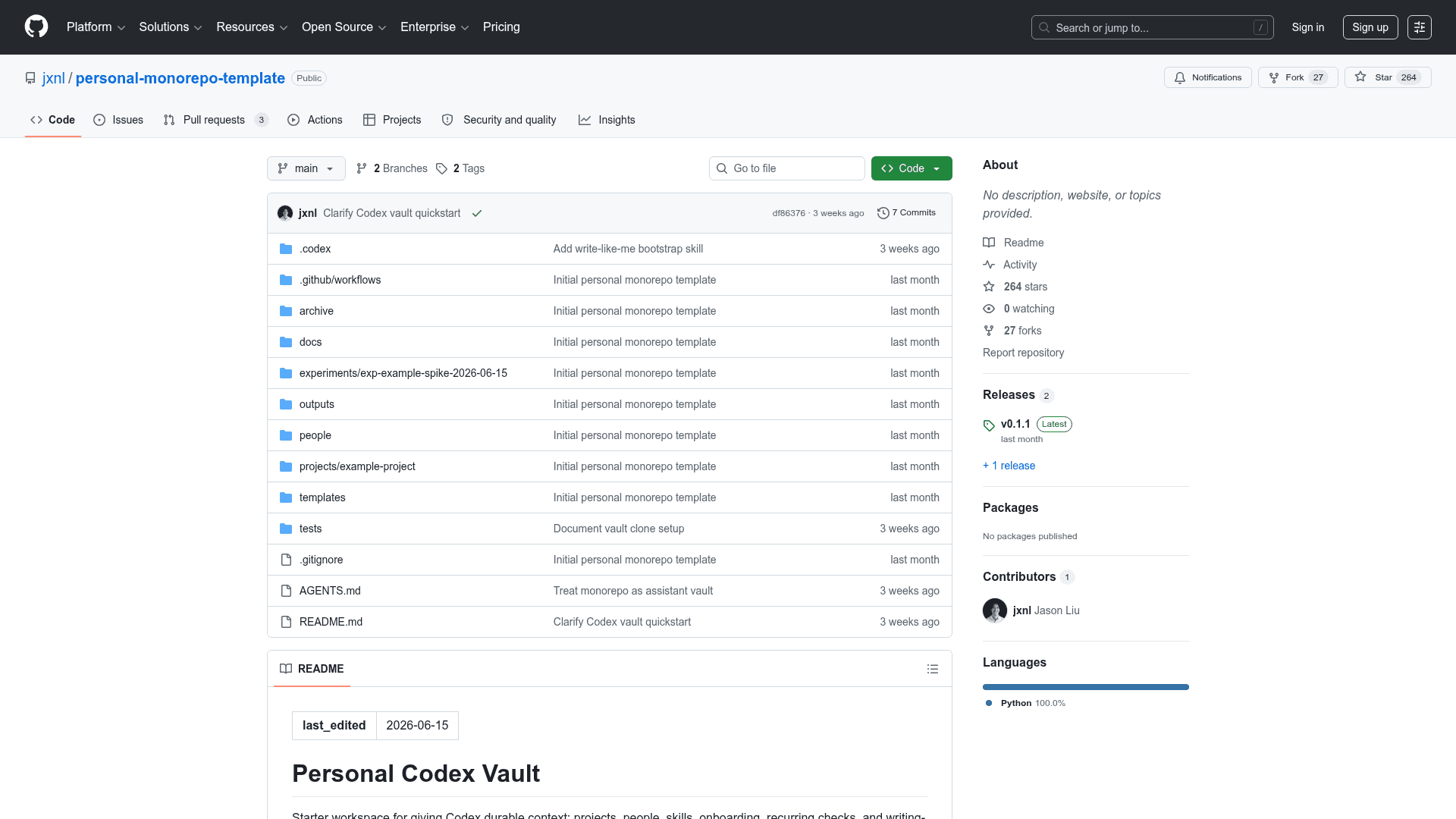
    Personal Codex Vault is a GitHub template repository created by Jason Liu (jxnl) that provides a structured workspace for giving OpenAI Codex persistent, durable context. It acts as a shared-memory vault where Codex can look up information before acting and write back important context after user approval. The template was published in June 2026 as an early-stage, actively developed project.

    What It Is

    Personal Codex Vault is a monorepo scaffold designed to serve as the long-term memory layer for Codex-powered AI workflows. Rather than starting each Codex session from scratch, users clone this template as ~/vault and point a Codex project at it. The repo then becomes the canonical store for project notes, collaborator profiles, repo-local skills, and writing-style memory that Codex can read and update over time.

    Repository Structure

    The template organizes context into clearly scoped directories:

    • projects/ — long-lived active work
    • experiments/ — short-lived spikes and proofs of concept
    • people/ — notes about collaborators and agents
    • .codex/skills/ — repo-local skill definitions Codex can invoke
    • templates/ — starter files for new entries
    • tests/ — checks for template integrity

    Onboarding Workflow

    Setup is designed to be a single command. After cloning the template and creating a Codex project rooted at ~/vault, users trigger onboarding by running the onboard-me command in a new thread. The onboarding skill then:

    • Reads the workspace and asks what projects and people matter
    • Checks for missing plugins (Gmail, Slack, GitHub, Google Drive, Browser, and others)
    • Offers thread automations for recurring checks, defaulting to 9:00 AM and 4:00 PM check-ins
    • Bootstraps a write-like-me skill from sent Slack and email writing
    • Proactively proposes people/*.md, project packets, and AGENTS.md updates

    Codex is instructed to ask before sending messages, editing shared docs, creating automations, or writing shared memory.

    Built-in Skills

    Repo-local skills live under .codex/skills/ and cover the most common recurring workflows:

    • onboarding — first-time setup
    • assistant — ongoing work support after onboarding
    • loop — recurring checks on a thread
    • new-project — scaffold a new project or experiment
    • new-person — create a person note
    • write-like-me-bootstrap — generate a personal writing-style skill from Slack and email history

    Release And Licensing

    The repository reached its initial tagged release at v0.1.1, published on June 15, 2026, the same day the earlier v0.1.0 tag landed, indicating active early-stage development. No license file is present in the repository at this time, so no formal open-source terms are declared.
    Community Discussions

    Be the first to start a conversation about Personal Codex Vault

    Share your experience with Personal Codex Vault, ask questions, or help others learn from your insights.

    Pricing

    FREE

    Free Template

    Free GitHub template that can be cloned and used without cost.

    • Full monorepo template
    • All built-in skills
    • Onboarding workflow
    • Community contributions via GitHub

    Capabilities

    Key Features

    • Durable shared memory vault for Codex
    • Structured directories for projects, experiments, and people
    • Repo-local skills under .codex/skills/
    • Automated onboarding via $onboard me command
    • Write-like-me skill bootstrapped from Slack and email
    • Recurring check-in automations (9 AM and 4 PM defaults)
    • Plugin integration support (Gmail, Slack, GitHub, Google Drive, etc.)
    • Chrome extension support via Codex Chrome Extension
    • AGENTS.md and people/*.md auto-proposal during onboarding
    • Template integrity tests

    Integrations

    OpenAI Codex
    Gmail
    Outlook
    Google Calendar
    Google Drive
    Notion
    Slack
    Microsoft Teams
    GitHub
    Linear
    Chrome
    Browser

    Ratings & Reviews

    No ratings yet

    Be the first to rate Personal Codex Vault and help others make informed decisions.

    Developer

    Jason Liu

    Jason Liu develops Instructor, an open-source Python library for structured LLM outputs. He focuses on building developer tools that simplify working with large language models through type-safe data extraction. The project has gained significant traction in the AI development community for its elegant Pydantic-based approach.

    Read more about Jason Liu
    GitHub
    2 tools in directory

    Similar Tools

    Pieces icon

    Pieces

    AI-powered desktop app for developers that captures workflow context, builds on-device long-term memory, and integrates with IDEs, browsers, CLIs, and local LLMs for context-aware coding.

    Memoriq icon

    Memoriq

    A private, end-to-end encrypted vault for saving and searching AI conversations from ChatGPT, Claude, Gemini, and Grok — hosted or self-hostable.

    PMB icon

    PMB

    Local-first persistent memory for AI coding agents (Claude Code, Cursor, Codex) over MCP, storing decisions, lessons, and facts in a single SQLite file on your disk with no cloud or API keys required.

    Browse all tools

    Related Topics

    Agent Memory

    Memory layers, frameworks, and services that enable AI agents to store, recall, and manage information across sessions. These tools provide persistent, semantic, and contextual memory for agents, supporting personalization, long-term context retention, graph-based relationships, and hybrid RAG + memory workflows.

    95 tools

    AI Coding Assistants

    AI tools that help write, edit, and understand code with intelligent suggestions.

    618 tools

    Knowledge Management

    AI-powered systems for organizing, discovering, and accessing collective team knowledge with intelligent search, tagging, and contextual recommendations across knowledge bases and wikis.

    122 tools
    Browse all topics
    Back to all toolsSuggest an edit
    ratings
    discussions