
Pi Extensions for the Pi Coding Agent
A TypeScript monorepo of independently installable extensions for the Pi Coding Agent, covering coding, browser automation, research, Git workflows, observability, and more.
At a Glance
Fully free and open source under the MIT License. All packages are freely installable from npm.
Engagement
Available On
Listed Aug 2026
About Pi Extensions for the Pi Coding Agent
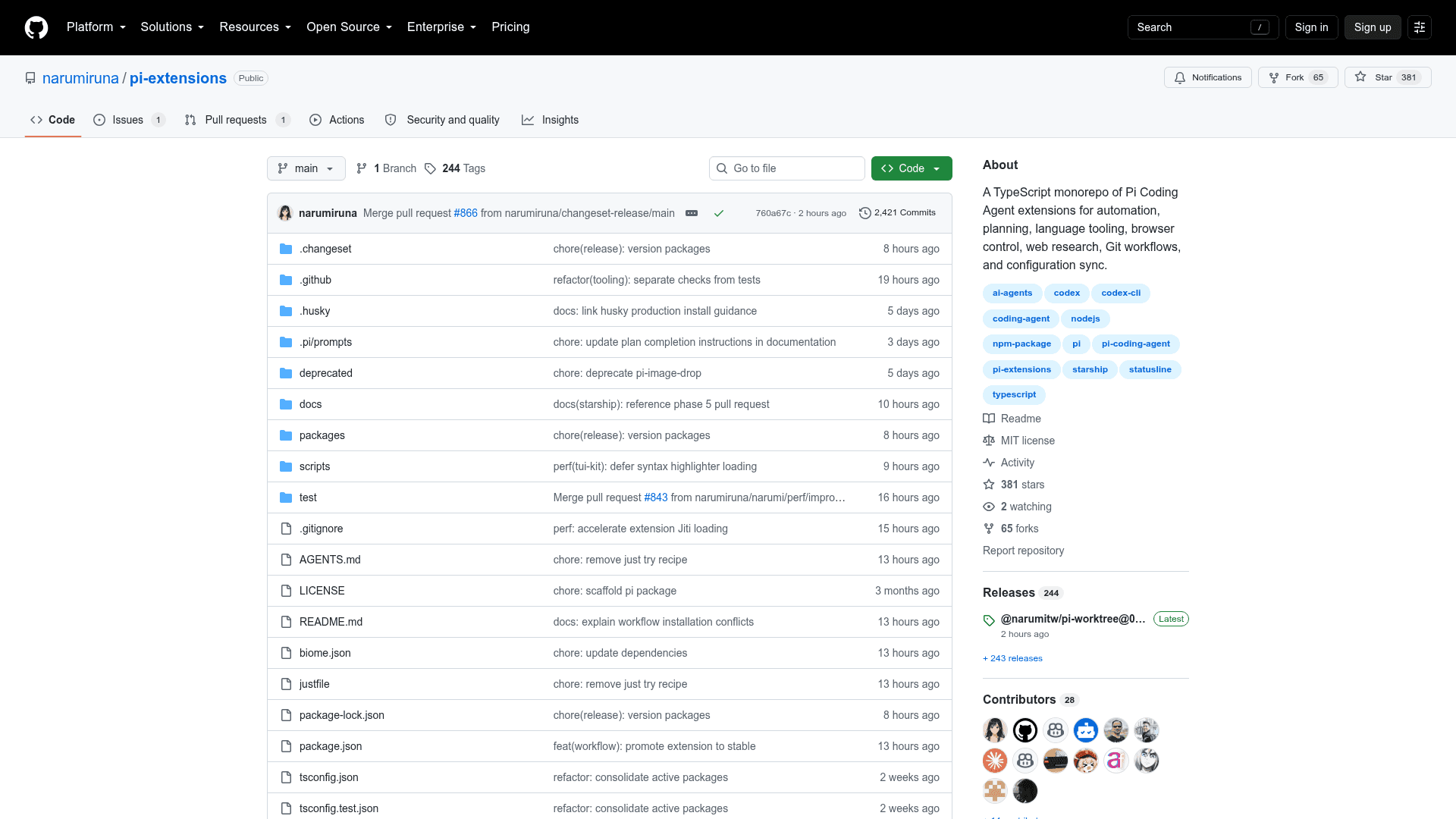
Pi Extensions is an open-source TypeScript monorepo maintained by narumiruna that provides independently installable extensions and reusable libraries for the Pi Coding Agent. Every package is published separately under the @narumitw npm scope, so users install only what they need. The project is licensed under MIT and hosted on GitHub, where it has accumulated 370 stars and 65 forks as of mid-2026.
What It Is
Pi Extensions is a collection of plug-in packages that extend the capabilities of the Pi Coding Agent — a terminal-based AI coding assistant. Rather than shipping a monolithic feature set, the project organizes extensions into focused, composable units across five functional areas: coding and delegation, browser and research, task and workspace workflows, accounts and data, and status and observability. Each extension is a standalone npm package that can be installed permanently with pi install or tried temporarily with pi -e.
Extension Categories and Highlights
The repository groups its stable extensions into well-defined categories:
- Coding and delegation:
pi-lspbrings language-server diagnostics and code actions for JavaScript, TypeScript, Python, Rust, Go, Ruby, C/C++, JVM, .NET, Swift, shell, and infrastructure formats.pi-subagentsenables delegating isolated work in single, parallel, or chained execution modes.pi-plan-modeadds a read-only/plancollaboration step before implementation begins. - Browser and research:
pi-chrome-devtoolsconnects to Chrome via the DevTools Protocol to inspect tabs, navigate pages, evaluate JavaScript, and capture screenshots.pi-firecrawlintegrates Firecrawl for page scraping, site crawling, URL discovery, and web search. - Task and workspace workflows:
pi-goalkeeps the agent working until a goal is verified complete, with an optional ordered queue.pi-worktreemanages Git worktrees while carrying the Pi session into another workspace.pi-caffeinateprevents system sleep during long-running prompts. - Accounts and data:
pi-accountsswitches named OpenAI Codex, Anthropic, and GitHub Copilot OAuth accounts.pi-syncsyncs Pi settings and optional sessions through Cloudflare R2 or S3-compatible storage. - Status and observability:
pi-statuslineshows model, tools, Git state, context usage, tokens, cost, and time in a configurable footer.pi-langfusesends agent runs, token usage, costs, and tool activity to Langfuse.pi-github-prsurfaces pull request checks, reviews, and comment counts via theghCLI.
Architecture and Development Model
The repository is a TypeScript monorepo using npm workspaces. Each active package contains its own package.json, README.md, LICENSE, tsconfig.json, and TypeScript source under src/. Stable extensions expose a thin src/index.ts Pi entrypoint; reusable libraries publish built ESM and type declarations from dist/. The pi-tui-kit library provides reusable navigation helpers and declarative UI flows for extension authors. Versioning is managed through Changesets, with packages versioned independently and published with npm provenance. The release workflow creates package-specific tags and GitHub releases such as @narumitw/pi-goal@0.50.0.
Experimental Extensions
Several extensions are published and installable but carry an explicit experimental lifecycle warning, meaning their interaction models and APIs may change between releases. These include pi-analytics for private local metrics, pi-chat for ephemeral peer-to-peer chat rooms, pi-file-context for attaching file snapshots with Git provenance to prompts, pi-fleet for managing multiple Pi processes in Ghostty splits, pi-recall for saving and quoting messages across sessions, and pi-workflow for an integrated Plan-to-Goal handoff combining pi-plan-mode and pi-goal.
Update: @narumitw/pi-workflow@0.4.0
The latest release as of August 19, 2026 is @narumitw/pi-workflow@0.4.0, reflecting active development across the monorepo. The repository was last pushed on August 19, 2026, and the project shows consistent release cadence with independent package versioning. Several earlier packages — including pi-biome-lsp, pi-python-lsp, pi-codex-accounts, pi-codex-usage, and pi-retry — have been deprecated and replaced by more capable successors, signaling ongoing architectural refinement.
Community Discussions
Be the first to start a conversation about Pi Extensions for the Pi Coding Agent
Share your experience with Pi Extensions for the Pi Coding Agent, ask questions, or help others learn from your insights.
Pricing
Open Source
Fully free and open source under the MIT License. All packages are freely installable from npm.
- All stable extensions freely installable via npm
- All experimental extensions freely installable via npm
- MIT license — use, modify, and distribute freely
- Full source code available on GitHub
Capabilities
Key Features
- Independently installable npm packages under @narumitw scope
- Language-server diagnostics via pi-lsp for JS, TS, Python, Rust, Go, Ruby, C/C++, JVM, .NET, Swift, shell
- Browser automation via Chrome DevTools Protocol with pi-chrome-devtools
- Web scraping and crawling via Firecrawl integration
- Sub-agent delegation in single, parallel, or chained modes
- Goal-driven agent execution with pi-goal
- Git worktree management with pi-worktree
- Multi-account switching for OpenAI Codex, Anthropic, and GitHub Copilot
- Settings sync via Cloudflare R2 or S3-compatible storage
- Observability integration with Langfuse
- Configurable status footer with model, Git, token, cost, and time info
- GitHub PR checks and review status via gh CLI
- Read-only plan mode before implementation
- OpenAI Codex Remote Compaction V2 checkpoint support
- Experimental peer-to-peer chat rooms
- File context attachment with Git provenance
- Private local analytics for model calls and tool activity
- Starship-style TOML footer with Pi-specific modules
- Reusable pi-tui-kit library for extension authors
- Independent package versioning via Changesets