
Polygres
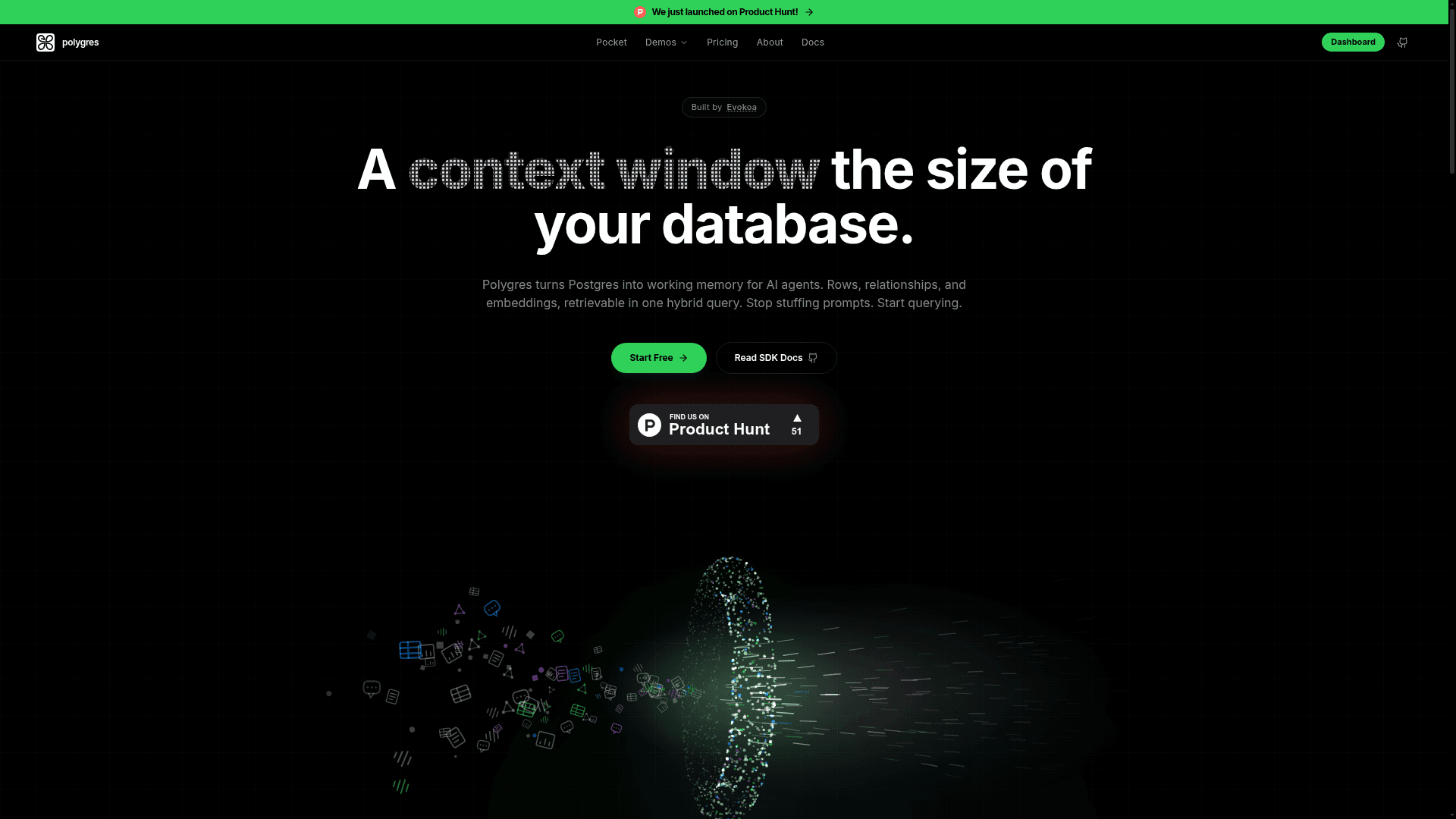
Polygres turns Postgres into working memory for AI agents by combining relational, graph, and vector search into a single hybrid retrieval query.
At a Glance
Open source and free forever. Run pgGraph and pgVector on your own Postgres instance.
Engagement
Available On
Listed Aug 2026
About Polygres
Polygres is a database platform built by Evokoa that extends PostgreSQL with native graph traversal (pgGraph) and HNSW vector search (pgVector), exposing them through a unified hybrid retrieval API designed for AI agents. It launched on Product Hunt and is available as a managed cloud service or as a self-hosted open-source stack. The Python SDK (Apache 2.0) is published on PyPI at version 0.1.0, and a companion CLI (polygres-cli) handles project management from the terminal.
What It Is
Polygres positions itself as "working memory for AI agents" — a single query endpoint that replaces the typical combination of a separate vector store, a graph database, and a relational database. Instead of syncing data across multiple systems, agents query Polygres once and receive a ranked, token-ready context block that fuses relational rows, multi-hop graph paths, and semantic embeddings. The core components are pgGraph (foreign-key-based graph traversal) and pgContext (ten concurrent search methods fused into one ranked result), running on top of a standard PostgreSQL 17 instance.
How the Retrieval Stack Works
Polygres exposes three retrieval layers that can be used independently or chained:
- Vector search — HNSW similarity search with scalar filters,
similar_torow lookups, and optional embedding value return. - Text search — TSVector full-text search and fuzzy matching against configured columns.
- Graph traversal —
expand,neighborhood,related,path, andconnectionoperations over a compiled graph built from existing foreign keys; supports multi-hop traversal up to a configurable depth. - Hybrid retrieval —
graph_first,vector_first, andjointmodes that blend graph context scores with vector similarity scores into a single ranked page of results.
Every list-style method returns a Page with cursor-based pagination and an auto_paging_iter() helper.
Architecture and Deployment Model
The SDK is a pure HTTP client — it does not open direct Postgres connections or bundle drivers like asyncpg or psycopg. It authenticates with an API key and a per-project Runtime API URL. The managed cloud runs on Kubernetes and Docker with automated vertical and horizontal scaling. Self-hosters can run pgGraph and pgVector on any existing Postgres instance using the open-source components. A visual Schema Playground in the dashboard lets teams configure relationships, manage join tables, and build hybrid indexes without writing SQL.
Agent Skills Integration
Polygres ships an optional Agent Skills package (Evokoa/polygres-skills) compatible with Codex, Claude Code, and other coding agents. Once installed, agents can be prompted to write, test, and troubleshoot retrieval code using the SDK. The skill is installed via npx skills add or through native plugin marketplaces in Codex and Claude Code, and covers both SDK retrieval guidance and CLI project-management tasks.
Update: SDK v0.1.0
The Polygres SDK reached version 0.1.0, published to PyPI on July 10, 2026. The release separates the SDK (polygres-sdk) from the CLI (polygres-cli), which were previously bundled in the 0.2.x package. The GitHub repository under Evokoa/polygres-sdk is licensed Apache 2.0 and was last pushed in July 2026. Interactive demos for Wikipedia-scale hybrid search and a user-memory retrieval playground are live at polygres.com, and the CLI is documented at docs.evokoa.com/polygres/cli.
Community Discussions
Be the first to start a conversation about Polygres
Share your experience with Polygres, ask questions, or help others learn from your insights.
Pricing
Self-Hosted
Open source and free forever. Run pgGraph and pgVector on your own Postgres instance.
- Open Source pgGraph & pgVector
- Run on any Postgres instance
- Community Support
Launch
Ideal for building personal projects, hobby applications, and early-stage agents.
- Managed cloud database hosting
- Support: Email & Community Discord
Scale
For companies and teams scaling production agents with dedicated support channels.
- Automated vertical & horizontal scaling
- Support: Email & Community Discord
- Private Discord/Slack Channel
- Support Hours: 8:00 AM - 5:00 PM
Enterprise
For organizations requiring custom compliance, high availability, and 24/7 SLA support.
- Dedicated database cluster infrastructure
- Email & Community Discord
- Private Discord/Slack Channel
- Support Hours: 24/7
- Dedicated Support SLA & Uptime SLA
Capabilities
Key Features
- Hybrid retrieval combining vector, graph, and relational search in one query
- pgGraph: multi-hop graph traversal over existing foreign keys
- pgContext: ten concurrent search methods fused into one ranked result
- HNSW vector similarity search with scalar filtering
- TSVector full-text search and fuzzy text matching
- Graph-first, vector-first, and joint hybrid retrieval modes
- Cursor-based pagination with auto_paging_iter()
- Managed cloud hosting with automated vertical and horizontal scaling
- Self-hosted open-source deployment on any Postgres instance
- Visual Schema Playground for configuring relationships and hybrid indexes
- Polygres CLI for project management and terminal-based queries
- Agent Skills for Codex and Claude Code integration
- PostgreSQL 17 base with ACID compliance
- Python SDK (Apache 2.0) published on PyPI