Portkey
A production-ready AI Gateway and LLMOps platform that routes to 1,600+ LLMs with a unified API, plus observability, guardrails, prompt management, and governance.
At a Glance
About Portkey
Portkey is a full-stack LLMOps platform built by Portkey, Inc. (San Francisco) that combines an open-source AI Gateway with a hosted control plane for observability, guardrails, prompt management, and AI governance. The core gateway is MIT-licensed and available on GitHub, while the hosted and enterprise tiers add advanced features on top. Palo Alto Networks has announced its intent to acquire Portkey, as noted on the Portkey homepage.
What It Is
Portkey sits between your application and any LLM provider, acting as a unified routing and management layer. Developers send requests to a single OpenAI-compatible API endpoint, and Portkey handles routing, reliability, caching, logging, and policy enforcement across 1,600+ language, vision, audio, and image models from 45+ providers. The gateway is described in the GitHub README as "blazing fast (<1ms latency) with a tiny footprint (122kb)" and "battle tested, with over 10B tokens processed everyday" — these are vendor-published claims.
Core Capabilities
- AI Gateway: Universal API with automatic fallbacks, load balancing, retries (up to 5 attempts with exponential backoff), request timeouts, and conditional routing
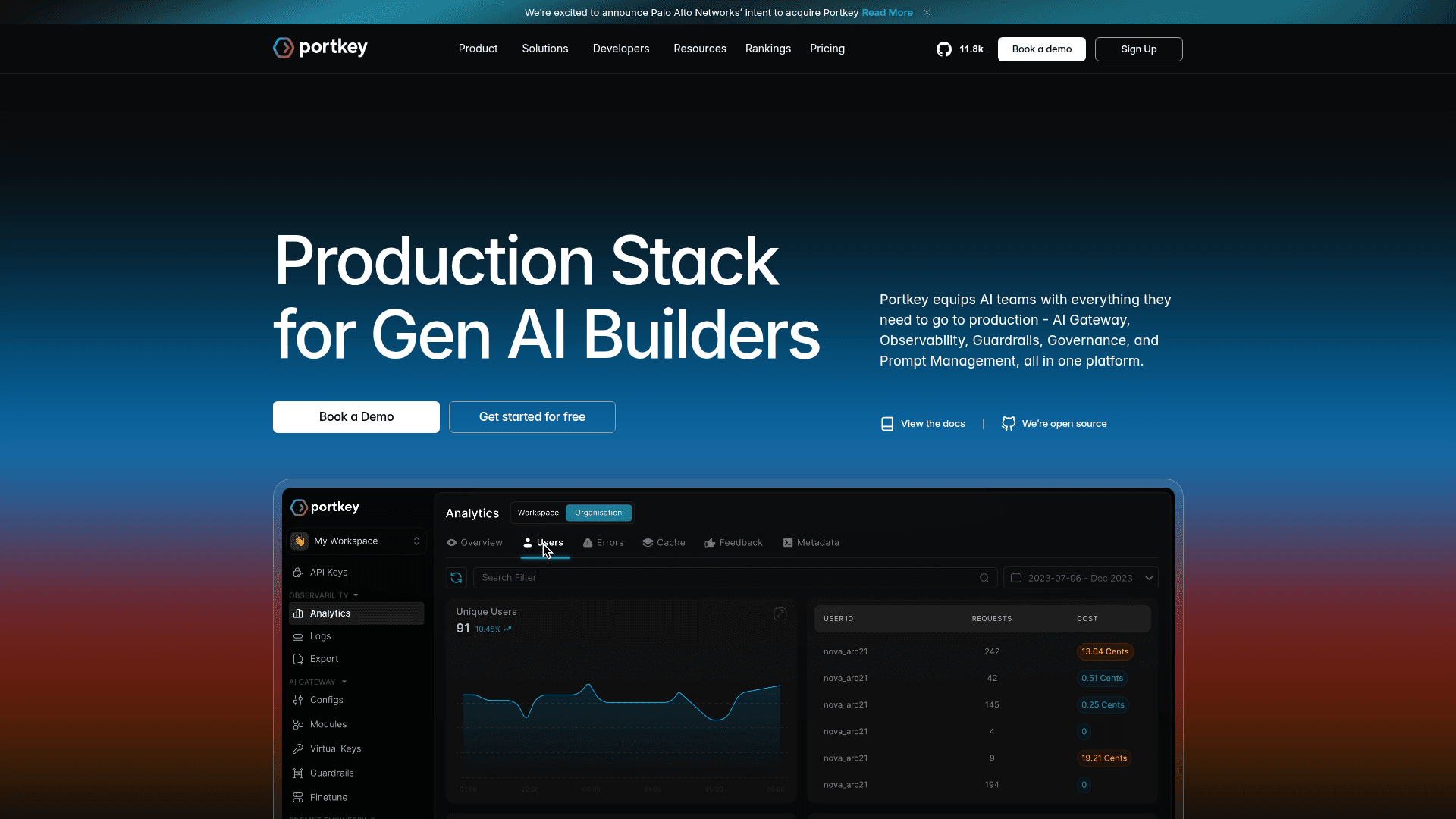
- Observability: Real-time logs, traces, feedback, custom metadata, filters, and alerts with configurable retention periods
- Guardrails: 40+ pre-built guardrail checks for inputs and outputs, PII redaction, and support for custom or partner guardrail hooks
- Prompt Management: Versioned prompt templates, a collaborative playground, API deployment, and variable management
- MCP Gateway: Centralized authentication, access control, and observability for Model Context Protocol servers — works with Claude Desktop, Cursor, VS Code, and any MCP-compatible client
- AI Governance: Role-based access control (RBAC), SSO (Okta), granular budget and rate limits, org-wide audit logs, and team management
Open-Source Gateway Architecture
The AI Gateway is published under the MIT License at github.com/Portkey-AI/gateway and had 11,806 GitHub stars as of the last recorded update. It is written in TypeScript and can be run locally via npx @portkey-ai/gateway, deployed via Docker, Node.js, Cloudflare Workers, AWS EC2, or Kubernetes. The open-source tier provides the universal API, retries, routing, guardrails, automatic fallbacks, load balancing, and a basic dashboard. Advanced features — semantic caching, prompt template management, full observability, and governance — are available in the hosted and enterprise versions. The GitHub README notes that "Gateway 2.0 (Pre-Release)" is merging the core enterprise gateway into open source.
Integration Ecosystem
Portkey integrates with major agent frameworks including LangChain, LlamaIndex, Autogen, CrewAI, Phidata, and Control Flow. Supported LLM providers include OpenAI, Azure OpenAI, Anthropic, Google Gemini, Mistral, Cohere, Together AI, Perplexity, Ollama, Stability AI, and 40+ others. The SDK supports Node.js, Python, REST, and OpenAI-compatible SDKs. Integration requires as few as 3 lines of code changes to an existing OpenAI client setup.
Update: Gateway v1.15.2 and Acquisition Announcement
The latest open-source release is v1.15.2, published January 12, 2026. The repository was last pushed to in May 2026. Separately, Palo Alto Networks announced its intent to acquire Portkey — a signal of enterprise validation for the AI Gateway category. The GitHub README also references a Series A funding announcement and previews Gateway 2.0, which will merge the enterprise gateway codebase into the open-source repository.
Community Discussions
Be the first to start a conversation about Portkey
Share your experience with Portkey, ask questions, or help others learn from your insights.
Pricing
Open Source
Self-hosted open-source gateway with no usage limits on requests.
- Universal API
- Retries & Timeouts
- Routing
- Guardrails
- Automatic Fallbacks
Developer
Free forever plan for prototyping and testing.
- 10k recorded logs per month
- 3-day log retention, 30-day metrics retention
- AI Gateway (Universal API, Fallbacks, Load Balancing, Retries)
- Observability (Logs, Traces, Feedback, Custom Metadata, Filters)
- 3 Prompt Templates with Playground, API Endpoints, Versioning, Variables
Production
For teams ready to deploy LLM apps in production.
- 100k recorded logs per month
- +$9 overages per additional 100k requests
- 30-day log retention, 90-day metrics retention
- AI Gateway (Universal API, Fallbacks, Load Balancing, Retries)
- Observability (Logs, Traces, Feedback, Metadata, Filters, Alerts)
- LLM & Partner Guardrails
- Unlimited Prompt Templates with Playground, API Endpoints, Versioning, Variables
- Role-Based Access Control
- Service Account API Keys
- Production Support
- Simple & Semantic Caching
Enterprise
For organizations with complex compliance needs and high-volume production workloads.
- 10M+ recorded logs per month
- Custom retention periods for Logs & Metrics
- Custom Guardrail Hooks, Advanced Evaluation Templates
- Role-Based Access Control, SSO, Granular Budget & Rate Limits
- Private Cloud Deployment
- Data Export to Data Lakes
- VPC Hosting
- SOC2 Type 2, GDPR, HIPAA compliance
- Custom BAAs
- Data Isolation
- Dedicated Onboarding & Priority Support
Capabilities
Key Features
- Universal API for 1,600+ LLMs
- Automatic fallbacks and retries
- Load balancing across providers
- Request timeouts
- Simple and semantic caching
- Real-time observability with logs and traces
- Prompt template management and versioning
- 40+ pre-built guardrails
- PII redaction
- Role-based access control (RBAC)
- SSO with Okta
- MCP Gateway for Model Context Protocol servers
- Virtual key management
- Budget and rate limits
- Org-wide audit logs
- Multi-modal support (vision, audio, image)
- Agent framework integrations
- Private cloud and VPC deployment
- SOC2, HIPAA, GDPR, CCPA compliance
Integrations
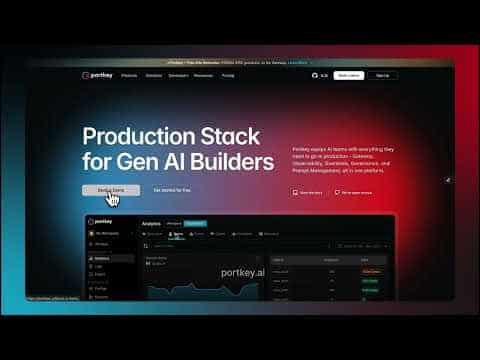
Demo Video